What is IR35?
IR35 — the off-payroll working rules — is a set of UK tax rules introduced by HMRC to tackle disguised employment. It targets contractors who work through their own limited company (a personal service company, or PSC) but, in reality, operate just like an employee of the end client.
The principle is simple: if your day-to-day working relationship looks like employment, you should pay broadly the same tax and National Insurance as an employee — regardless of how you're invoiced.
What inside IR35 means
If a contract is judged inside IR35, HMRC treats the engagement as employment for tax purposes. The fee-payer (usually the agency or end client) must run PAYE on the contractor's income before paying it across. In practice, most contractors use an umbrella company for these contracts.
- Income taxed via PAYE — Income Tax and employee NI
- Employer NI and the Apprenticeship Levy come out of the assignment rate
- Umbrella margin, holiday pay and pension handled at source
- Tax efficiency of a limited company effectively disappears
What outside IR35 means
An outside IR35 contract is a genuine business-to-business arrangement. The contractor runs their own limited company, invoices the client, and decides how to pay themselves — typically a small director's salary plus dividends, with employer pension contributions from the company.
- Genuine B2B engagement with a real trading company
- Small salary at the primary threshold to minimise NI
- Dividends after Corporation Tax on retained profit
- Broader expense rules and employer pension flexibility
Inside vs outside IR35 at a glance
These are the practical differences a contractor will feel every month. Take-home figures are reconciled from the worked example below.
| What differs | Outside IR35 (Ltd) | Inside IR35 (Umbrella) |
|---|---|---|
| Tax treatment | Corp Tax + salary/dividends | PAYE on full assignment rate |
| National Insurance | Employer NI only on small salary | Employer NI + Apprenticeship Levy deducted first |
| Business expenses | Broad — accountant, insurance, equipment | Very limited (SDC rules for most) |
| Pension options | Employer contributions from company (efficient) | Salary sacrifice via umbrella |
| Employment rights | Company director — no statutory rights | Rights arise through the umbrella employer and depend on the employment arrangement — not automatic against the end client |
| Holiday pay | Self-funded from company profits | Included / rolled up in assignment rate |
| Sick pay | Self-funded | Statutory Sick Pay via umbrella |
| Administration | Limited company + accountant (£80–150/mo) | Umbrella handles everything |
| Flexibility | High — retain profits, control extraction | Low — PAYE every payslip |
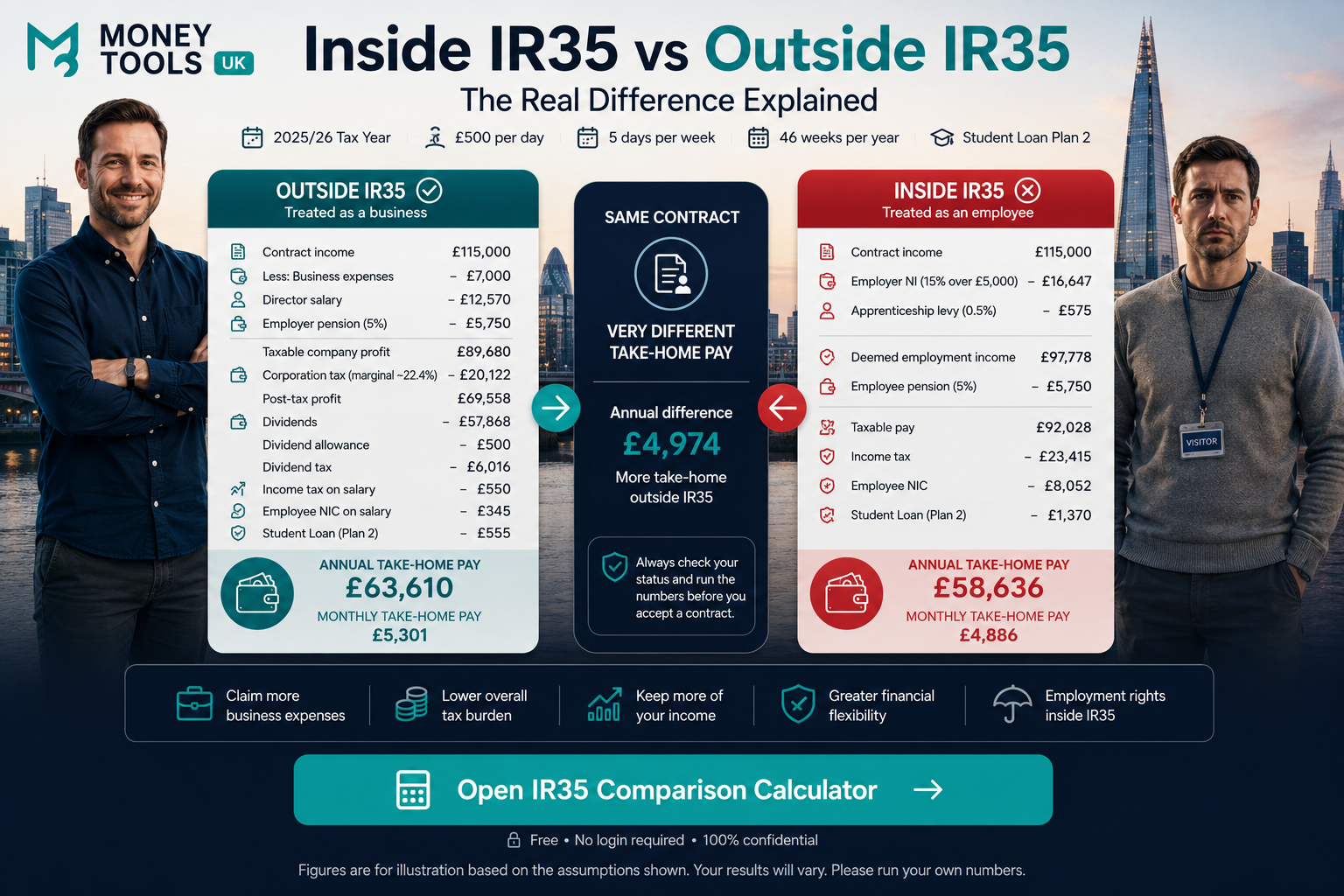
| Typical 2025/26 take-home (£500/day) | ≈ £63,600/yr (£5,301/mo) | ≈ £58,600/yr (£4,886/mo) |
| Best suited for | Genuine B2B contracts, long-term contractors | Inside IR35 assignments, short engagements |
Worked example (£500/day, 2025/26)
The following worked example is the single source of truth for every financial figure on this page. All calculations use current HMRC 2025/26 rates.
Scenario and assumptions
- Day rate: £500
- 5 days per week × 46 working weeks = £115,000 gross
- England tax code 1257L, Student Loan Plan 2
- 5% pension contribution on both sides
- Outside IR35: £5,000 business expenses, £100/month umbrella margin used for parity on the inside side
- All dividends distributed each year (no company retention)
Outside IR35 — Limited Company
- Contract income (£500 × 5 × 46)£115,000
- Business expenses− £5,000
- Employer pension (5%)− £5,750
- Director salary− £12,570
- Employer NI (15% > £5,000 ST)− £1,136
- Profit before Corp Tax£90,544
- Corporation Tax (marginal, ~22.4%)− £20,244
- Distributable as dividends£70,300
- Dividend tax (basic + higher)− £14,258
- Student Loan Plan 2 (9%)− £5,002
- Employee NI (salary at PT)£0
- Income Tax on salary (PA covers)£0
Annual take-home
£63,610
Monthly: £5,301
Inside IR35 — Umbrella
- Assignment rate (£500 × 5 × 46)£115,000
- Umbrella margin (£100/mo)− £1,200
- Employer NI (15% > £5,000 ST)− £14,127
- Apprenticeship Levy (0.5%)− £496
- Gross salary£99,177
- Employee pension (5%)− £4,959
- Income Tax (20% + 40%)− £25,119
- Employee NI (8% + 2%)− £3,994
- Student Loan Plan 2 (9%)− £6,469
Annual take-home
£58,636
Monthly: £4,886
Why the outside route wins on cash
On identical £500/day contracts, the outside IR35 route delivers £63,610/year in take-home pay, versus £58,636/year inside IR35 — a difference of £4,974 a year (about £415/month), plus a £5,750 employer pension pot on the outside route funded by the company before Corporation Tax.
The gap comes from three levers unique to outside IR35: dividends avoid National Insurance entirely, the small director salary sits inside the personal allowance, and employer pension contributions reduce Corporation Tax before profits are extracted.
Money Tools UK Insight
Compare your own IR35 take-home in seconds
Plug your day rate, expenses and pension into our IR35 comparison calculator and see the reconciled numbers for your contract.
Umbrella companies and IR35
Umbrella companies are the default solution for inside IR35 contracts. The umbrella employs the contractor, runs PAYE payroll, handles holiday pay and pension auto-enrolment, and pays a net salary each week or month.
- Required for most inside IR35 assignments
- Simple — no accountant, no company admin
- Compliant by design (PAYE handled at source)
- Employer costs and umbrella margin reduce take-home pay
See our full Umbrella vs PAYE guide or run the numbers in the Umbrella Company Calculator.
Limited companies and IR35
A limited company (PSC) is the most tax-efficient structure when a contract is genuinely outside IR35. You become a director, pay yourself a small salary, and take the rest as dividends after Corporation Tax — with optional employer pension contributions from the company.
- Best suited to outside IR35 contracts
- Bookkeeping, VAT and payroll responsibilities
- Specialist contractor accountant typically £80–£150/month
- Profits can be retained in the company for future years
Try our Contractor Calculator to model your own outside IR35 take-home.
Who determines IR35 status?
Since the 2021 reforms, responsibility for deciding IR35 status depends on the size of the end client.
- Medium and large private-sector clients: the client decides and issues a Status Determination Statement (SDS).
- Public-sector clients: always responsible for determining status.
- Small private-sector clients: the contractor's own company makes the determination (the small company exemption).
Common IR35 tests
HMRC and tribunals look at the working relationship as a whole. These factors carry the most weight:
- Control: who decides what, how, when and where the work is done?
- Substitution: can you genuinely send a substitute?
- Mutuality of obligation: is the client obliged to offer work and you to accept?
- Financial risk: do you risk your own money, equipment, or fixing defects?
- Business independence: multiple clients, marketing, insurance, own tools?
HMRC risks and penalties
IR35 enquiries can be expensive. If HMRC successfully challenges a status determination, the fee-payer (or the contractor's company in small-client situations) can face significant liabilities.
- Back taxes and employee/employer National Insurance
- Interest on unpaid amounts
- Penalties depend on behaviour — an ordinary careless mistake, a deliberate error and a concealed error each attract very different penalty ranges under HMRC's rules, and reasonable care with clear contemporaneous evidence can reduce or remove them altogether
- Multi-year reviews going back several tax years
Compliance matters
Common contractor mistakes
- Assuming every limited company contract is automatically outside IR35
- Using a PSC for an inside IR35 contract with no tax benefit
- Ignoring or not challenging an SDS issued by the client
- Forgetting employer NI is deducted from the assignment rate inside IR35
- Comparing gross day rates rather than net take-home pay
Estimate your own contractor income
Run the numbers for both routes with your own day rate, expenses and pension.
Editorial standards & sources
Reviewed by the Money Tools UK editorial team. Last reviewed 21 July 2026 for the 2025/26 UK tax year.
- HMRC: Understanding off-payroll working (IR35) (ESM10000 series)
- HMRC: Rates and thresholds for employers 2025 to 2026
- HMRC: Corporation Tax rates and reliefs (marginal relief 2025/26)
- GOV.UK: Dividend tax and Student Loan repayment thresholds
Figures are estimates for a generic contractor in England on tax code 1257L. Your actual take-home depends on your specific circumstances, expenses and pension arrangements.
Related calculators
IR35 Comparison Calculator
Compare PAYE, umbrella and outside IR35 limited company take-home pay side by side.
Open calculatorUmbrella Company Calculator
Estimate your umbrella take-home pay after PAYE, NI, employer costs and margin.
Open calculatorContractor Calculator (Outside IR35)
Model salary, dividends and corporation tax for a UK limited company contractor.
Open calculatorTake-Home Pay Calculator
Standard UK PAYE salary calculator showing tax, NI and net pay.
Open calculatorSalary to Hourly Calculator
Convert an annual salary into an hourly and daily equivalent.
Open calculatorStudent Loan Calculator
See how Plan 2 repayments reduce your take-home pay each month.
Open calculatorFrequently asked questions
Related guides
More flagship guides and tools from Money Tools UK.
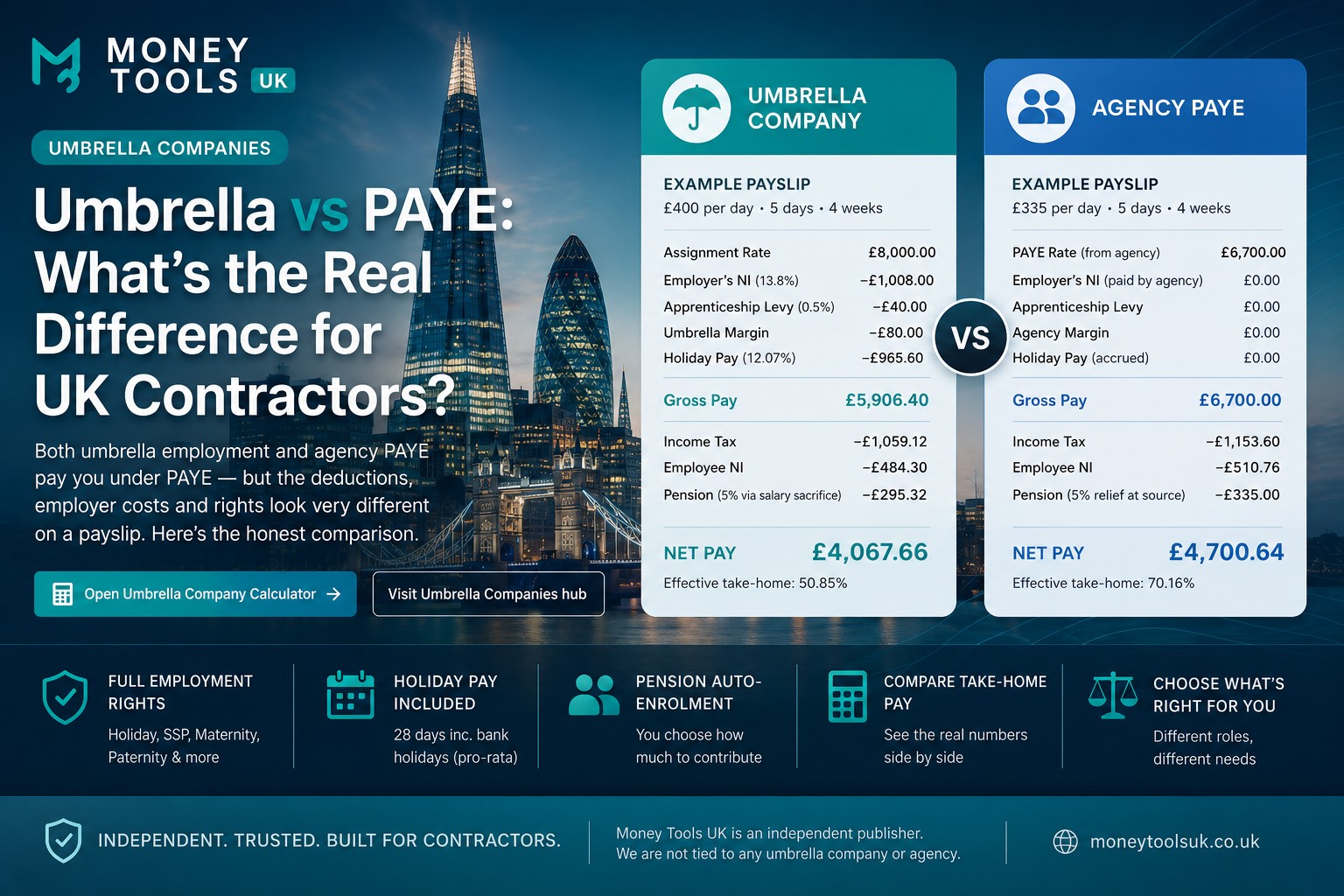
The real difference between umbrella and agency PAYE for inside IR35 contractors.
Read guide
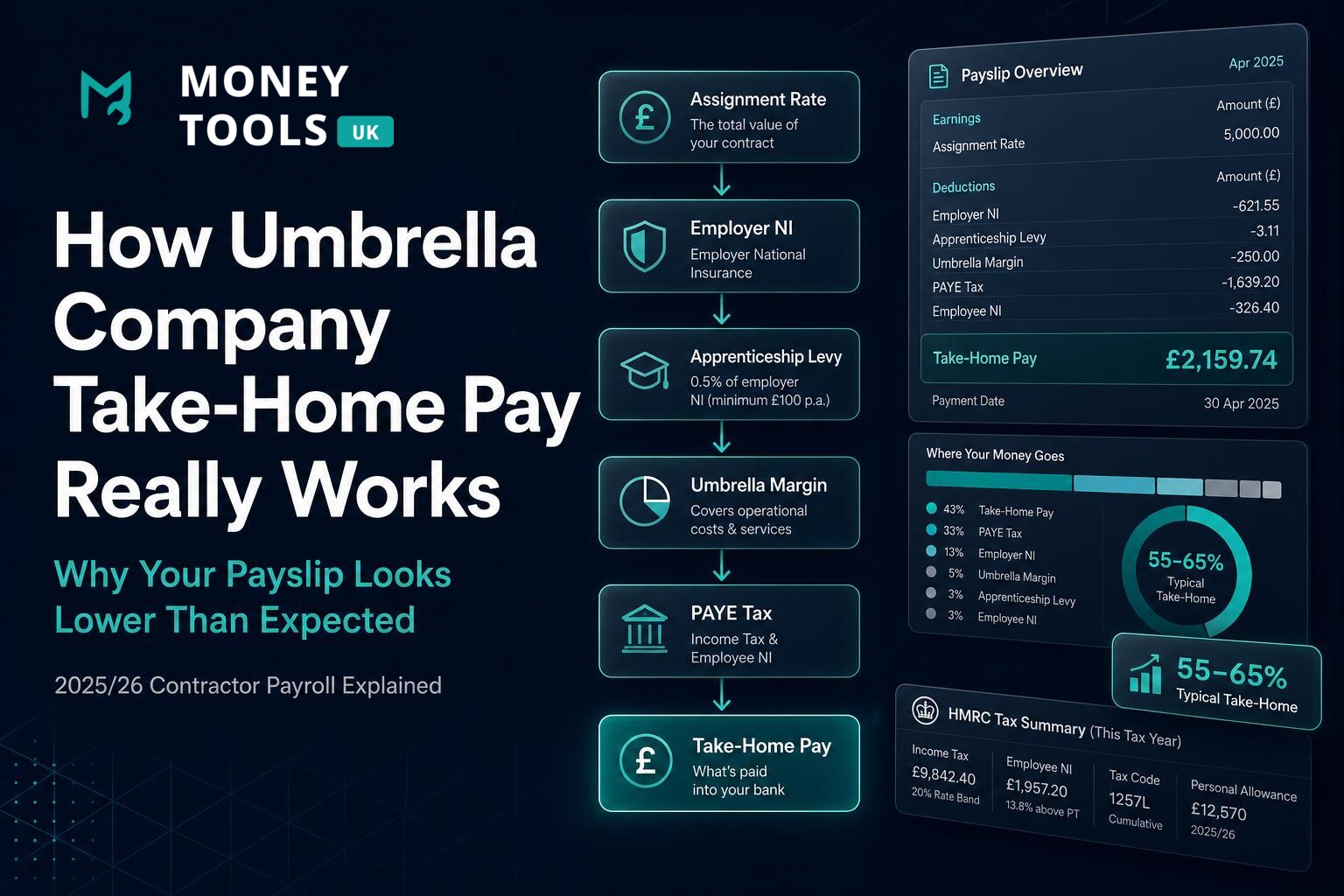
A plain-English breakdown of umbrella pay, deductions and take-home.
Read guide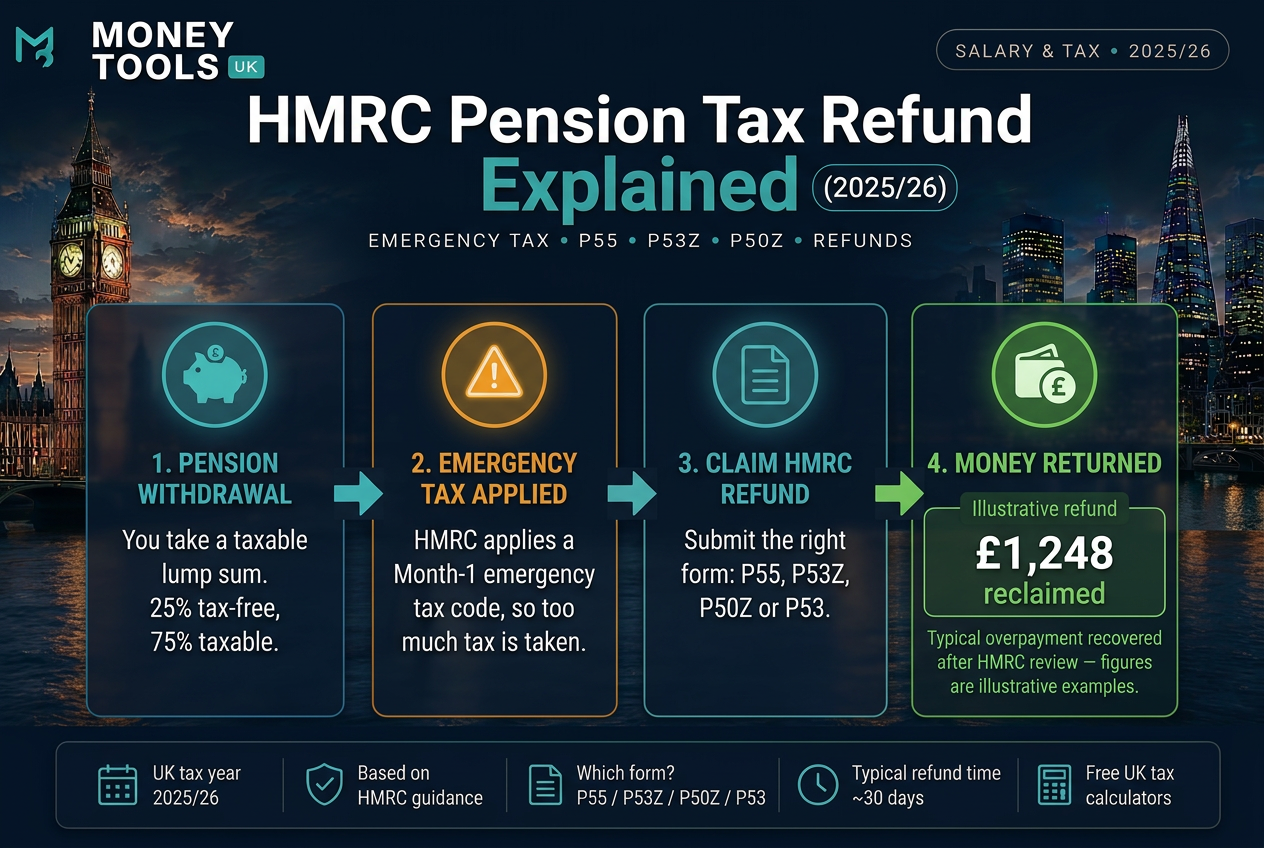
How to reclaim emergency tax on a pension withdrawal — including P55, P50Z and P53Z.
Read guideDisclaimer: This content is for informational purposes only and should not be treated as financial, tax, mortgage, investment or legal advice.