
For UK limited company contractors working outside IR35, the single biggest tax decision each year is the split between salary and dividends. Get it right and you keep thousands more per year. Get it wrong and you trigger employer's NI you didn't need to pay, or miss out on relief you were entitled to. Here's how to choose your split for the 2025/26 tax year.
Why the split matters
Salary is a deductible expense for the company — it reduces the corporation tax bill — but it attracts income tax and both employer and employee NI. Dividends are paid out of after-tax profits, so the company has already paid corporation tax on them, but the dividend tax rates (8.75% / 33.75% / 39.35%) are much lower than income tax.
The art is finding the salary level that captures the maximum corporation tax saving without triggering employer's NI, then using dividends for the rest.
The 2025/26 thresholds you need
- Personal allowance: £12,570.
- NI primary threshold (employee starts paying): £12,570.
- NI secondary threshold (employer starts paying): £5,000.
- Employment Allowance: up to £10,500 — but unavailable to single-director companies with no other employees.
- Dividend allowance: £500.
- Dividend tax: 8.75% / 33.75% / 39.35%.
The classic split: single-director company
If you're a sole director with no other employees on payroll, you can't claim the Employment Allowance. The most-tax-efficient salary is typically the secondary threshold of £5,000 — or, if you want the corporation tax saving, the personal allowance of £12,570 with the small employer's NI cost offset by extra corporation tax relief.
At £12,570 salary you trigger employer's NI of (£12,570 − £5,000) × 13.8% = ~£1,045. The corporation tax saving on the salary is £12,570 × 19% (small profits rate) = ~£2,388. Net saving: ~£1,343 versus paying yourself dividends only — so £12,570 usually wins.
Companies with two or more employees on payroll
If your company employs at least one other person on a salary above the secondary threshold (commonly a spouse), you qualify for the Employment Allowance. That covers the first £10,500 of employer's NI for the year, which means you can pay yourself the full £12,570 salary with no employer's NI cost at all. This is often the optimal salary in those companies.
HMRC scrutiny on spouse salaries
Topping up with dividends
Once your salary is set, dividends can be paid out of any retained post-tax profits. The order in which they're taxed matters:
- First £500 of dividends: tax-free under the dividend allowance.
- Dividends within the basic rate band (up to £50,270 total income): 8.75%.
- Dividends within the higher rate band: 33.75%.
- Dividends in the additional rate band: 39.35%.
Most contractors aim to keep total income just under £50,270 in any year they can afford to, by retaining surplus profit in the company for a future leaner year, or by salary sacrifice pension contributions.
Pension contributions are the third lever
Employer pension contributions are a deductible expense for the company — corporation tax saved at 19% or 25% — and they don't count towards your personal taxable income. They're often more tax-efficient than dividends for higher earners, provided you're under the £60,000 annual allowance. Pensions are just one of many deductible costs — our contractor expenses guide covers the full range of allowable business expenses that reduce your corporation tax bill.
Model your full split for 2025/26
Run salary, dividends and pension contributions side by side in the contractor calculator.
Worked example: £100,000 of fee income
Sole director, no Employment Allowance, salary £12,570, £20,000 employer pension contribution, the rest as dividends:
- Fee income: £100,000.
- Less salary: £12,570.
- Less employer's NI on salary: £1,045.
- Less employer pension contribution: £20,000.
- Profit before tax: £66,385.
- Corporation tax (19%): ~£12,613.
- Distributable profit: ~£53,772.
- Personal income: £12,570 salary + £53,772 dividends = £66,342.
- Personal tax: ~£0 on salary, ~£3,303 basic rate dividend tax, ~£5,425 higher rate dividend tax = ~£8,728.
- Net to you in cash: ~£45,044, plus £20,000 in pension.
Common mistakes
- Paying a salary of £0 and missing the corporation tax saving and state pension credit.
- Paying a salary at your full personal allowance without checking whether Employment Allowance is available.
- Paying dividends with no formal board minute or dividend voucher (HMRC can recharacterise as salary).
- Drawing dividends when there are no distributable retained profits (illegal under the Companies Act).
- Forgetting to plan the year-end split — last-minute dividends in March often push you into the higher rate band.
For the bigger picture on contractor tax across structures, see how much tax UK contractors actually pay.
Get new UK finance and property guides from Money Tools UK
Plain-English UK finance insights, tax updates and property investing guides.
Related calculators
Contractor Calculator (Outside IR35)
The exact calculator this article is built around — open it and run your own numbers.
Open calculatorFrequently asked questions
Related guides
More flagship guides and tools from Money Tools UK.
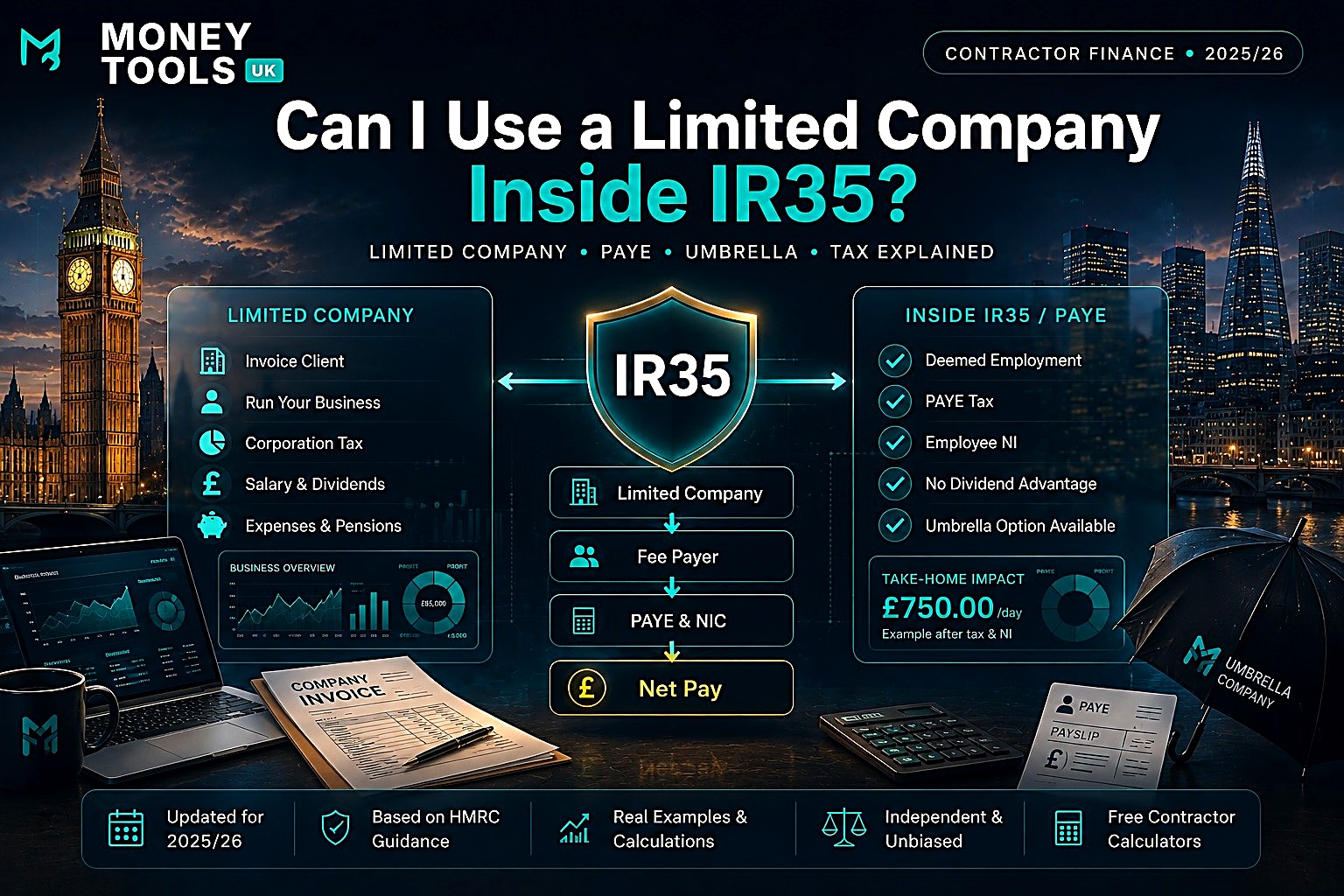
Can you still use a limited company inside IR35? Learn what happens to PAYE, dividends, Corporation Tax, expenses, umbrella companies and mixed inside/outside IR35 contracts.
Read guide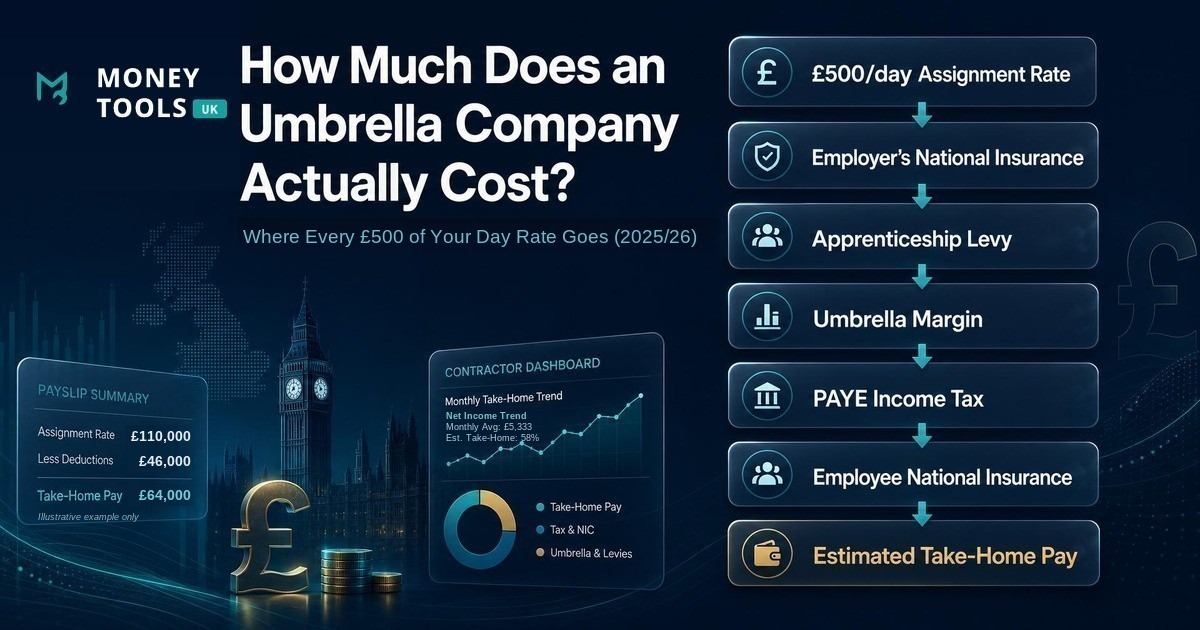
See how much an umbrella company really costs in 2025/26, including umbrella margin, Employer's NI, Apprenticeship Levy, holiday pay, pension deductions and contractor take-home pay.
Read guide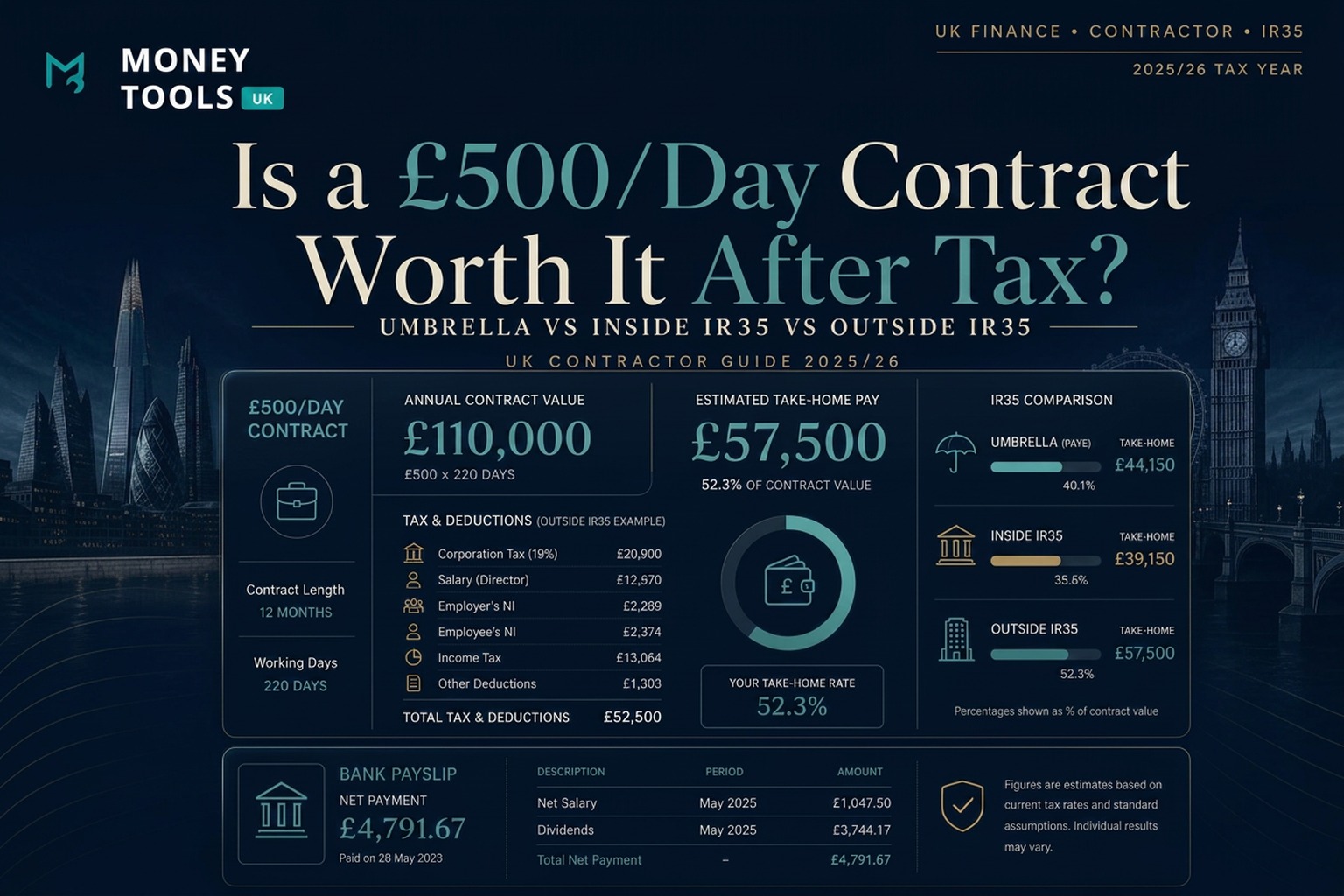
See how much a £500/day contract could be worth after tax in 2025/26. Compare umbrella company, inside IR35, outside IR35 and limited company take-home pay.
Read guideDisclaimer: This content is for informational purposes only and should not be treated as financial, tax, mortgage, investment or legal advice.