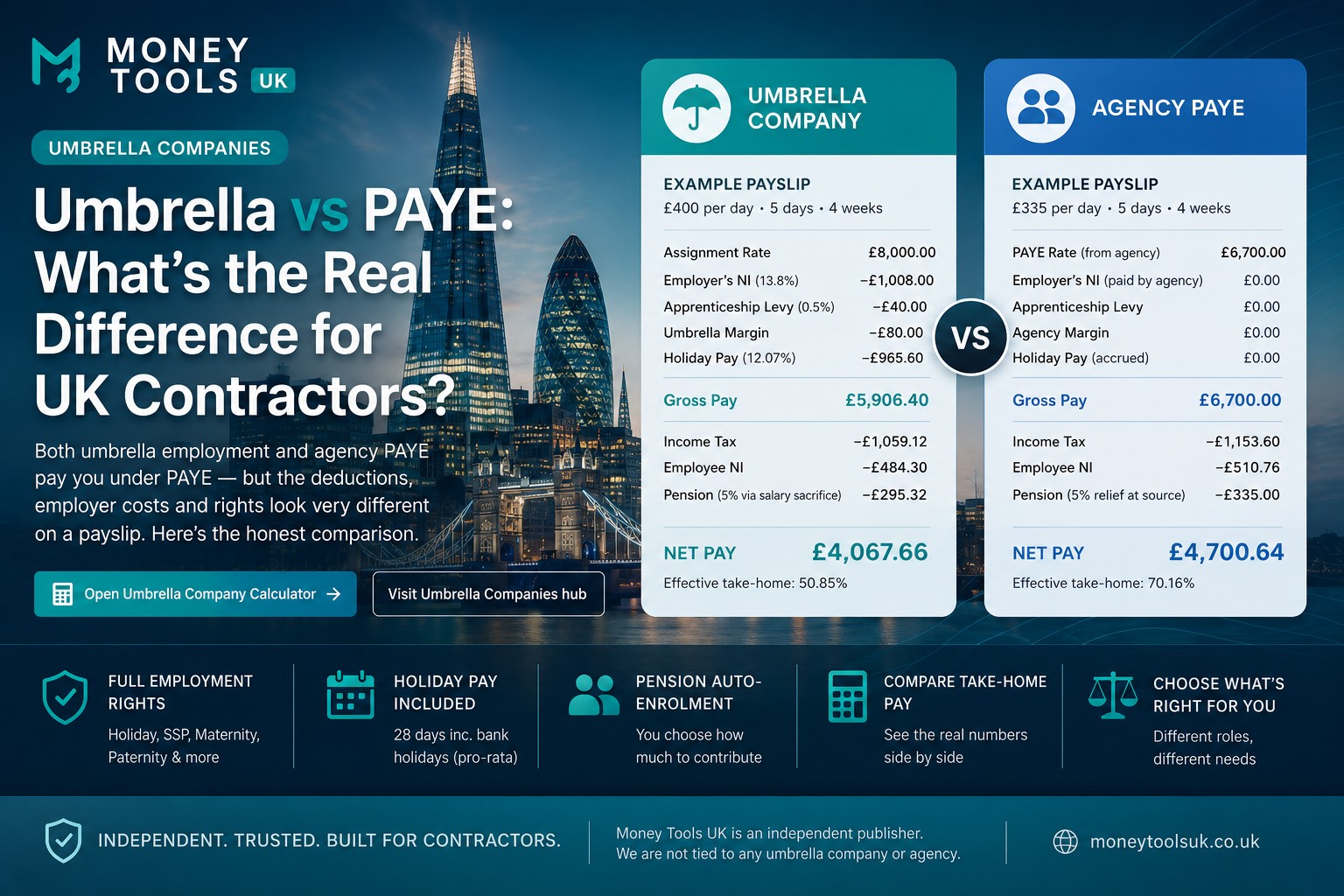
If you're working through a recruitment agency in the UK, you've almost certainly been asked to choose between an umbrella company and agency PAYE. Both pay you under PAYE. Both deduct income tax and National Insurance. Yet the take-home pay, the rights you get and the way the rate is quoted to you can look very different. This guide unpacks the real differences — with a full worked example on a £400/day contract — so you can pick the option that actually leaves you better off in 2025/26.
Quick answer
The 5-point summary
- Both routes are 100% PAYE. Income tax and employee NI are identical — same bands, same personal allowance.
- The rates aren't the same number. The umbrella "assignment rate" has to absorb employer's NI, the apprenticeship levy and the umbrella margin. Agency PAYE quotes the lower rate after those costs.
- On a £400/day umbrella assignment (£8,000 over 4 weeks, England, 1257L, Student Loan Plan 2, 5% pension), net take-home is around £4,048. The equivalent PAYE rate of £335/day (£6,700) delivers around £3,957 — because the agency absorbs employer costs from a lower headline rate.
- Umbrella wins on continuous employment, salary-sacrifice pensions and moving between agencies.
- Agency PAYE wins on simplicity and on very low day rates where the fixed umbrella margin bites.
Quick take-home summary
Umbrella — £400/day
£4,048/4 wks
≈ £1,012/week net after employer NI (15%), levy, £20 margin, rolled-up holiday pay, PAYE, Plan 2 student loan and 5% pension.
Agency PAYE — £335/day
£3,957/4 wks
≈ £989/week net. Agency absorbs employer NI and levy from a lower headline rate; holiday pay is accrued separately, not rolled up.
Reviewed for 2025/26
Sources
HMRC PAYE income tax bands for 2025/26; Class 1 NI (employee 8%/2%, employer 15%); employer's NI secondary threshold £5,000 per year; apprenticeship levy 0.5%; Student Loan Plan 2 threshold £28,470 at 9%.
Calculation logic
All figures reconciled against the Money Tools UK Umbrella Calculator and Take-Home Pay Calculator. England, tax code 1257L, Student Loan Plan 2, 5% relief-at-source pension assumed on both routes for a like-for-like comparison.
Last updated
16 July 2026 — refreshed for 2025/26 rates and expanded worked example.
Editorial standard
Independent guide from Money Tools UK. No affiliate links to umbrella providers. Every figure derived from HMRC rates, not provider marketing.
Comparison at a glance
| Feature | Umbrella Company | Agency PAYE |
|---|---|---|
| Who employs you | The umbrella company | The recruitment agency |
| Quoted rate | Higher (assignment rate) | Lower (PAYE rate) |
| Employer's NI (15%) | Deducted from your rate | Paid by the agency |
| Apprenticeship levy (0.5%) | Deducted from your rate | Paid by the agency |
| Umbrella margin | £15–£30 per week | None |
| Holiday pay | 12.07% rolled up or accrued | Accrued separately |
| Income tax + employee NI | Standard PAYE | Standard PAYE |
| Pension via salary sacrifice | Yes — easy to set up | Rare on agency PAYE |
| Continuous employment | Yes, across assignments | New PAYE per contract |
| Best for mortgage applications | Continuous PAYE payslips | Depends on lender |
| Typical use case | Inside IR35, multiple assignments | Single short assignment |
What is agency PAYE?
Agency PAYE means the recruitment agency that places you with the end client also employs you for payroll purposes. They run you through their own PAYE scheme, deduct income tax and Class 1 National Insurance, and pay the employer's NI contribution themselves out of the rate they've agreed with the client.
The headline rate you're quoted is the rate you actually earn before personal tax. You receive statutory holiday pay (28 days including bank holidays for a full-time worker), statutory sick pay if you qualify, and pension auto-enrolment after the qualifying period.
What is an umbrella company?
An umbrella company is a third-party employer. The agency pays the umbrella an assignment rate, the umbrella deducts the costs of employing you — employer's NI, the apprenticeship levy and their own margin — and what's left becomes your gross pay. From that gross pay, the umbrella then deducts income tax and employee NI and pays you the net.
You're a permanent employee of the umbrella, so you get the same statutory rights as any other UK employee: holiday pay, SSP, pension auto-enrolment and continuity of employment between contracts.
Two rates, not one
Which one should you pick?
Umbrella vs PAYE — decision flow
Deductions side by side
Take a £400/day assignment. On agency PAYE you'd typically be offered around £335/day as the headline rate (the agency keeps £65/day to cover employer's NI, apprenticeship levy and their margin). On umbrella, you'd be quoted £400/day, and the umbrella would deduct those same employer costs from your side.
- Employer's NI (15% above the secondary threshold): paid by the agency on PAYE, paid out of your assignment rate on umbrella.
- Apprenticeship levy (0.5%): almost always paid out of your assignment rate on umbrella.
- Umbrella margin: typically £15–£30 per week. Doesn't exist on agency PAYE.
- Holiday pay: usually rolled up into the gross on umbrella (12.07%) — visible but yours; accrued separately on agency PAYE.
- Income tax and employee NI: identical on both — same bands, same thresholds, same personal allowance.
Worked example: £400/day contract
Below is the authoritative Money Tools UK worked example for a contractor earning £400/day, 5 days/week over 4 weeks (£8,000 assignment gross) in England, 2025/26, tax code 1257L, Student Loan Plan 2, 5% pension. Every figure reconciles with the Umbrella Calculator and Take-Home Pay Calculator.
Umbrella Company
£400/day assignment rate
- Assignment rate (4 weeks)
- £8,000.00
- Umbrella margin (£20/wk)
- − £80.00
- Employer's NI (15%)
- − £978.37
- Apprenticeship levy (0.5%)
- − £34.54
- Gross taxable pay (incl. 12.07% rolled-up HP £744.05)
- £6,907.09
- Income tax (PAYE)
- − £1,795.91
- Employee NI (8%/2%)
- − £292.85
- Student Loan (Plan 2, 9%)
- − £424.54
- Pension (5% RAS)
- − £345.35
- Net pay (4 weeks)
- £4,048.44
Agency PAYE
£335/day equivalent PAYE rate
- PAYE rate (4 weeks)
- £6,700.00
- Employer's NI (paid by agency)
- £0.00
- Apprenticeship levy (paid by agency)
- £0.00
- Umbrella margin
- £0.00
- Holiday pay (accrued separately)
- £0.00
- Gross taxable pay
- £6,700.00
- Income tax (PAYE)
- − £1,713.07
- Employee NI (8%/2%)
- − £288.71
- Student Loan (Plan 2, 9%)
- − £405.90
- Pension (5% RAS)
- − £335.00
- Net pay (4 weeks)
- £3,957.32
Why is the PAYE rate lower?
Reading the numbers correctly
Compare the two on your own day rate
Plug your assignment rate into the umbrella calculator to see the full deduction stack and your real net pay.
Take-home pay: which actually wins?
Once you compare like-for-like rates, take-home pay between umbrella and agency PAYE is usually within £20–£40 per week. The umbrella margin is the only structural cost on umbrella that doesn't exist on agency PAYE — everything else (employer's NI, levy, income tax, employee NI) is paid in both cases, just by a different party from the same pot of money.
Where umbrella often pulls ahead is on flexibility: one continuous employment across multiple agencies, easier salary-sacrifice pension contributions, and the ability to roll from one assignment straight into the next without a P45 in between. Where agency PAYE pulls ahead is simplicity: no margin, one payslip from one party, and no risk of choosing a non-compliant umbrella.
Rights and protections
Both routes give you full UK employment rights for tax purposes — you are an employee of either the agency or the umbrella. That means:
- 28 days statutory holiday including bank holidays (pro-rata).
- Statutory Sick Pay if you meet the earnings threshold.
- Pension auto-enrolment, with the option to opt out.
- Statutory maternity, paternity and adoption pay if eligible.
- National Minimum Wage protections.
Continuity of employment is the practical edge umbrella has: because you remain employed by the umbrella between assignments, mortgage lenders generally treat your income as employed PAYE income with continuous service rather than a string of short agency contracts.
When to pick which
Pick agency PAYE if
- You're on a single, short assignment with one agency.
- The role is low day-rate (under ~£200/day) where the umbrella margin eats a meaningful percentage.
- You don't want to think about choosing a compliant umbrella.
Pick umbrella if
- You move between agencies or assignments regularly.
- You want to make significant pension contributions via salary sacrifice.
- You want continuous employment for mortgage or finance applications.
- The role is inside IR35 and your only realistic alternative is umbrella anyway.
Avoid non-compliant umbrellas
How to compare properly
Always ask the agency for both rates: the PAYE rate and the umbrella assignment rate. Then put each into the right calculator. The Umbrella Calculator models the full assignment-rate deduction stack, while the Take-Home Pay Calculator will give you a clean view of the PAYE rate. Compare the net weekly pay, not the headline numbers.
For inside IR35 contracts, the umbrella route is usually the only practical option — see Why inside IR35 take-home is so low. If you're weighing up a limited company alternative for outside IR35 work, the IR35 Comparison Calculator puts umbrella, PAYE and Ltd side by side, and Inside vs Outside IR35 explains the status test in plain English.
Get new UK finance and property guides from Money Tools UK
Plain-English UK finance insights, tax updates and property investing guides.
Related calculators
Umbrella Company Calculator
The exact calculator this article is built around — open it and run your own numbers.
Open calculatorFrequently asked questions
Related guides
More flagship guides and tools from Money Tools UK.
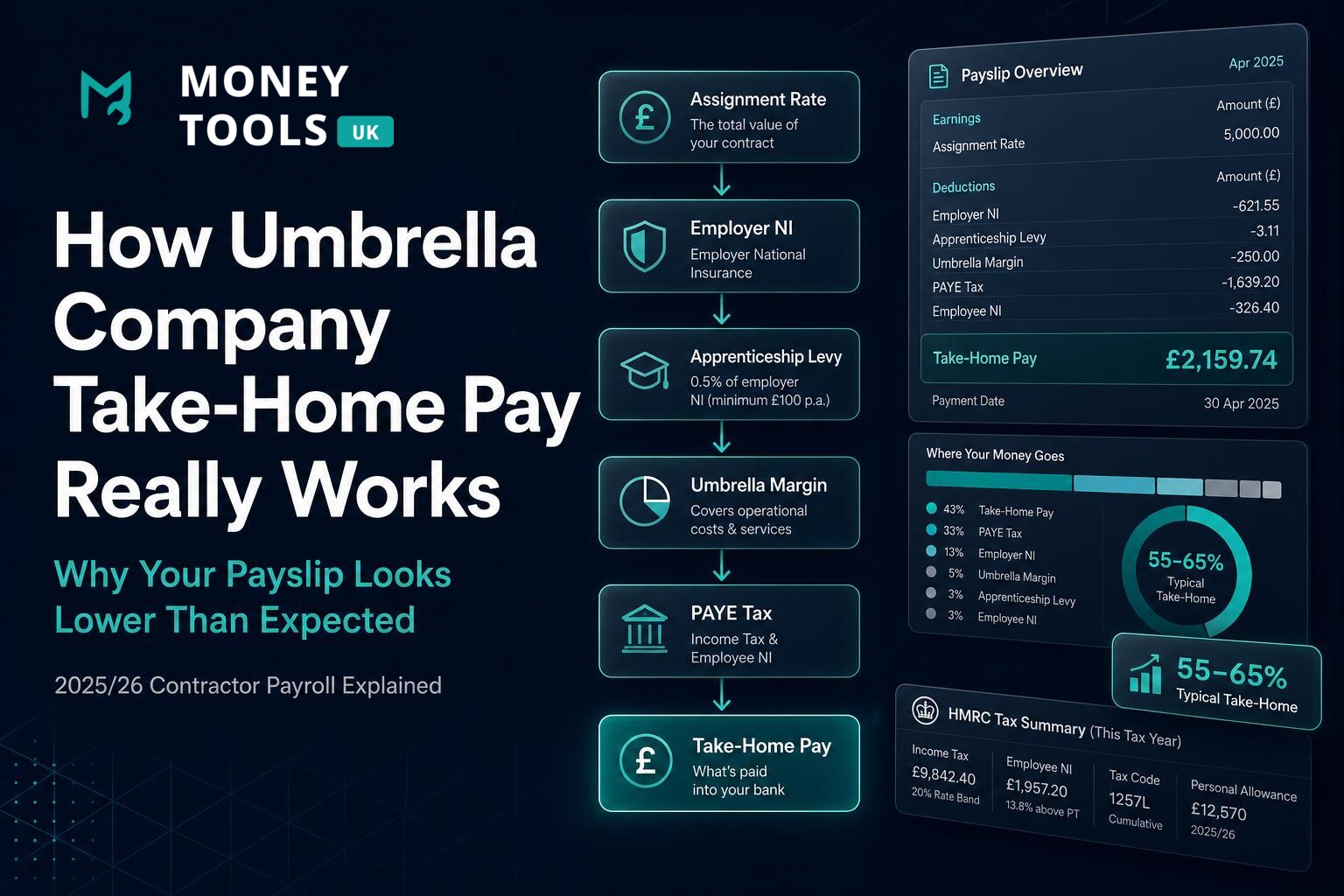
Understand every deduction on your umbrella payslip in 2025/26 — employer's NI, employee NI, Income Tax, the Apprenticeship Levy, umbrella margin, pensions and student loans, with worked examples.
Read guide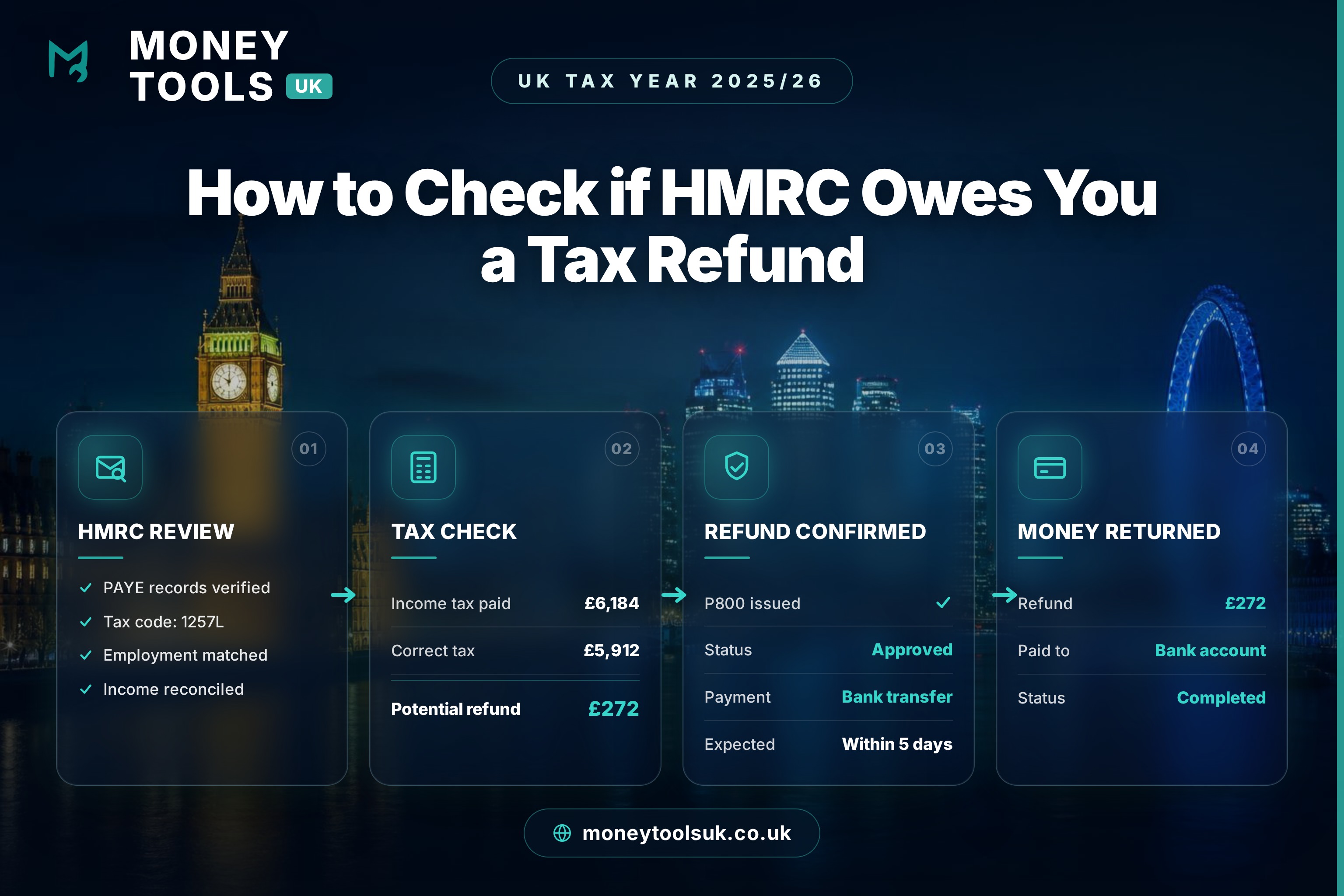
A plain-English UK guide to checking if HMRC owes you a tax refund: why overpayments happen, how to use your Personal Tax Account, P800 and Simple Assessment, when refunds are automatic, how to claim, and how to avoid tax refund scams.
Read guide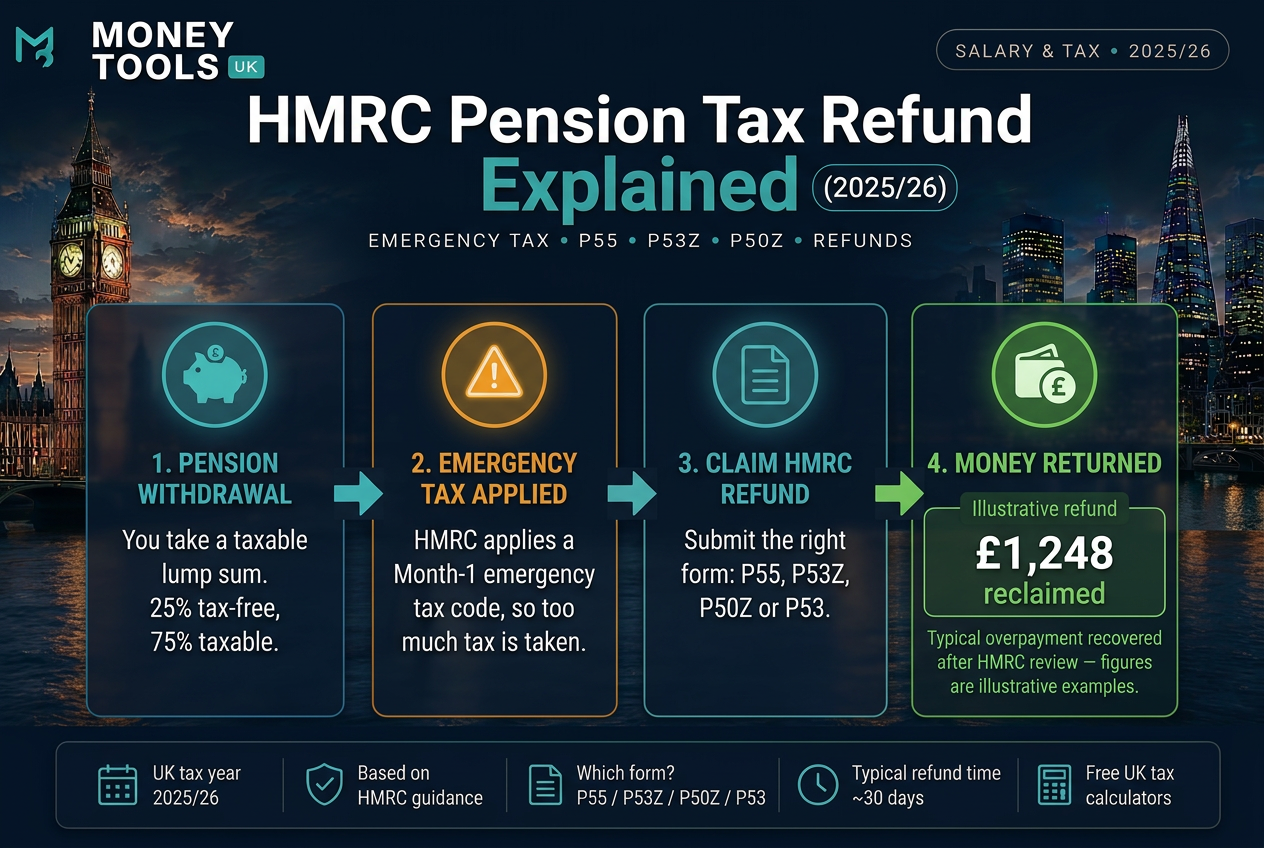
Why HMRC overtaxes pension withdrawals with emergency tax, how pension tax refunds work, and which form to use — P55, P53Z, P50Z or P53 — to reclaim overpaid tax for 2025/26.
Read guideDisclaimer: This content is for informational purposes only and should not be treated as financial, tax, mortgage, investment or legal advice.