IR35 is the set of UK tax rules that decides whether a contractor working through an intermediary should be taxed as an employee or as a genuine business. "Inside IR35" means the rules apply and you're taxed broadly like an employee. "Outside IR35" means the rules don't apply and you're taxed as a business. The status decides who pays employer's NI, what deductions come off your day rate, and how much you actually keep.
Who decides your IR35 status?
Since April 2021, in the public sector and in medium and large private sector clients, the end client is legally responsible for assessing your status. They issue a Status Determination Statement (SDS) and the fee-payer (usually the agency) deducts tax and NI accordingly.
For small private clients (those that meet at least two of: less than £10.2m turnover, less than £5.1m balance sheet total, fewer than 50 employees), the contractor's own limited company — usually called a personal service company or PSC — remains responsible for deciding status under the original IR35 rules.
What makes a role inside IR35?
HMRC and the courts look at the realities of the working arrangement, not just the words of the contract. The three factors that matter most are:
- Personal service: can someone else turn up in your place? A genuine right of substitution points outside IR35.
- Control: does the client tell you what to do, when, where and how? Heavy control points inside.
- Mutuality of obligation: is the client obliged to give you work and you obliged to accept it beyond the agreed deliverable? Mutuality points inside.
Secondary factors include financial risk, provision of your own equipment, integration into the client's team, exclusivity, and whether you'd be invited to staff events. None of these are decisive on their own; the picture as a whole is what counts.
How the tax actually differs
Outside IR35
Your limited company invoices the client. The company pays corporation tax (25% main rate / 19% small profits rate / a marginal rate between £50k and £250k profits in 2025/26). You then take a small salary plus dividends, or salary plus retained profits. Personal tax is income tax on the salary plus dividend tax (8.75% basic, 33.75% higher, 39.35% additional) with a £500 dividend allowance.
Inside IR35
The fee-payer treats your assignment rate as employment income. Employer's NI (13.8%) and the apprenticeship levy (0.5%) come off the rate first. The remainder — your "deemed direct payment" — has employee NI and income tax deducted at PAYE rates. Your limited company can still receive payment, but almost no contractor uses a PSC for inside IR35 work; umbrella employment is the standard route.
The same £500/day, two outcomes
See your numbers on a real contract
Run the same day rate inside and outside IR35 to see exactly where the gap comes from.
Practical implications
- Expenses: outside IR35 you can claim the full range of legitimate business expenses through the company. Inside IR35 you can only claim the same expenses an ordinary employee could claim — almost none. See what expenses contractors can claim for the full list of allowable costs.
- Pension: both inside and outside, salary sacrifice pension contributions are highly efficient. On umbrella inside IR35 these come off before tax and employer's NI; outside IR35 the company pays them as an employer contribution.
- Holiday and sick pay: umbrella employment inside IR35 gives you statutory employment rights; outside IR35 through your own company you're a director, with no statutory holiday or SSP.
- Stability: umbrella gives continuous employment between assignments, which mortgage lenders like.
Negotiating an inside IR35 rate
If a role moves from outside to inside IR35, the natural ask is a higher day rate to absorb the new tax cost. As a rough rule, an inside IR35 rate needs to be roughly 20–25% higher than an outside IR35 rate to leave you with similar take-home. Use the Inside IR35 Calculator to model the rate uplift you actually need.
Status checks and keeping records
For small-client work where you decide your own status, keep contemporaneous evidence: signed contracts with a genuine right of substitution, written confirmation of arrangements from the client, evidence of business risk (your own kit, your own insurance, multiple concurrent clients) and a CEST or independent IR35 review. HMRC enquiries can come years after the contract ends; the time to document is now.
For full background reading, see our guide to inside vs outside IR35 and the breakdown of why inside IR35 take-home pay is so low.
Get new UK finance and property guides from Money Tools UK
Plain-English UK finance insights, tax updates and property investing guides.
Related calculators
IR35 Comparison Calculator
The exact calculator this article is built around — open it and run your own numbers.
Open calculatorFrequently asked questions
Related guides
 Why Is Inside IR35 Take-Home Pay So Low?An honest, line-by-line explanation of why inside IR35 contracts pay so little after deductions — and the small levers you can still pull.
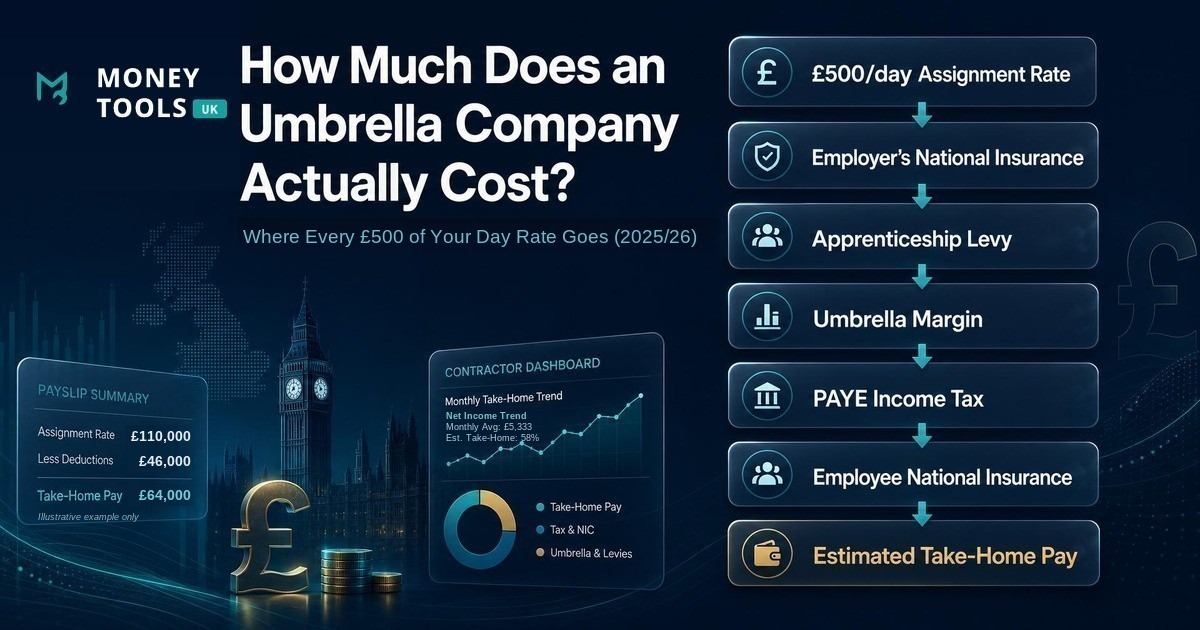 How Much Does an Umbrella Company Actually Cost? (2025/26)See how much an umbrella company really costs in 2025/26, including umbrella margin, Employer's NI, Apprenticeship Levy, holiday pay, pension deductions and contractor take-home pay.
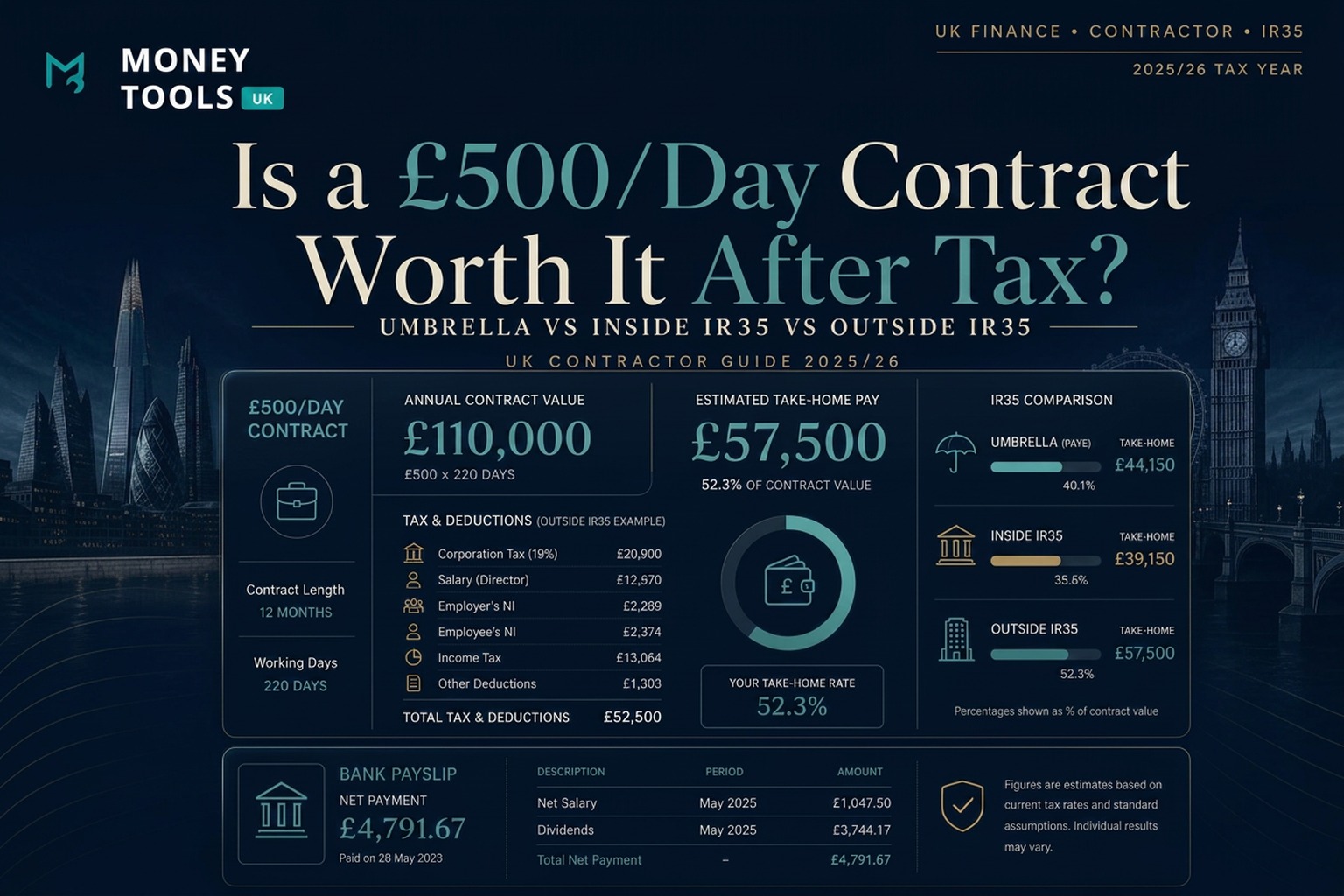 Is a £500/Day Contract Worth It After Tax? (2025/26)See how much a £500/day contract could be worth after tax in 2025/26. Compare umbrella company, inside IR35, outside IR35 and limited company take-home pay.
Disclaimer: This content is for informational purposes only and should not be treated as financial, tax, mortgage, investment or legal advice.