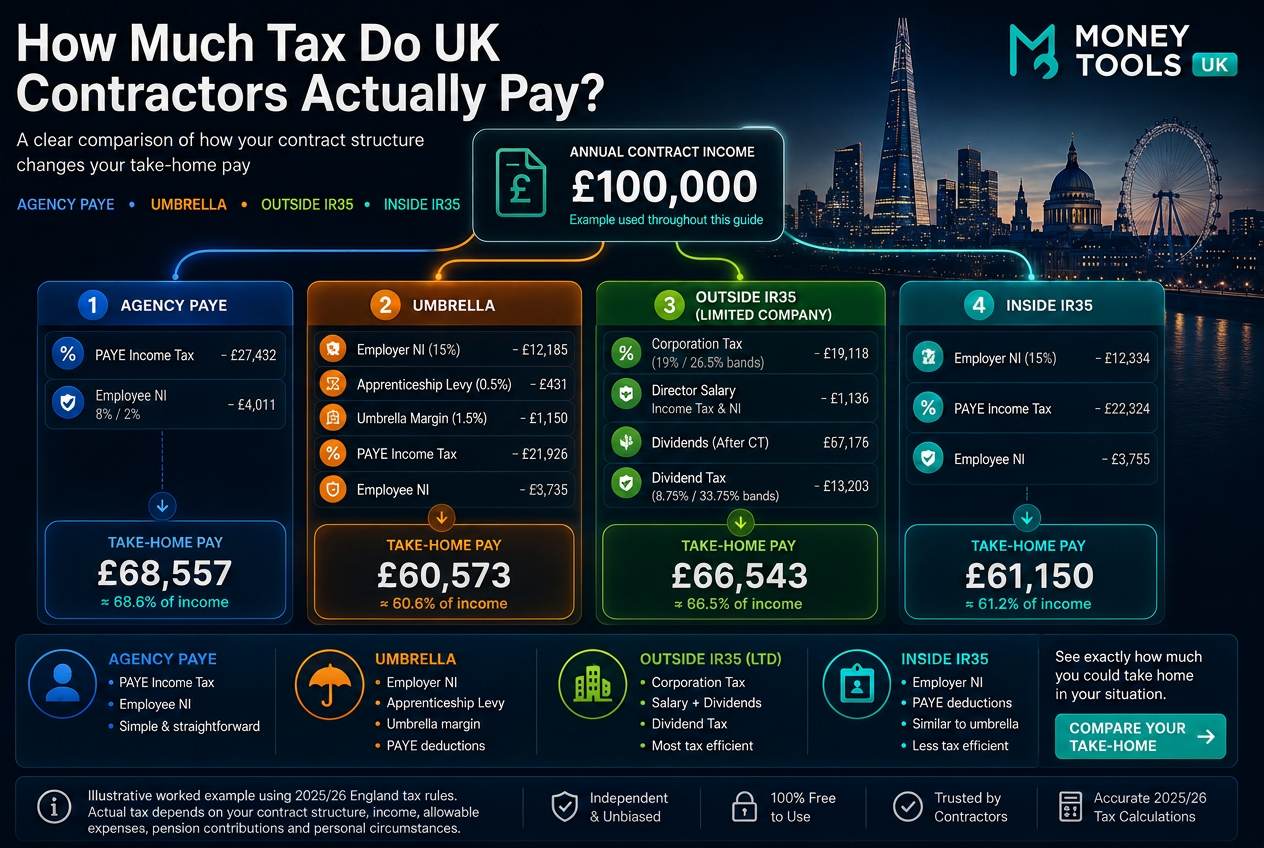
Illustrative worked example using 2025/26 England tax rules. Actual tax depends on your contract structure, income, allowable expenses, pension contributions and personal circumstances.
"How much tax do UK contractors actually pay?" is one of the questions a good calculator answers in 30 seconds and an article takes 2,000 words to explain. The honest answer is that it depends almost entirely on your contract structure — Agency PAYE, Umbrella, Outside IR35 through a limited company, or Inside IR35. On the same £100,000 of annual contract income, take-home pay can vary by more than £8,000 a year depending on which route you take.
This guide uses one canonical worked example throughout — a £100,000 annual contract, 2025/26 tax year, England, standard tax code 1257L, no student loan, no pension contributions and no salary sacrifice — so every number in the hero image, the tables, the summary boxes and the FAQs comes from the same calculation engine that powers the Contractor Tax Calculator.
Money Tools UK Key Takeaways
Three things to remember before you read on
- Structure matters more than optimisation. On £100,000, Outside IR35 keeps roughly £66,543 and Umbrella keeps roughly £60,573 — an almost £6,000 gap driven entirely by structure, not clever tax planning.
- Umbrella and Inside IR35 look almost identical. Both absorb employer's National Insurance (15%), the 0.5% Apprenticeship Levy and full PAYE. On £100,000 they land at £60,573 and £61,150 respectively.
- Agency PAYE is not directly comparable. On the same headline £100,000 you keep about £68,557, but the agency has already absorbed employer costs — the true contract value would be materially higher than an equivalent Umbrella assignment rate.
The four contractor structures
UK contractors usually work through one of four setups:
- Agency PAYE: the agency employs you, runs PAYE and absorbs employer costs before quoting your rate.
- Umbrella company: a third-party employer deducts employer's NI, the Apprenticeship Levy and its margin from the assignment rate, then pays your gross salary under PAYE.
- Outside IR35 (Limited Company / PSC): your own company invoices the client, pays Corporation Tax on profits and you extract income as a small salary plus dividends.
- Inside IR35: HMRC treats the engagement as employment. Income is taxed via a deemed employment payment — the numbers land close to Umbrella.
The 2025/26 numbers used in this guide
- Personal allowance: £12,570 (tapered above £100,000).
- Basic rate 20% up to £50,270; higher rate 40% to £125,140; additional rate 45%.
- Employee NI: 8% between £12,570 and £50,270, then 2%.
- Employer NI: 15% above the £5,000 secondary threshold (2025/26).
- Apprenticeship Levy: 0.5% of gross employer pay.
- Dividend allowance: £500. Dividend tax: 8.75% / 33.75% / 39.35%.
- Corporation Tax: 19% under £50k profit, 25% over £250k, 26.5% marginal in between.
The canonical £100,000 worked example
Every figure below is generated by the Contractor Tax Calculator using a £100,000 annual contract, 2025/26 England tax bands, standard 1257L tax code, no student loan, no pension contributions and no salary sacrifice. The Umbrella scenario assumes a typical £25/week margin over 46 working weeks (£1,150/year). Round pounds shown.
| Structure | Main taxes paid | Take-home pay | Effective | Best suited to |
|---|---|---|---|---|
Agency PAYE | PAYE Income Tax, Employee NI | £68,557 | ≈ 68.6% | Employment rightsShort assignments |
Umbrella | Employer NI, Apprenticeship Levy, PAYE, Employee NI | £60,573 | ≈ 60.6% | Inside IR35Low admin |
Outside IR35 (Ltd) | Corporation Tax, Dividend Tax, small salary PAYE | £66,543 | ≈ 66.5% | Most tax efficientLonger engagements |
Inside IR35 | Employer NI, Apprenticeship Levy, PAYE, Employee NI | £61,150 | ≈ 61.2% | Public sectorClient-determined |
Agency PAYE — £68,557 take-home
On Agency PAYE the agency employs you and absorbs employer NI and the Apprenticeship Levy inside the rate they offer. You pay Income Tax and Employee NI on the £100,000 headline:
- PAYE Income Tax: £27,432
- Employee NI (8% / 2%): £4,011
- Total deductions: £31,443
- Take-home pay: £68,557 (≈ 68.6% of contract income)
Umbrella — £60,573 take-home
Under Umbrella the £100,000 assignment rate must first cover the umbrella margin and all employer costs before your gross salary is calculated. PAYE then applies to that gross:
- Umbrella margin (~£25/week × 46 weeks): £1,150
- Employer NI (15% above £5,000): £12,185
- Apprenticeship Levy (0.5%): £431
- Gross taxable salary: £86,234
- PAYE Income Tax: £21,926
- Employee NI: £3,735
- Take-home pay: £60,573 (≈ 60.6% of contract income)
Model your own day rate through Umbrella
See the full assignment-rate breakdown including employer's NI, the Apprenticeship Levy and the umbrella margin.
Outside IR35 Limited Company — £66,543 take-home
Outside IR35 the classic small-salary-plus-dividends structure applies. The company takes a director salary at the personal allowance, pays Corporation Tax on the remaining profit and distributes the balance as dividends:
- Director salary: £12,570 (no Income Tax, no Employee NI)
- Employer NI on salary (15% above £5,000): £1,136
- Taxable profit: £86,294
- Corporation Tax (19% up to £50k + 26.5% marginal): £19,118
- Dividends after Corporation Tax: £67,176
- Dividend Tax (8.75% and 33.75% bands): £13,203
- Take-home pay: £66,543 (≈ 66.5% of contract income)
Legitimate business expenses reduce taxable profit and therefore Corporation Tax. See our allowable contractor expenses guide for the full list.
Inside IR35 — £61,150 take-home
Inside IR35 the limited company benefit disappears. Income is taxed as employment via the deemed payment mechanism — structurally identical to Umbrella minus the umbrella margin. Employer NI at 15% and the Apprenticeship Levy still come out of the assignment rate before PAYE:
- Employer NI (15% above £5,000): £12,334
- Apprenticeship Levy (0.5%): £436
- Gross taxable salary: £87,229
- PAYE Income Tax: £22,324
- Employee NI: £3,755
- Take-home pay: £61,150 (≈ 61.2% of contract income)
Most contractors choose Umbrella for Inside IR35 work rather than running their PSC — the tax outcome is almost identical and the Umbrella removes the payroll admin.
Effective take-home at a glance
- Agency PAYE @ £100k: ≈ 68.6% take-home.
- Outside IR35 Ltd @ £100k: ≈ 66.5% take-home.
- Inside IR35 @ £100k: ≈ 61.2% take-home.
- Umbrella @ £100k: ≈ 60.6% take-home.
Pension contributions move all of these materially — sometimes by £5,000+ a year for higher-rate contractors. See our best salary and dividend split guide for the limited company optimisation in detail, and salary sacrifice explained for the Umbrella and Inside IR35 lever.
Money Tools UK Summary
On the same £100,000 contract, choosing the correct structure is worth roughly £8,000 a year — far more than any micro-optimisation inside a single structure. Outside IR35 through a limited company remains the most tax-efficient route for genuinely outside contractors; Umbrella and Inside IR35 look almost identical on paper and are the pragmatic choice when the engagement is determined inside; Agency PAYE is best for short engagements where you value employment rights over headline pay. Small tax optimisations (pension contributions, allowable expenses) matter, but they matter less than choosing the correct structure in the first place. Always compare your own circumstances using the Contractor Tax Calculator before you accept a contract.
Practical takeaways
- The single biggest tax decision a contractor makes is structure, not micro-optimisation within a structure.
- IR35 status drives that decision more than any other factor — see Inside vs Outside IR35 Explained.
- Pension contributions are the most powerful legal lever across every structure — especially Umbrella and Inside IR35 salary sacrifice.
- A good contractor tax calculator models all four structures side by side from a single set of inputs — use it before you accept a contract, not after.
Get new UK finance and property guides from Money Tools UK
Plain-English UK finance insights, tax updates and property investing guides.
Related calculators
Contractor Tax Calculator
The exact calculator this article is built around — open it and run your own numbers.
Open calculatorFrequently asked questions
Related guides
More flagship guides and tools from Money Tools UK.
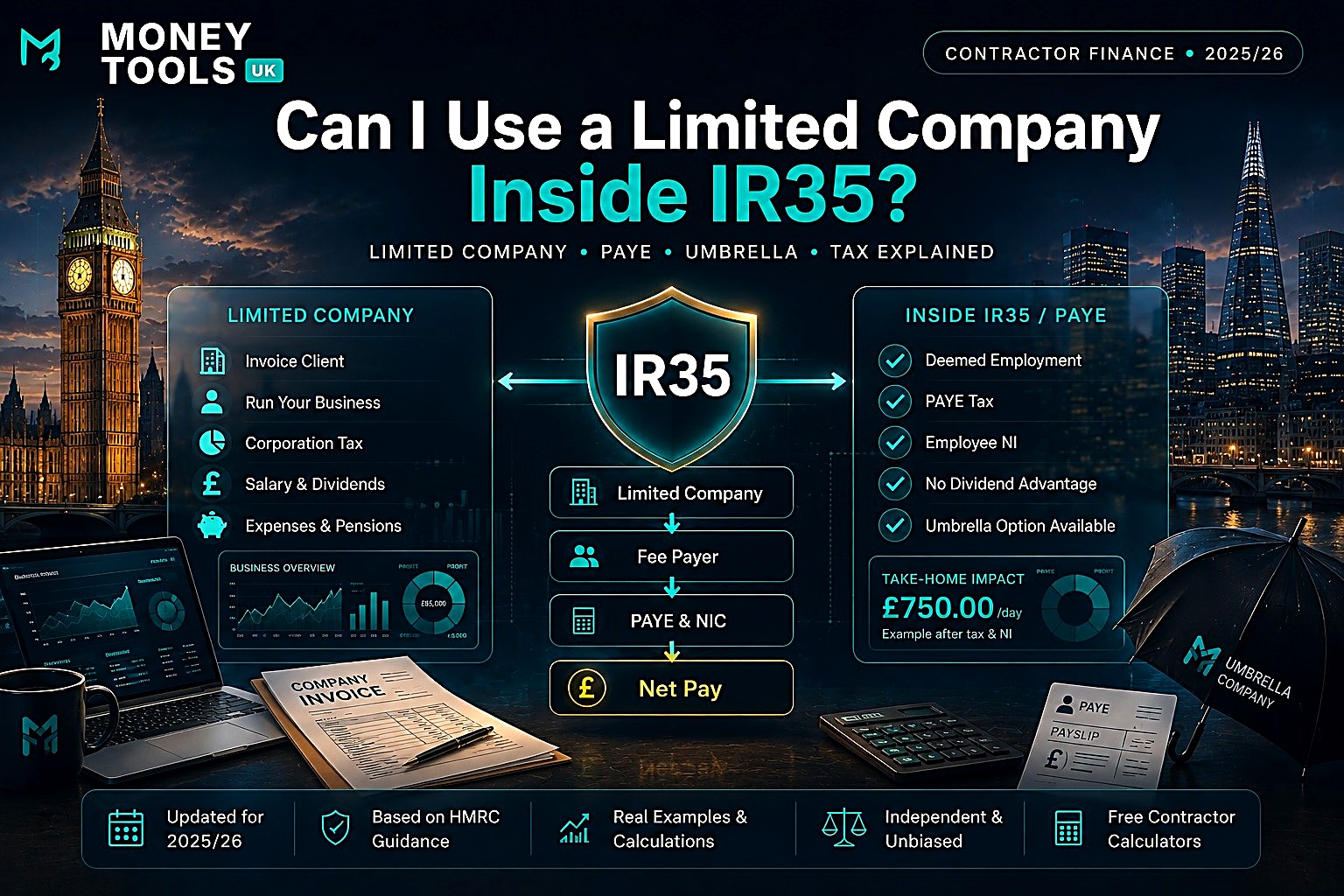
Can you still use a limited company inside IR35? Learn what happens to PAYE, dividends, Corporation Tax, expenses, umbrella companies and mixed inside/outside IR35 contracts.
Read guide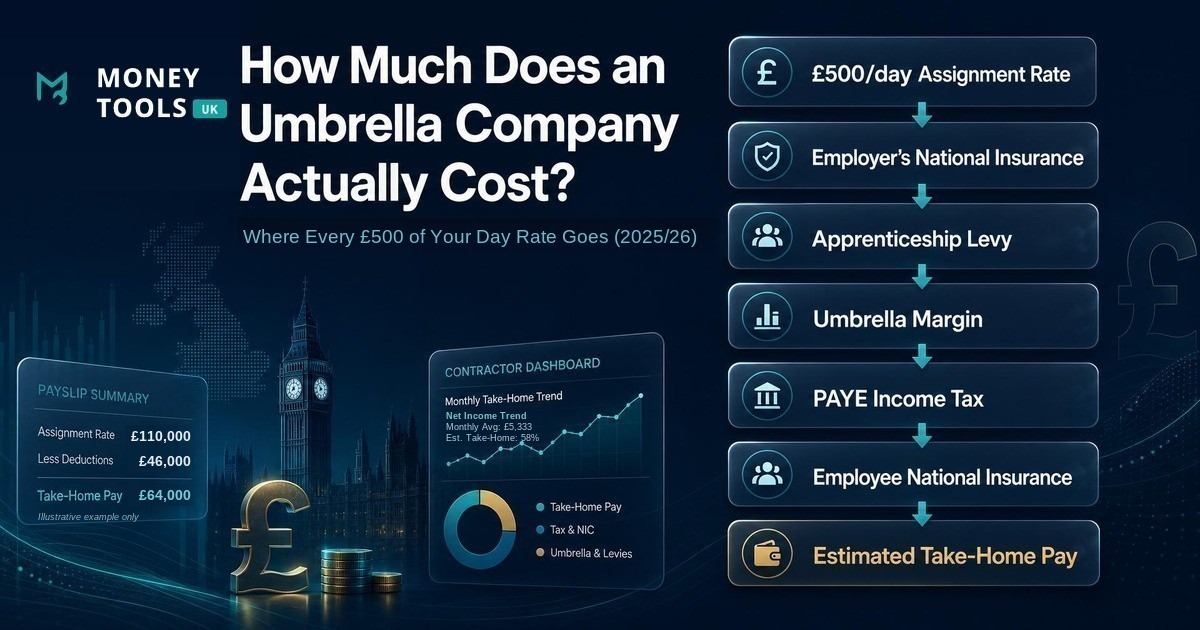
See how much an umbrella company really costs in 2025/26, including umbrella margin, Employer's NI, Apprenticeship Levy, holiday pay, pension deductions and contractor take-home pay.
Read guide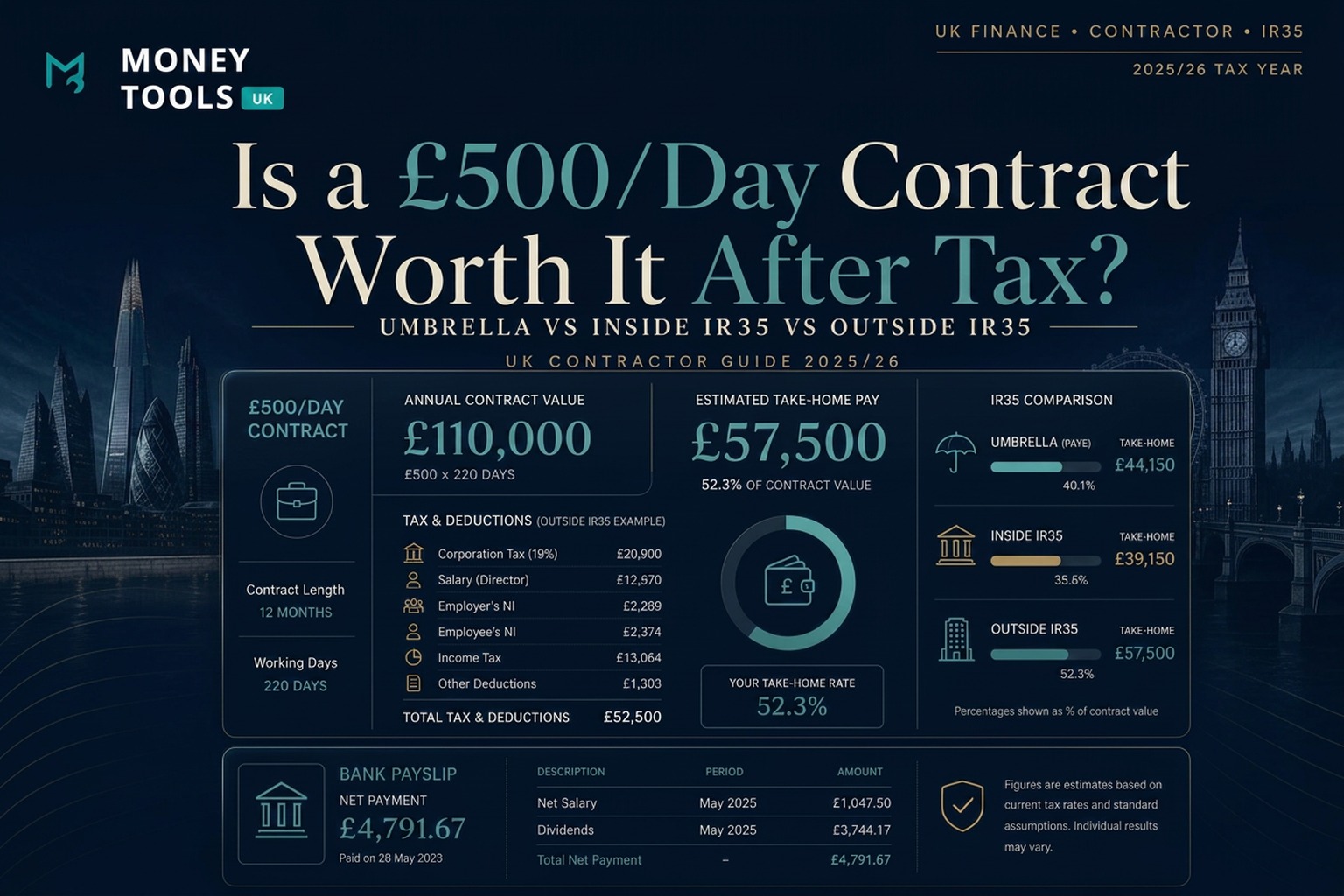
See how much a £500/day contract could be worth after tax in 2025/26. Compare umbrella company, inside IR35, outside IR35 and limited company take-home pay.
Read guideDisclaimer: This content is for informational purposes only and should not be treated as financial, tax, mortgage, investment or legal advice.