
Take one ordinary £220,000 UK house. Let it to a single family and it produces £1,250 a month. Convert the same property into a five-room House in Multiple Occupation and it produces £2,400 a month. Same bricks, same street, same purchase price — two completely different businesses.
This guide compares HMO investing and single-let buy-to-let using one canonical worked example from start to finish: the same £220,000 property, the same £680 monthly mortgage, operated both ways. Every figure in the hero image, the tables, the call-outs and the FAQs below comes from that single example, so you can see exactly where the extra income goes and what it costs you in workload, regulation and risk. Run your own numbers in the HMO Deal Calculator and the Buy-to-Let ROI Calculator.
Definitions
A single-let buy-to-let is a property let to one household — a single tenant, a couple or a family — on a single Assured Shorthold Tenancy.
A House in Multiple Occupation (HMO) is a property let to three or more unrelated tenants who share kitchen or bathroom facilities. A large HMO (five or more unrelated tenants) requires a mandatory HMO licence anywhere in England and Wales. Many councils also operate additional or selective licensing schemes that catch smaller HMOs. Our HMO investing guide covers the licensing regime in more depth.
The canonical worked example
One property, £220,000 purchase price, interest-only finance at 75% LTV giving a £680 monthly mortgage payment in both scenarios. The only variable is how the property is operated.
| Monthly figure | HMO | Buy-to-let |
|---|---|---|
| Rental income | £2,400 (5 × £480) | £1,250 (one family) |
| Mortgage payment | £680 | £680 |
| Operating costs | £770 (utilities, management, licensing) | £250 (maintenance, letting) |
| Net cash flow | £950 | £320 |
| Net yield (annual) | 10.2% | 5.6% |
The HMO produces £950 a month against the buy-to-let's £320 — roughly £7,560 a year more cash flow from the same asset, and a net yield of 10.2% versus 5.6%. That gap is the entire case for HMOs, and the rest of this guide is about what you pay for it. Sense-check the income side with the Rental Yield Calculator and the purchase costs with the Stamp Duty Calculator.
HMO vs buy-to-let: full comparison
| Criteria | HMO | Buy-to-let |
|---|---|---|
| Monthly income | £2,400 gross on the worked example | £1,250 gross on the same property |
| Net cash flow | £950 per month | £320 per month |
| Net yield | 10.2% | 5.6% |
| Management | Hands-on; specialist agents charge 12–15% | Light touch; agents charge 8–10% |
| Regulation | Licensing, fire safety, room sizes, amenity ratios | Standard landlord compliance only |
| Tenant turnover | High — rooms churn every 6–18 months | Low — families often stay for years |
| Void risk | Partial: one empty room costs £480, not £2,400 | Total: an empty property costs the full £1,250 |
| Financing | Specialist HMO mortgages, 0.25–1% higher, experience usually required | Competitive mainstream products, widely available |
| Capital growth | Driven by rental performance and commercial valuation | Driven by the owner-occupier market |
| Exit strategy | Sells to investors on a yield basis; smaller buyer pool | Sells to owner-occupiers or investors; deep market |
| Workload | Comparable to running five small tenancies plus bills | A few hours a year if managed |
| Ideal investor | Experienced, cash-flow focused, comfortable with compliance | First-time or passive landlords seeking simplicity |
Where the extra £770 goes
The HMO in the worked example carries £770 a month of operating costs against the buy-to-let's £250. That difference is not waste — it is the cost of running a serviced product:
- Bills: HMO rooms are let bills-inclusive — gas, electricity, water, broadband and often council tax.
- Management: 12–15% of a much larger rent roll, versus 8–10% of £1,250.
- Licensing and compliance: licence fees, fire alarm servicing, emergency lighting, annual gas and five-yearly electrical checks.
- Communal cleaning and wear: higher turnover means shorter redecoration cycles and furnished rooms.
Local licensing changes everything
Financing
Both scenarios in the worked example assume the same £680 interest-only mortgage, but you will not get there the same way. Single-let mortgages are competitive and widely available; HMO mortgages are a specialist product. Expect:
- HMO interest rates 0.25–1% above equivalent single-let products.
- Lender requirement that you have at least 12 months' BTL ownership experience.
- Maximum 75% LTV, sometimes 70% on larger HMOs.
- Rent stress tests calculated on assumed single-let rent for some lenders, full HMO rent for others.
If the property needs a conversion before it can be let as an HMO, that work is usually funded with short-term lending — see our bridging finance guide — and refinanced onto an HMO mortgage afterwards. That is exactly the BRRR strategy applied to HMOs.
Management workload
Self-managing the five-room HMO above is roughly equivalent to self-managing five single lets — but with the added work of bills management, communal cleaning, tenant disputes and rolling room turnover. Most successful HMO landlords use a specialist HMO management company, which is already built into the £770 operating cost in the worked example.
Compare a specific HMO deal end to end
Run a property as both single let and HMO to see the cash-flow gap on your own numbers.
Exit strategy
Single lets sell easily to owner-occupiers, which keeps the market deep. HMOs typically sell only to other investors, on a yield basis. That can be either an advantage (HMO valuations in some areas exceed comparable single-let valuations because yield justifies a higher price) or a disadvantage (smaller buyer pool, longer time to sell).
Which strategy should you choose?
The £950 versus £320 gap is not free money — it is payment for work, risk and compliance. Use this framework to decide which side of the worked example fits you.
Choose HMO if
- You need £950-a-month cash flow now, not growth later
- You already own at least one buy-to-let
- You have capital for conversion and compliance works
- Your target area has no Article 4 restriction
- You have access to specialist HMO management
Choose buy-to-let if
- This is your first investment property
- You want a near-passive £320 a month
- You are buying primarily for capital growth
- You have no appetite for licensing or planning work
- You want the widest possible resale market
Still undecided? Model both versions of the same property side by side in the Property Deal Analyser before you make an offer.
Common mistakes
Where HMO investors get caught out
- Ignoring licensing. Operating the five-room HMO above without a mandatory licence risks unlimited fines and a rent repayment order for up to 12 months' rent — £28,800 on these figures.
- Missing an Article 4 direction. In an Article 4 area you need full planning permission to convert a family home into an HMO. Buying first and checking later is how investors end up with an unlettable house.
- Underestimating utilities. Bills-inclusive rooms transfer energy-price risk to you. The £770 cost line assumes sensible usage, not five tenants heating the house with the windows open.
- Assuming full occupancy. One empty room for three months removes £1,440 from the year — model 90–95% occupancy, not 100%.
- Underestimating management time. Five tenancies, five deposits, five sets of disputes. Budget for an agent even if you plan to self-manage.
- Unrealistic profit expectations. £950 a month is a well-run HMO in a strong location — not a guaranteed national average.
Money Tools UK Key Takeaways
Five things to remember
- Same property, different business. The £220,000 house produces £2,400 a month as an HMO and £1,250 as a single let — the asset didn't change, the operating model did.
- Cash flow is roughly three times higher. £950 a month versus £320, and 10.2% net yield versus 5.6%.
- The uplift is paid for in costs and work. £770 of monthly operating costs versus £250, plus licensing and hands-on management.
- Regulation decides feasibility before numbers do. Licensing and Article 4 can rule out an HMO conversion entirely, however good the spreadsheet looks.
- Match the strategy to your stage. Buy-to-let for simplicity and growth; HMO for income once you have experience, capital and management in place.
For more on the maths behind property deals, see rental yield vs ROI and how to analyse a property deal.
Get new UK finance and property guides from Money Tools UK
Plain-English UK finance insights, tax updates and property investing guides.
Related calculators
HMO Deal Calculator
The exact calculator this article is built around — open it and run your own numbers.
Open calculatorFrequently asked questions
Related guides
More flagship guides and tools from Money Tools UK.
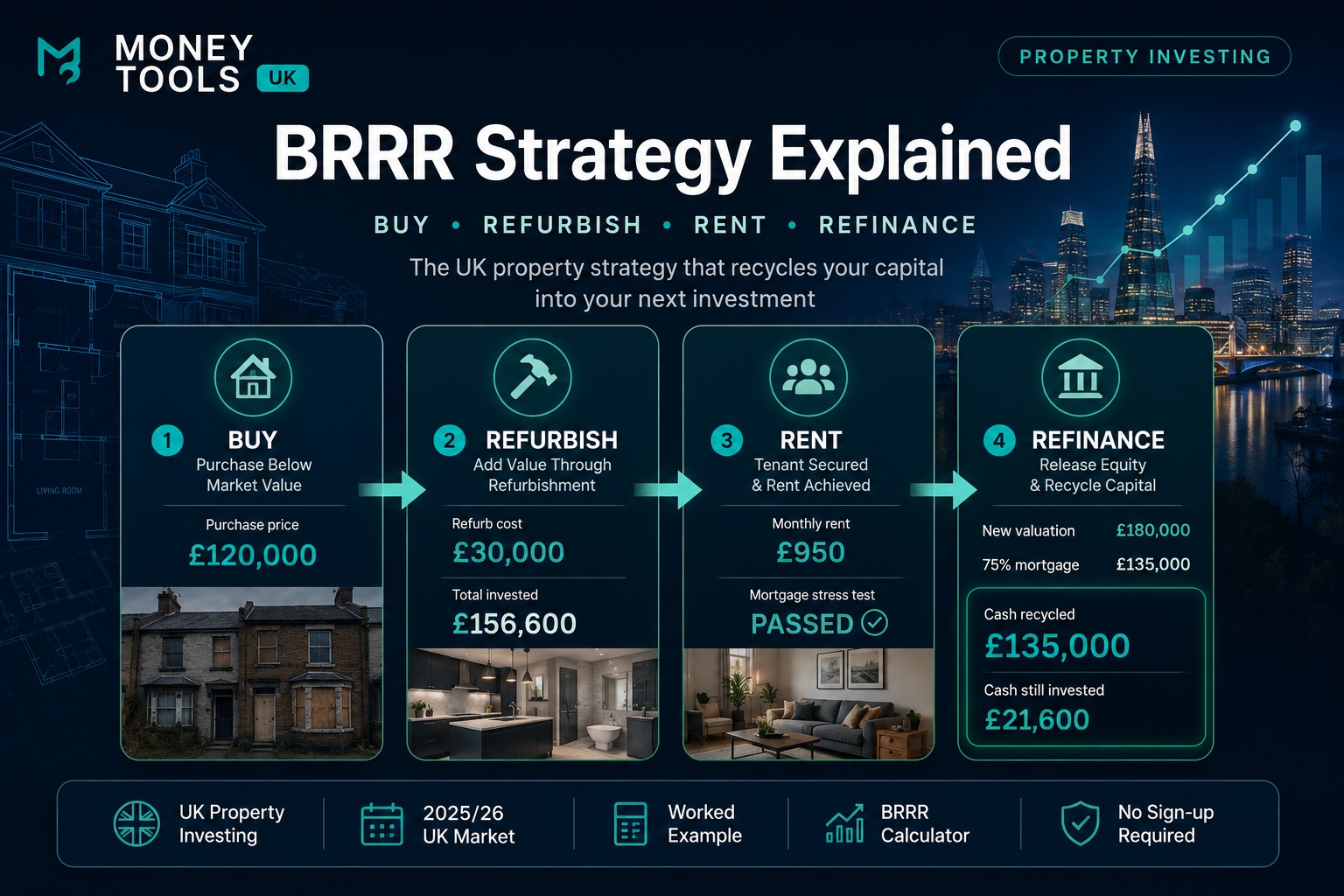
How the Buy, Refurbish, Rent, Refinance (BRRR) strategy works in the UK — including funding, refurb costs, refinance pitfalls and a worked example.
Read guide
A repeatable framework for analysing UK buy-to-let, HMO and flip deals — purchase, refurb, finance costs, cash flow and ROI.
Read guide
Rental yield, gross yield, net yield and cash-on-cash ROI explained for UK property investors — with formulas and worked examples.
Read guideDisclaimer: This content is for informational purposes only and should not be treated as financial, tax, mortgage, investment or legal advice.