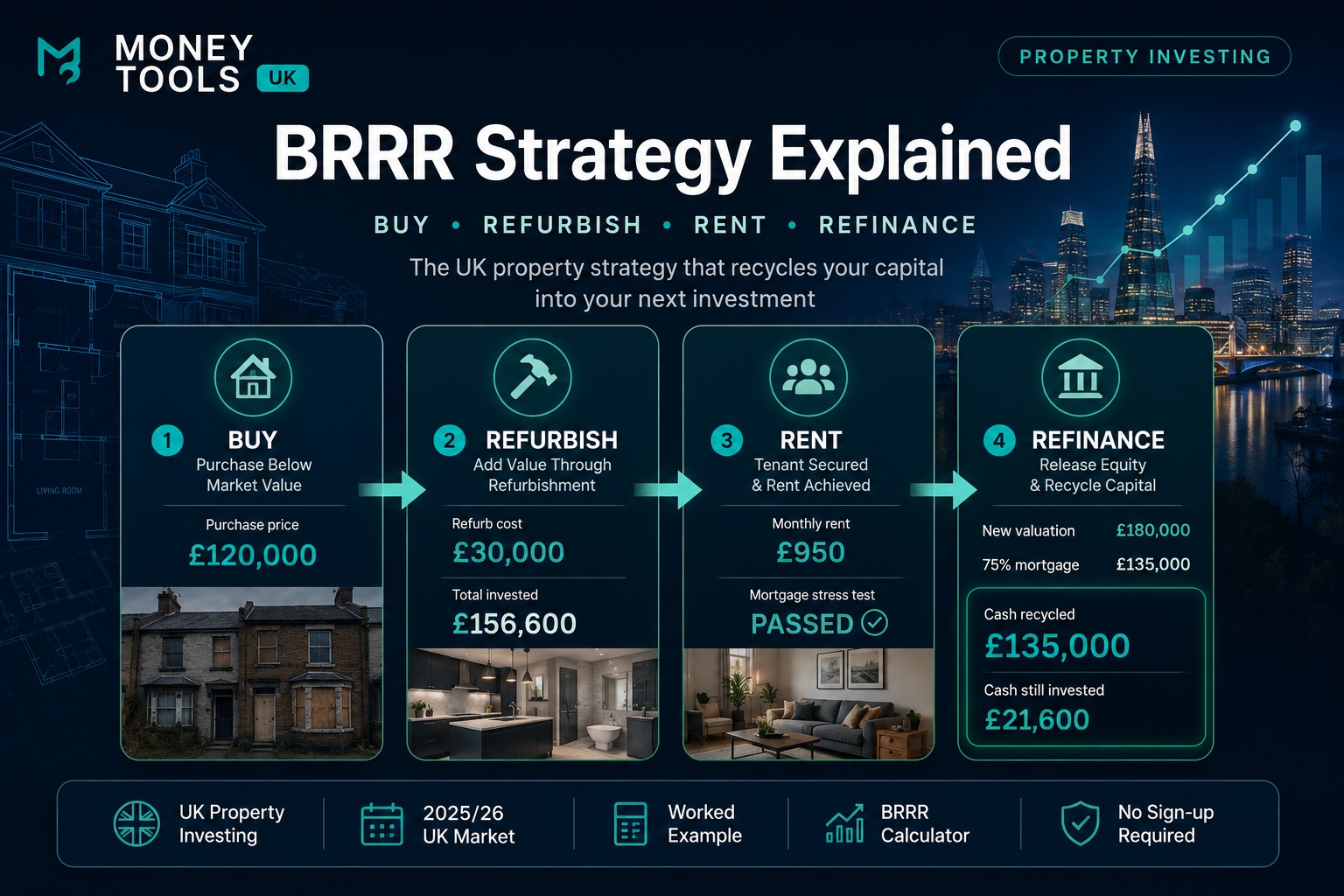
BRRR — Buy, Refurbish, Rent, Refinance — is the strategy that lets UK property investors recycle most of the cash they put into a deal back out again, so the same deposit can buy the next property instead of being locked into the last one. Rather than saving an entirely new deposit for every purchase, you buy below market value, add real value through a refurbishment, let the property, then remortgage at the higher valuation and pull your capital back out.
Done well, that recycling is how small portfolios grow into large ones. Done badly, it's how investors end up with refinanced properties that only just cover the mortgage. This guide walks through the strategy as it works in 2026 UK conditions, using one canonical worked example — a £120,000 purchase with a £30,000 refurbishment — that every figure in the hero image, the tables and the FAQs below is drawn from. You can test your own numbers in the BRRR Calculator.
What is BRRR?
BRRR follows four steps:
- Buy: a property below market value, usually one needing refurbishment.
- Refurbish: add value through targeted works — new kitchen, bathroom, layout changes, decor.
- Rent: let the property at the new market rent.
- Refinance: remortgage onto a long-term buy-to-let mortgage at the new, higher value to release most or all of your original cash.
The aim is to have a tenanted, cash-flowing property with little or none of your original deposit still tied up in it. That deposit can then be used on the next deal.
Why it works in the UK
Buy-to-let lenders typically lend up to 75% of the open market value once a property is mortgageable and tenanted. If you can buy and refurbish for less than 75% of the post-refurb valuation, the refinance recycles your cash entirely. The two levers are buying well (below market) and adding measurable value through the refurb.
Funding the purchase
You almost never use a standard buy-to-let mortgage to buy a BRRR property — most won't lend on properties that aren't currently habitable. The two common funding routes are:
- Cash: simplest, fastest, no interest cost during the refurb. Limits portfolio scale.
- Bridging finance: short-term lending, typically 9–12 months, charged at ~0.6–1% per month. See our guide on bridging finance for the full breakdown.
The refurb that adds value
Not every pound spent on a refurb adds a pound to the valuation. The refurbs that move surveyor numbers most are the ones that fix the property's biggest weaknesses: a brand new kitchen and bathroom, structural fixes (damp, roof, rewire), opening up the layout, adding an extra bedroom in unused space, and finishing to a clean, modern, lettable standard.
Cosmetic improvements (decor, flooring, garden) help with speed of let and rent achieved, but rarely move the surveyor's comparable-based valuation more than a few thousand pounds.
Surveyors price on comparables
Rent and the mortgage stress test
Buy-to-let lenders require the rent to cover the mortgage by a stress factor — typically 125–145% at a stressed interest rate of 5.5–8%. If the rent doesn't pass the stress test, the lender will reduce how much they'll lend, regardless of the valuation. That can break the refinance even when the valuation comes in.
Always model the rent stress test up-front using the post- refurb expected rent and a realistic stressed rate.
Refinance: the part that goes wrong
Most BRRR deals fail at the refinance stage, for one of three reasons:
- The valuation comes in below expectation. Local ceiling ignored, refurb didn't add the assumed value, or a quiet comparables market.
- The rent doesn't stress. Higher interest rates have made this much more common since 2022.
- The bridging period runs out before refinance completes. BTL lenders typically want six months' ownership before they'll lend on a remortgage at uplifted value, so plan your bridge length accordingly.
Model your full BRRR cycle
Test purchase, refurb, bridging cost, refinance valuation and post-refinance cash flow in one place.
A worked UK example
A two-bed terraced needing a full refurbishment, with a local ceiling of £180,000. This is the canonical worked example used throughout this guide — the same figures appear in the hero image, the tables below and the key takeaways. Stamp duty is the additional-dwelling rate; the mortgage is interest-only at 5.5%.
| Stage | Figure |
|---|---|
| Purchase price | £120,000 |
| Refurbishment | £30,000 |
| Stamp duty (additional dwelling) | £3,600 |
| Holding costs | £3,000 |
| Total cash invested | £156,600 |
| New valuation | £180,000 |
| Refinance at 75% LTV | £135,000 |
| Cash remaining invested | £21,600 |
| Monthly rent | £950 |
| Monthly mortgage | £619 |
| Monthly cash flow | Approximately £330 |
The deal recycles £135,000 of the £156,600 invested, leaving £21,600 in the property and roughly £330 a month of cash flow before maintenance and management. Not every deal recycles 100% of the cash, and that's normal — a successful BRRR pulls 70–90% of your money back out into the next deal, with cash flow that justifies the residual stake. Check the purchase costs with the Stamp Duty Calculator and the income side with the Rental Yield Calculator and Buy-to-Let ROI Calculator.
Deal screening
Can this deal BRRR?
- Bought below market value
- Refurbishment genuinely adds value
- Rent comfortably supports lender affordability
- Comparable sales support the valuation
- Clear refinance strategy
- Adequate contingency budget
If any of these six is a "no", the deal is a standard buy-to-let purchase, not a BRRR. Run it through the Property Deal Analyser before you commit.
Common BRRR mistakes
Where UK BRRR deals go wrong
- Paying too much initially. The margin is made on the purchase — overpay by £10,000 and you leave that cash in the deal forever.
- Underestimating refurbishment costs. Most refurbs come in 10–25% over budget.
- Assuming optimistic valuations. Surveyors price on comparables, not on what you spent.
- Failing lender affordability stress tests. A valuation you can't borrow against is worthless.
- Having insufficient contingency. Carry 15–25% of the refurb budget in reserve.
- Overestimating rental income. Use let comparables, not asking prices.
When not to BRRR
- When the local ceiling means the refurb can't justify itself.
- When stress-test rates would prevent a refinance even with a higher valuation.
- When refurb costs are wildly uncertain (heritage properties, unknown structural issues).
- When you don't have contingency cash for over-runs — most refurbs come in 10–25% over budget.
BRRR pairs well with HMO conversions, where the value uplift on a permitted HMO can be much higher than a single-let refurb. See also our pieces on HMO vs buy-to-let, bridging finance and how to analyse a property deal.
Money Tools UK Key Takeaways
Five things to remember about BRRR
- BRRR recycles capital, it doesn't create it. In the worked example, £135,000 of the £156,600 invested comes back out, leaving £21,600 in the deal to fund the next purchase.
- The profit is made on the purchase. Buying at £120,000 against a £180,000 post-refurb ceiling is what makes the 75% LTV refinance work.
- Refurbishment must add measurable value. £30,000 well spent moves the valuation; £30,000 of cosmetics usually doesn't.
- The refinance depends on rent, not just value. £950 a month against a £619 interest-only payment has to clear the lender's stress test before £135,000 is released.
- Cash flow justifies the residual stake. Roughly £330 a month on £21,600 left in the deal is the return you're actually holding — model it in the BRRR Calculator before you buy.
Get new UK finance and property guides from Money Tools UK
Plain-English UK finance insights, tax updates and property investing guides.
Related calculators
BRRR Calculator
The exact calculator this article is built around — open it and run your own numbers.
Open calculatorFrequently asked questions
Related guides
More flagship guides and tools from Money Tools UK.

Compare HMO investing with single-let buy-to-let on yield, void risk, regulation, mortgages and management workload across the UK.
Read guide
A repeatable framework for analysing UK buy-to-let, HMO and flip deals — purchase, refurb, finance costs, cash flow and ROI.
Read guide
Rental yield, gross yield, net yield and cash-on-cash ROI explained for UK property investors — with formulas and worked examples.
Read guideDisclaimer: This content is for informational purposes only and should not be treated as financial, tax, mortgage, investment or legal advice.