
Property investors who scale don't analyse deals slowly — they triage fast and analyse deeply only the ones that look promising. This guide gives you a repeatable 10-minute framework to evaluate any UK buy-to-let, HMO or flip opportunity before you waste a viewing, an offer or a survey fee.
Step 1: Establish the realistic purchase price
The asking price is rarely the deal price. Look at:
- Recent sold comparables (Land Registry, Rightmove sold prices) within 0.25 miles, same property type, same number of bedrooms.
- How long the property has been on the market — over 3 months suggests room to negotiate.
- The vendor's situation: probate sales, distressed sales and motivated investors usually take 8–15% below asking.
Set your max bid before you make the offer, not during the negotiation.
Step 2: Estimate the refurb honestly
Walk through every room and assign a number. UK rules of thumb:
- Light refresh (decor, carpets, deep clean): £4–£8k per property.
- Full kitchen replacement: £5–£12k.
- Full bathroom replacement: £3–£6k per bathroom.
- Full rewire: £4–£7k for a typical three-bed.
- New boiler and central heating: £3–£5k.
- Windows: £600–£1,000 each.
- Loft conversion: £30–£60k.
- Single-storey extension: £25–£50k.
Add a 15–25% contingency on top. Refurbs over-run more often than they come in under budget.
Step 3: Establish the realistic rent
Use SpareRoom for HMO room rates, OpenRent and Rightmove for single lets, and at least one local letting agent for a sanity check. Don't rely on the asking rents you see online — check what's actually let recently.
Step 4: Model the financing
- What's the deposit (typically 25%)?
- What's a realistic mortgage rate today and stress rate?
- Will the rent pass the lender's stress test (commonly 145% at 5.5–7%)?
- If using bridging, what's the total interest cost across the expected hold?
See our bridging finance guide for the full breakdown.
Step 5: Build the cash flow
Monthly:
- Rent (net of voids — use a 5–8% void allowance).
- Less mortgage interest.
- Less management (8–15% of rent depending on type).
- Less maintenance reserve (10% of rent is a safe baseline).
- Less ground rent / service charge if leasehold.
- Less landlord insurance, gas and electrical compliance, licensing fees (annualised).
- Less bills (HMOs only).
What's left is your monthly net cash flow. If it's under £150/month per property after all of the above, the deal has no buffer for rate rises or void shocks.
A 10-minute analysis in practice
Run a full deal in the analyser
Plug your numbers into the property deal analyser to see yield, ROI, cash flow and stress-tested affordability in one view.
Step 6: Calculate ROI honestly
Cash-on-cash ROI = annual net cash flow ÷ total cash invested (deposit + stamp duty + legals + refurb). Anything below 6% cash-on-cash on a single let in 2026 is hard to justify unless you have a strong capital growth case. HMOs and BRRR-with-pull-out can target 15%+.
For a deeper dive, see rental yield vs ROI.
Step 7: Test the exit
Always know how you'd sell:
- To owner-occupiers (works for single lets).
- To another investor on yield (works for HMOs and tenanted singles).
- By BRRR refinance and hold long-term.
- Flip — see the deal-killer questions below.
Common deal-killers to spot fast
- Short lease (under 80 years) — expensive to extend, kills mortgageability.
- Cladding or EWS1 issues on flats post-Grenfell — major mortgageability hit.
- Article 4 area for HMO conversions — planning required.
- Coal mining or flooding risk in the area — survey shock and insurance cost.
- EPC below E (and below C from 2030 for new tenancies under proposed rules).
- Leasehold flats with onerous ground rent escalation.
- Non-standard construction (prefab, BISF, single-skin brick) — limited mortgage options.
For more on the strategies you might apply once a deal passes triage, see BRRR strategy explained and HMO vs buy-to-let.
Get new UK finance and property guides from Money Tools UK
Plain-English UK finance insights, tax updates and property investing guides.
Related calculators
Property Deal Analyser
The exact calculator this article is built around — open it and run your own numbers.
Open calculatorFrequently asked questions
Related guides
More flagship guides and tools from Money Tools UK.
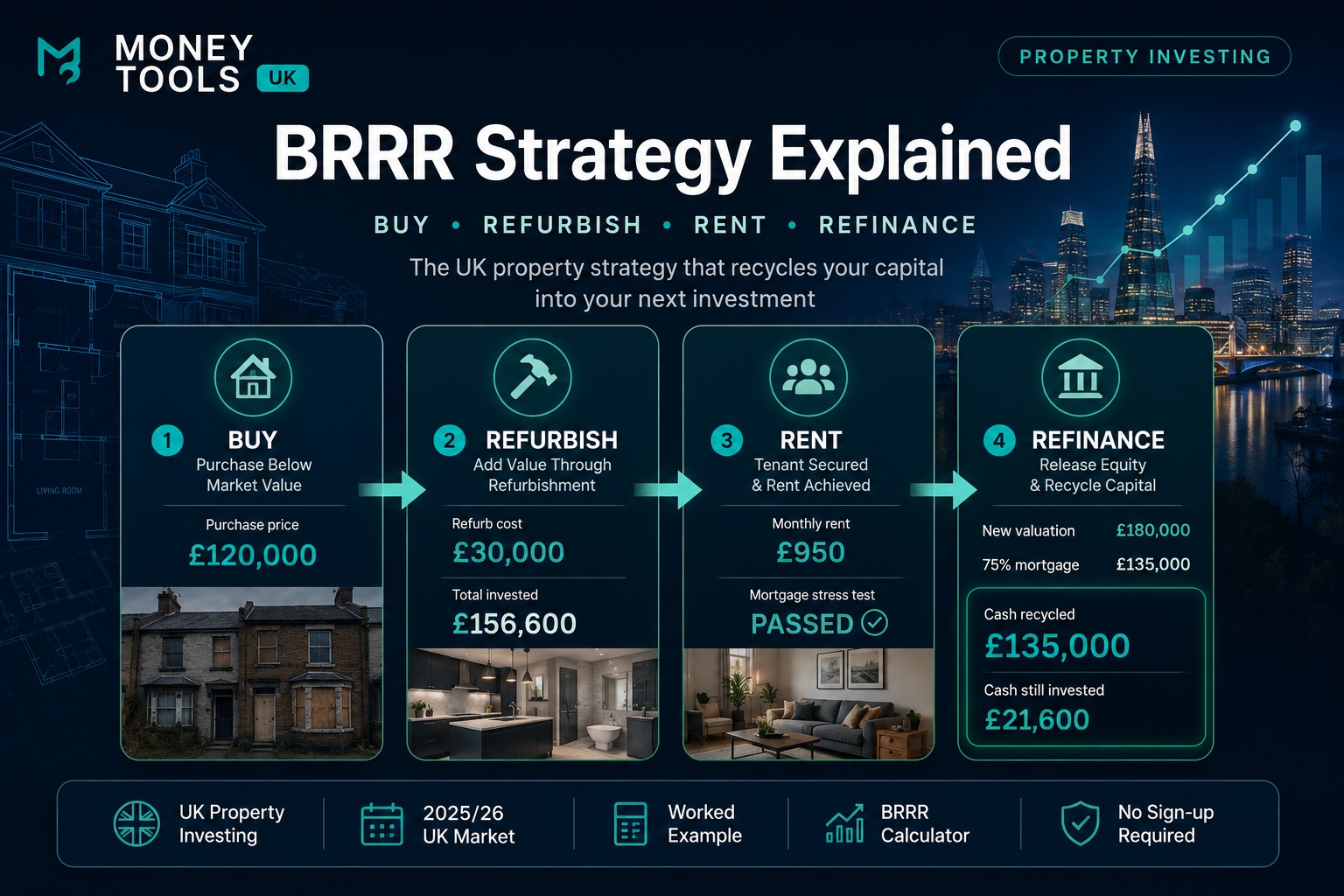
How the Buy, Refurbish, Rent, Refinance (BRRR) strategy works in the UK — including funding, refurb costs, refinance pitfalls and a worked example.
Read guide
Compare HMO investing with single-let buy-to-let on yield, void risk, regulation, mortgages and management workload across the UK.
Read guide
Rental yield, gross yield, net yield and cash-on-cash ROI explained for UK property investors — with formulas and worked examples.
Read guideDisclaimer: This content is for informational purposes only and should not be treated as financial, tax, mortgage, investment or legal advice.