
Every inside IR35 contractor has had the same moment: the rate looks reasonable, the offer goes through, the first payslip lands, and the take-home feels brutal. This guide walks through every single deduction so you know exactly where the money went — and what (if anything) you can do about it.
The rate isn't the rate
Inside IR35 (and umbrella) work is quoted as an assignment rate. This is the amount the agency pays the umbrella or fee-payer for your work, not the amount your employer pays you. From that single rate, every cost of employing you has to come out before income tax and employee NI are even calculated.
The deduction stack
Run a £450/day inside IR35 assignment over a typical week and the deductions look something like this:
- Umbrella margin: ~£20–£30 (a flat fee, set by the umbrella).
- Employer's NI: 13.8% on the gross above the secondary threshold — typically £200–£260/week on this assignment rate.
- Apprenticeship levy: 0.5% — a small but real deduction (£10–£12/week).
- Holiday pay accrual (12.07%): usually rolled up into your gross — visible but yours.
- Income tax (20% / 40%): on your gross above the personal allowance.
- Employee NI (8% / 2%): on your gross above the primary threshold.
- Pension auto-enrolment: 5% (unless you opt out).
- Student loan: if applicable, 9% above the repayment threshold.
Stack those together on a higher-rate contractor and the effective deduction from assignment rate to net pay can land between 38% and 45%.
A worked example — £450/day, 2025/26 England
Why it feels so unfair
Two reasons. First, you see the assignment rate quoted as if it were your salary, then you see employer's NI deducted from your side — which a permanent employee never sees on a payslip. Second, an outside IR35 limited company contractor on the same nominal rate would keep £200–£400 more per week, because they'd avoid both the employer's NI and the inflexible PAYE structure. The gap is real, and it's structural.
What actually helps
1. Pension contributions via salary sacrifice
This is the single biggest legal lever. Salary sacrifice contributions come off the gross before employer's NI, employee NI and income tax. A £500/month contribution for a higher-rate contractor can cost as little as £270 of net pay, with £230 of "free" pension on top.
2. Use your full personal allowance
Make sure your tax code is right. A wrong code (often "BR" when you start a new umbrella mid-year) means no personal allowance and overpaid tax. Check on your HMRC personal tax account and chase the umbrella to update.
3. Negotiate the rate up
If a role moves from outside to inside IR35, an uplift of 20–25% is the rough mark to keep your take-home roughly constant. Use the Inside IR35 Calculator to find your exact number.
4. Avoid scheme umbrellas
If a payslip looks too good (loan payments, tax-free advances, offshore trust income), HMRC will eventually catch up — and the bill goes to you, not the scheme. Stick to compliant umbrellas paying you 100% PAYE.
Find the rate uplift you actually need
Compare your current outside IR35 contract with an inside IR35 equivalent and see the rate increase that closes the gap.
What doesn't help
- "High take-home" umbrellas: already covered — these are tax avoidance schemes.
- Running the income through your PSC: the deemed payment rules apply the same employer's NI and PAYE deductions, plus you carry the admin.
- Claiming employee expenses: inside IR35 (and from 2016 for most umbrella workers) you can only claim what an ordinary employee could claim — almost nothing. Outside IR35 is different — see what expenses contractors can claim through a limited company.
Plan the contract before you sign
The best time to fix inside IR35 take-home is before you accept the contract. Use the Umbrella Calculator to model the assignment rate, decide your pension contribution upfront, and negotiate accordingly. For a fuller comparison with outside IR35, see inside IR35 vs outside IR35.
Get new UK finance and property guides from Money Tools UK
Plain-English UK finance insights, tax updates and property investing guides.
Related calculators
Inside IR35 Calculator
The exact calculator this article is built around — open it and run your own numbers.
Open calculatorFrequently asked questions
Related guides
More flagship guides and tools from Money Tools UK.
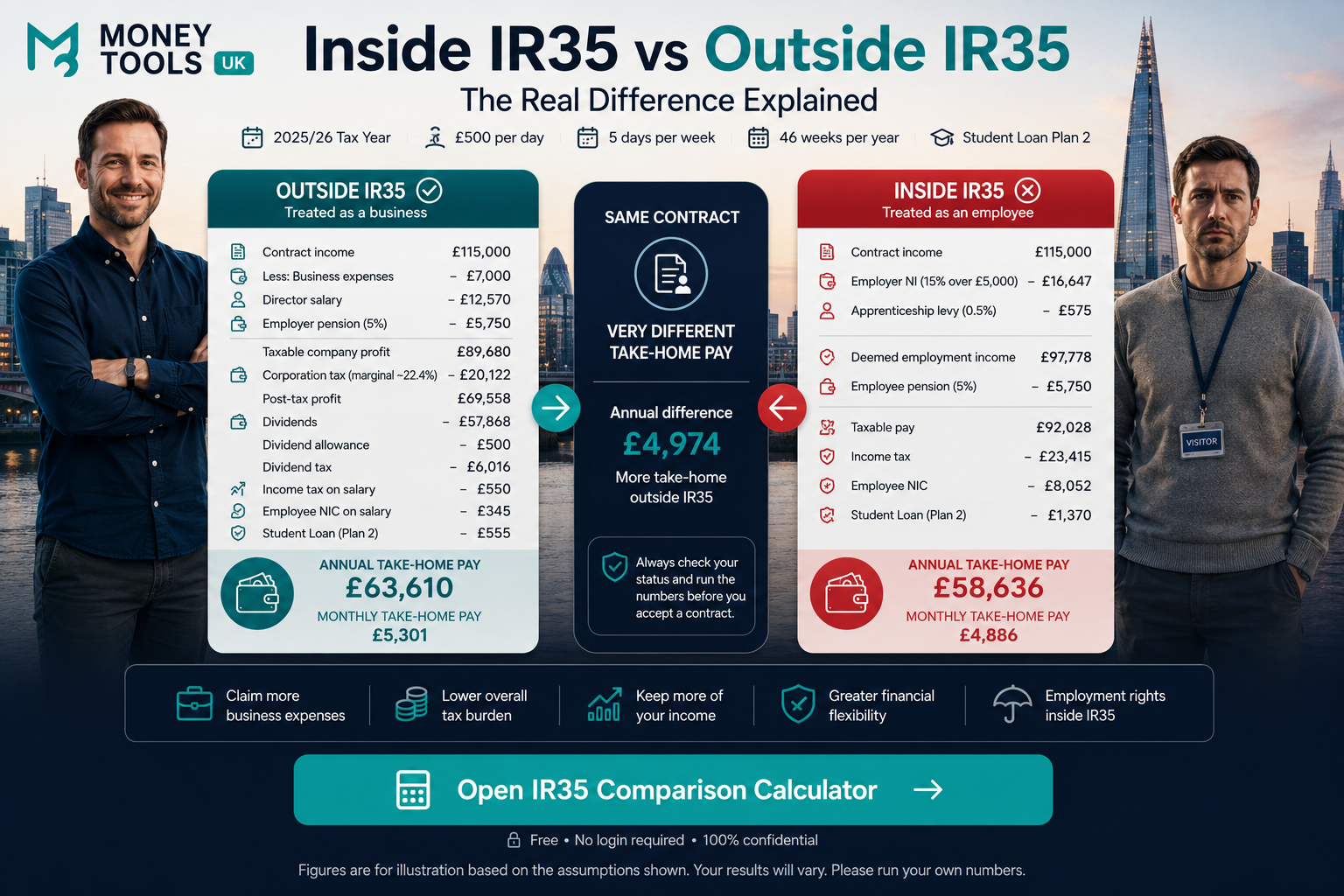
What inside and outside IR35 actually mean for UK contractors, how status is decided, and how each option affects take-home pay in 2025/26.
Read guide
A plain-English UK guide to checking if HMRC owes you a tax refund: why overpayments happen, how to use your Personal Tax Account, P800 and Simple Assessment, when refunds are automatic, how to claim, and how to avoid tax refund scams.
Read guide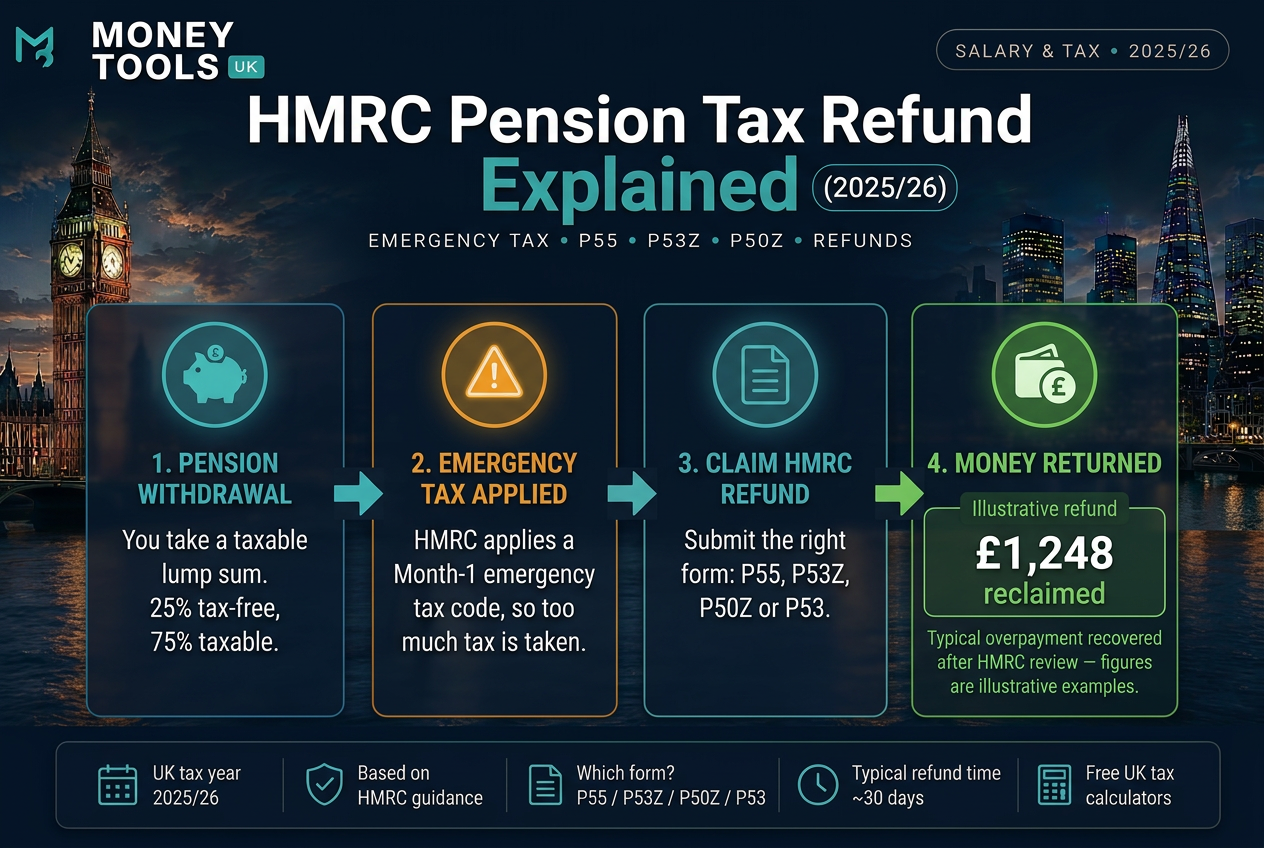
Why HMRC overtaxes pension withdrawals with emergency tax, how pension tax refunds work, and which form to use — P55, P53Z, P50Z or P53 — to reclaim overpaid tax for 2025/26.
Read guideDisclaimer: This content is for informational purposes only and should not be treated as financial, tax, mortgage, investment or legal advice.