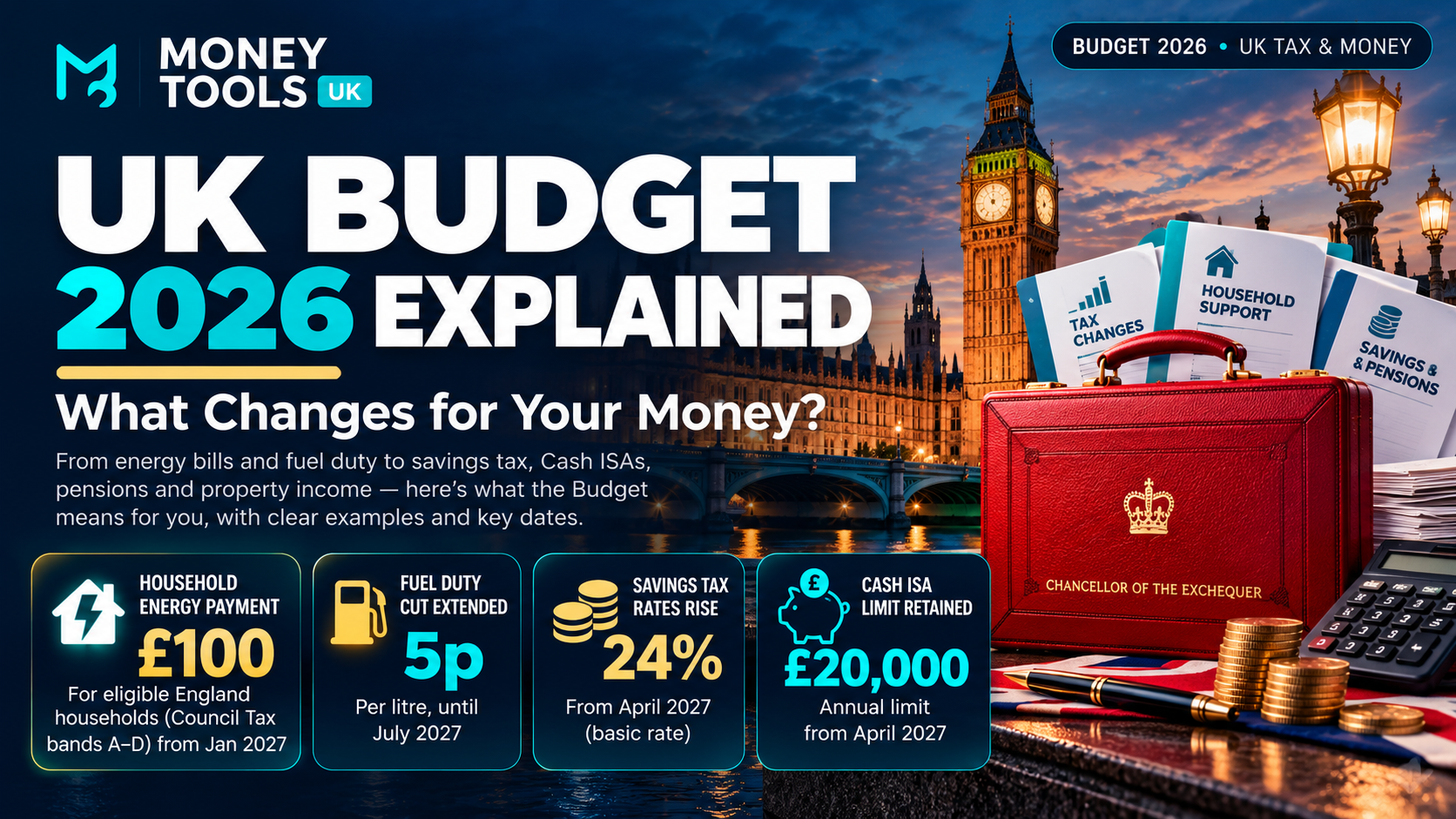
Household Energy Payment
£100
Fuel duty cut extended
5p
Savings basic rate from Apr 2027
24%
Cash ISA limit retained
£20,000
Energy bills, savings tax, Cash ISAs, fuel duty, pensions and property income: discover what the Autumn Budget means for your finances, when changes take effect and how much they could cost or save you.
The quick answer
The UK Budget 2026 brings new support for household energy costs, an extension of the fuel duty cut, higher future tax rates on savings and property income, and changes for pensioners, landlords, employees and self-employed workers.
Four announcements stand out:
- £100 household energy payment: Eligible households in England in Council Tax bands A–D are due to receive support from January 2027.
- Fuel duty: The existing 5p-per-litre reduction is extended through 30 June 2027.
- Savings tax: Basic-rate tax on taxable savings interest rises from 20% to 24% from 6 April 2027.
- Cash ISAs: The £20,000 annual subscription limit is retained.
But not everyone will be better off. Some households may receive additional support while also paying more tax on savings or rental income.
The most important question
Announcements, legislation and effective dates
Budget 2026 at a glance
- Household Energy Payment
- £100 for eligible England households in Council Tax bands A–D
- From January 2027
- Domestic electricity VAT
- Temporary 0% rate extended
- Until July 2027
- Fuel duty
- Existing 5p-per-litre cut extended
- Through 30 June 2027
- Savings income tax
- Basic 24%, higher 44%, additional 49%
- 6 April 2027
- Property income tax
- Basic 24%, higher 44%, additional 49%
- 6 April 2027
- Cash ISA
- £20,000 annual limit retained
- 2027/28
- Trading Allowance
- Increased from £1,000 to £3,000
- 6 April 2027
- Pension Tax Allowance
- Targeted relief for qualifying pensioners
- 6 April 2027
- Business mileage
- 55p for first 10,000 qualifying miles; 35p thereafter, with different effective dates
- 2026/27 and 2027/28
- Gas standing charges
- Planned abolition, with costs transferred to unit rates
- Target: end of 2027 or soon after
Money Tools UK key point
Income tax and take-home pay: will you pay more?
The headline rates of income tax on employment earnings remain unchanged for 2027/28 in England, Wales and Northern Ireland:
- Basic
- 20%
- Higher
- 40%
- Additional
- 45%
The standard Personal Allowance remains £12,570, subject to the usual eligibility rules.
For taxpayers with adjusted net income above £100,000, the Personal Allowance continues to reduce by £1 for every £2 above that threshold.
This creates the familiar effective 60% marginal income tax rate across part of the £100,000–£125,140 income range for taxpayers subject to the main rates.
Example: earning £110,000
Money Tools UK tip
What about Scotland?
Scottish income tax rates and bands for non-savings, non-dividend income are set separately. Readers in Scotland should use the applicable Scottish tax rules rather than assume the England, Wales and Northern Ireland table applies to their salary.
The £100 Household Energy Payment
One of the most immediate Budget announcements is a new £100 Household Energy Payment.
The government says qualifying households in England in Council Tax bands A–D will receive a £100 payment directly into their bank accounts from January 2027, delivered through the Council Tax system. This is not necessarily a credit against a Council Tax bill.
The measure is expected to support up to 20 million households.
Who could qualify?
The main announced eligibility condition is that the household is in an England Council Tax band A, B, C or D property.
However, detailed administration and eligibility arrangements should be checked with the relevant local authority as implementation approaches.
The government’s energy explainer says eligible households paying Council Tax by Direct Debit do not need to apply: the payment will go directly into their bank account. If you do not pay by Direct Debit, your council will invite you to apply. The announced criteria cover your main home, not second homes or empty properties; full eligibility criteria, including details for Council Tax-exempt households, remain to be published.
The government is also providing funding to devolved administrations, but that does not mean the same payment mechanism will automatically apply in Scotland, Wales or Northern Ireland.
Worked example: a £100 household payment
Important
Electricity VAT and gas standing charges
Electricity VAT relief extended
Budget 2026 announces a three-month extension of the temporary 0% VAT rate on qualifying domestic electricity supplies in Great Britain, described by Treasury as lasting “until July 2027”. The original relief was announced on 21 July 2026 for 1 October 2026 to 31 March 2027. The precise inclusive expiry of the extension should be confirmed against its implementing rules, rather than assumed to be 31 July. Other qualifying domestic fuels remain subject to 5% VAT.
The original relief excludes Northern Ireland. Treasury says comparable support is being funded there and expects extended VAT relief from April 2027; readers should check the final Northern Ireland arrangements.
The government estimates that the extension will reduce the annualised Ofgem price-cap figure in April 2027 by around £50.
That £50 is an estimated effect on a typical-consumption benchmark, not a guaranteed refund or a fixed reduction for every customer.
Actual bills depend on consumption, tariff, region and the period covered.
Will gas standing charges disappear?
The government has asked Ofgem to abolish domestic gas standing charges, targeting the end of 2027 or as soon as possible afterward.
Currently, a standing charge is paid daily regardless of how much gas a household consumes.
Under the proposed reform, the costs presently recovered through standing charges would instead be recovered through gas unit rates, with targeted mitigations. Final tariff design and implementation remain subject to Ofgem’s decisions.
That means the financial impact will depend on consumption.
Worked example: moving costs from standing charges to unit rates
This is a hypothetical illustration, not a prediction of Ofgem’s eventual tariff design. A household using less gas might benefit more. A household using more could face a different outcome.
Money Tools UK warning
Fuel duty and business mileage
Fuel duty: the 5p cut continues
The government has extended the existing temporary 5p-per-litre fuel duty reduction through 30 June 2027.
A planned increase from January 2027 has therefore been deferred.
The announced plan is to restore the pre-cut rates and apply Retail Prices Index uprating from 1 July 2027, subject to the required legislation.
This is not a new 5p cut at the petrol pump. It is an extension of an existing reduction.
Worked example: a driver buying 100 litres a month
Business mileage rates increase
A temporary 55p rate for the first 10,000 qualifying car or van business miles was announced in May 2026. Budget 2026 makes it permanent, with effect from 6 April 2026. The increase from 25p to 35p above 10,000 miles was announced on 27 October 2026 and takes effect from 6 April 2027.
- First 10,000 qualifying business miles: 55p per mile, applying from 6 April 2026.
- Qualifying business miles above 10,000: 35p per mile, applying from 6 April 2027.
The dates are different, and that distinction matters.
Worked example: 8,000 qualifying business miles
Savings tax rises — but Cash ISAs remain protected
One of the Budget’s most important changes for savers is an increase in income tax rates on taxable savings interest.
From 6 April 2027:
Budget 2025 had already announced savings rates of 22%, 42% and 47% from April 2027. Budget 2026 proposes a further two-percentage-point increase to 24%, 44% and 49%, UK-wide. This is four percentage points above the rates applying in 2026/27. The further changes are to be legislated for in Finance Bill 2026–27.
- Basic
- 20%
- 24%
- Higher
- 40%
- 44%
- Additional
- 45%
- 49%
Each rate increases by four percentage points compared with the 2026/27 rates.
This does not mean all savings interest becomes taxable. The Personal Savings Allowance, starting rate for savings where applicable, and ISA rules still matter.
Worked example: £1,000 of taxable savings interest
Assume a saver has £1,000 of interest that is fully taxable after relevant allowances.
- Taxable interest
- £1,000
- £1,000
- Applicable rate
- 20%
- 24%
- Income tax
- £200
- £240
Additional annual tax: £40. The example holds the taxable amount constant and isolates the year-to-year rate change. Compared with the 22% rate previously announced for 2027/28, the further Budget 2026 increase adds £20, not £40, on the same taxable interest.
Does the Personal Savings Allowance still matter?
Yes.
For example, someone whose savings interest is entirely covered by their applicable allowance would not pay savings income tax on that interest merely because the headline rates increase.
The new rates primarily matter where savings income is actually taxable.
What happens to Cash ISAs?
The government has retained the £20,000 annual Cash ISA subscription limit.
This means qualifying interest earned inside a Cash ISA remains sheltered from income tax under the applicable ISA rules.
This retains the current £20,000 cash limit and reverses the previously announced plan to reduce it to £12,000 for investors under 65 from April 2027. The overall ISA subscription limit remains £20,000. Implementing secondary legislation is scheduled for November 2026.
Money Tools UK tip
Landlords: property income tax increases
From 6 April 2027, separate property income tax rates will apply in England, Wales and Northern Ireland.
Budget 2025 had already announced separate property rates of 22%, 42% and 47% for April 2027. Budget 2026 proposes a further two-percentage-point increase to 24%, 44% and 49%, through Finance Bill 2026–27. The combined increase from the 2026/27 main rates is four percentage points.
- Basic
- 20%
- 24%
- Higher
- 40%
- 44%
- Additional
- 45%
- 49%
The increase could affect individual landlords receiving taxable rental profits.
Worked example: £10,000 taxable rental profit
Assume a landlord has £10,000 of taxable property income falling entirely within the relevant basic-rate band.
- Taxable rental profit
- £10,000
- £10,000
- Rate
- 20%
- 24%
- Income tax
- £2,000
- £2,400
Additional annual tax: £400. This example assumes the same taxable profit in both years and isolates the tax-rate change. Compared with the previously announced 22% rate, the further Budget 2026 increase adds £200 on that profit, not £400.
Actual liability may differ because of other income, allowable expenses, finance-cost relief, losses, property ownership arrangements and other relevant rules.
Why rental yield alone isn’t enough
Imagine two landlords each own a property generating the same annual rent. Their gross rental yields might be identical, but their after-tax cash flows can differ considerably because of:
- Mortgage interest and finance-cost relief.
- Repairs, insurance and management fees.
- Their other taxable income.
- Ownership through an individual or company structure.
- Applicable property income tax rates.
Money Tools UK tip
Side hustles and self-employment: the £3,000 Trading Allowance
The Trading Allowance will increase from £1,000 to £3,000 from 6 April 2027.
This is an announced Finance Bill 2026–27 measure, subject to legislation.
The associated trading income Self Assessment reporting threshold will also increase to £3,000 under the announced measure.
This could help people with small amounts of qualifying trading or miscellaneous income.
Worked example: £2,500 of qualifying trading receipts
However, the Trading Allowance is not necessarily the best option for someone with substantial allowable business expenses, and it does not override every other reporting or tax obligation.
Money Tools UK key point
Pensioners: a new Pension Tax Allowance
The Budget confirms the introduction of a targeted Pension Tax Allowance from 6 April 2027.
The policy is intended to prevent pensioners whose total income is no greater than the full new State Pension from facing small income tax liabilities solely because of State Pension uprating.
The allowance will apply during the 2027/28, 2028/29 and 2029/30 tax years.
How does it work?
The Pension Tax Allowance is a reduction in income tax liability, not an increase in the standard Personal Allowance. Its maximum value is 20% of the amount by which the full annual new State Pension exceeds the Personal Allowance, capped at the individual’s income tax liability.
Worked example: full new State Pension in 2027/28
For qualifying pensioners whose income exceeds the relevant State Pension amount, the allowance is gradually withdrawn.
The published withdrawal mechanism is £1 of tax reduction for every £3 of total income above the relevant full-State-Pension threshold. Treasury’s explainer states that no relief remains at total income of £13,319 or more in 2027/28.
The published guidance covers people above State Pension age and those reaching it during the tax year. Eligibility depends on total income, regardless of its source, and does not require receipt of State Pension. HMRC applies the relief automatically where eligible.
Detailed eligibility and withdrawal calculations remain subject to the implementing legislation and HMRC guidance.
Budget 2025 had already announced protection against small State Pension-only tax liabilities from April 2027. Budget 2026 develops that commitment into the Pension Tax Allowance. Its legislation is proposed for Finance Bill 2026–27; the explainer and tax information note are policy guidance, not enacted statutory wording.
This is different from:
- Tax relief on pension contributions.
- The pension annual allowance.
- Tax-free pension lump sums.
- Emergency tax refunds after pension withdrawals.
Readers should not assume that the new allowance removes income tax on all private pension income. If you have already been overtaxed on a withdrawal, our HMRC Pension Tax Refund guide explains how to reclaim it.
Pension death benefits: another change
The government has announced removal of the two-year deadline for tax-free pension and lump-sum death benefits where the member died before age 75. Qualifying payments will not become taxable solely because more than two years have passed since the scheme first knew, or could reasonably have been expected to know, of the death. The age and Lump Sum and Death Benefit Allowance conditions continue to apply, including for earlier deaths.
The change applies to qualifying payments made on or after 28 October 2026, subject to the legislation.
Other pension tax rules and conditions continue to apply.
Business owners, contractors and investors
The Budget includes several measures beyond household tax and bills.
Business Asset Disposal Relief
The lifetime limit on qualifying gains eligible for Business Asset Disposal Relief will fall from £1 million to £500,000 for qualifying disposals on or after 6 April 2027, through proposed Finance Bill 2026–27 legislation. Special rules apply to certain earlier contracts, reorganisations and exchanges.
This could matter to business owners planning to sell or dispose of a qualifying business.
It does not mean every business sale automatically becomes subject to the same tax treatment.
Capital allowances
The government has announced changes to capital allowances, including a 50% main-rate first-year allowance for qualifying expenditure incurred on or after 1 January 2027 and a reduction in the main writing-down allowance rate to 12% from 1 April 2027 for Corporation Tax and 6 April 2027 for Income Tax. These are proposed Finance Bill 2026–27 measures, not a replacement for every other capital-allowance regime.
Businesses should check which assets, structures and expenditure qualify before incorporating these rates into investment decisions.
Making Tax Digital and tax administration
The government is continuing to modernise digital tax reporting.
The existing Making Tax Digital for Income Tax timetable starts on 6 April 2026 for qualifying income above £50,000, 6 April 2027 above £30,000 and 6 April 2028 above £20,000. Qualifying income is combined gross self-employment and property income before expenses, not taxable profit. Exemptions and HMRC’s eligibility rules still apply.
Some changes concern future reporting and payment processes rather than an immediate change in tax rates.
VAT e-invoicing and proposed Self Assessment payment-process changes are separate from this existing Making Tax Digital timetable. Readers should check the relevant official implementation guidance rather than infer a new deadline or a postponement from this Budget summary.
Businesses should avoid confusing a proposed administrative change with a new tax liability.
Worked examples: who gains and who pays more?
The examples below illustrate selected Budget measures separately. They do not represent complete household tax calculations.
Example A: household receiving energy support
An eligible England household in Council Tax band C receives the announced £100 payment.
Illustrative direct support: £100.
The household may also benefit from the electricity VAT extension, but the exact bill effect depends on consumption and tariff.
Example B: basic-rate saver
A saver has £1,000 of fully taxable interest after allowances.
- 2026/27
- £200
- 2027/28
- £240
Difference: £40 more tax annually.
Example C: individual landlord
A landlord has £10,000 of taxable rental profit wholly within the relevant basic-rate band.
- 2026/27
- £2,000
- 2027/28
- £2,400
Difference: £400 more tax annually.
Example D: a household affected by several measures
Suppose an eligible household receives £100 in energy support. One member also has £1,000 of taxable savings interest at the basic rate, producing £40 additional tax from April 2027.
Keep the amounts in separate periods:
One-off support and recurring tax
These measures occur in different periods. Their arithmetic difference is not a single-year Budget gain or a forecast of the household’s overall position.
A genuine household comparison must align tax years, eligibility, consumption and all relevant measures.
Money Tools UK warning
What hasn’t changed?
Several important elements of the tax system remain in place.
- The standard Personal Allowance remains £12,570.
- The main rates of income tax on employment earnings remain 20%, 40% and 45% for England, Wales and Northern Ireland.
- The overall ISA subscription limit remains £20,000.
- The pension annual allowance remains £60,000, subject to the usual conditions and restrictions.
- The Personal Savings Allowance continues to be relevant when calculating taxable savings interest.
These unchanged rules can still have financial consequences.
For example, fixed tax thresholds can increase the proportion of earnings exposed to higher rates as salaries rise.
Key point
What should you do following Budget 2026?
For employees
Check your expected take-home pay for the relevant tax year and understand how pension contributions and other income affect your tax position. The Take-Home Pay Calculator can explain deductions using its available 2024/25 and 2025/26 rules. It does not model Budget 2026 or 2027/28 changes.
For savers
Estimate how much interest you will earn outside ISAs and whether it exceeds your applicable tax-free allowances.
For landlords
Recalculate projected after-tax cash flow for 2027/28 rather than relying only on gross rental yield.
For self-employed workers
Review whether the higher Trading Allowance may apply, while checking whether actual-expense deductions are more beneficial.
For pensioners
Check eligibility for the new Pension Tax Allowance when the detailed implementation rules become available.
For households
Confirm the eligibility and delivery arrangements for the £100 energy payment, and compare energy tariffs based on total expected cost rather than standing charges alone. The Budget Planner can help you map the effect on your monthly household budget.
For everyone
Keep an eye on the effective dates. Measures announced in October 2026 do not all begin in October 2026.
Sources & references
Reviewed against official publications on 28 October 2026 and rechecked on 29 October 2026. Budget documents establish announcements; they do not by themselves establish enacted legislation or final delivery rules. Detailed pension eligibility and withdrawal calculations, full energy-payment eligibility criteria and the precise inclusive expiry of the electricity VAT extension remain subject to implementing rules and guidance.
- HM Treasury — Budget 2026 document
- Department for Energy Security and Net Zero — Budget 2026 energy measures and payment process
- HMRC — Budget 2026 Overview of Tax Legislation and Rates
- HMRC — Annex A: Rates and Allowances
- HM Treasury — Pension Tax Allowance Explainer
- HMRC — Reduction in Income Tax for eligible pensioners (TIIN)
- HM Treasury — Pension death benefits: letter to Parliament
- HMRC — Budget 2025 savings and property tax technical note
- HMRC — Earlier Cash ISA announcement (November 2025)
- HMRC — Increasing the Trading Allowance (TIIN)
- HMRC — Original domestic electricity VAT relief (not the extension)
- HMRC — Understanding Making Tax Digital for Income Tax
- HM Treasury — Budget 2026 supporting documents
How we calculate the examples
Our examples are illustrative and generally hold income or consumption constant so readers can see the effect of one specific measure.
They do not include every allowance, relief, deduction, threshold interaction or change in personal circumstances.
Where a government announcement involves a future implementation process, we distinguish the announcement from the final operating rules.
Article update history
- 29 October 2026
- First published. Checked against HM Treasury and HMRC Budget 2026 publications.
This article will be reviewed when relevant legislation, HMRC guidance, Ofgem decisions or other official implementation details change.
The Money Tools UK verdict
Budget 2026 offers immediate support to some households while increasing future tax liabilities for certain savers and landlords.
The £100 Household Energy Payment and extended fuel-duty reduction may provide welcome relief, but the longer-term tax changes could be more important for people with significant savings interest or rental profits.
For self-employed workers, the increased Trading Allowance may simplify tax obligations. For pensioners, the new Pension Tax Allowance offers targeted protection.
The bottom line
Whether Budget 2026 leaves you better or worse off depends on your individual finances — and on when each measure takes effect. Rather than relying on a single headline, examine your household income, allowances, bills, savings and investments together.
Get new UK finance and property guides from Money Tools UK
Plain-English UK finance insights, tax updates and property investing guides.
Related calculators
Take-Home Pay Calculator
Compare salary deductions using the calculator’s available 2024/25 and 2025/26 rules, not Budget 2026 or 2027/28 changes.
Open calculatorBudget Planner
Plan household income and spending. Enter one-off support separately from recurring monthly amounts.
Open calculatorRental Yield Calculator
Compare rent with property cost. Rental yield is not a personal income tax calculation.
Open calculatorBuy-to-Let ROI Calculator
Explore investment costs and returns using its stated assumptions, not a Budget 2026 or 2027/28 personal tax model.
Open calculatorFrequently asked questions
Related guides
More flagship guides and tools from Money Tools UK.
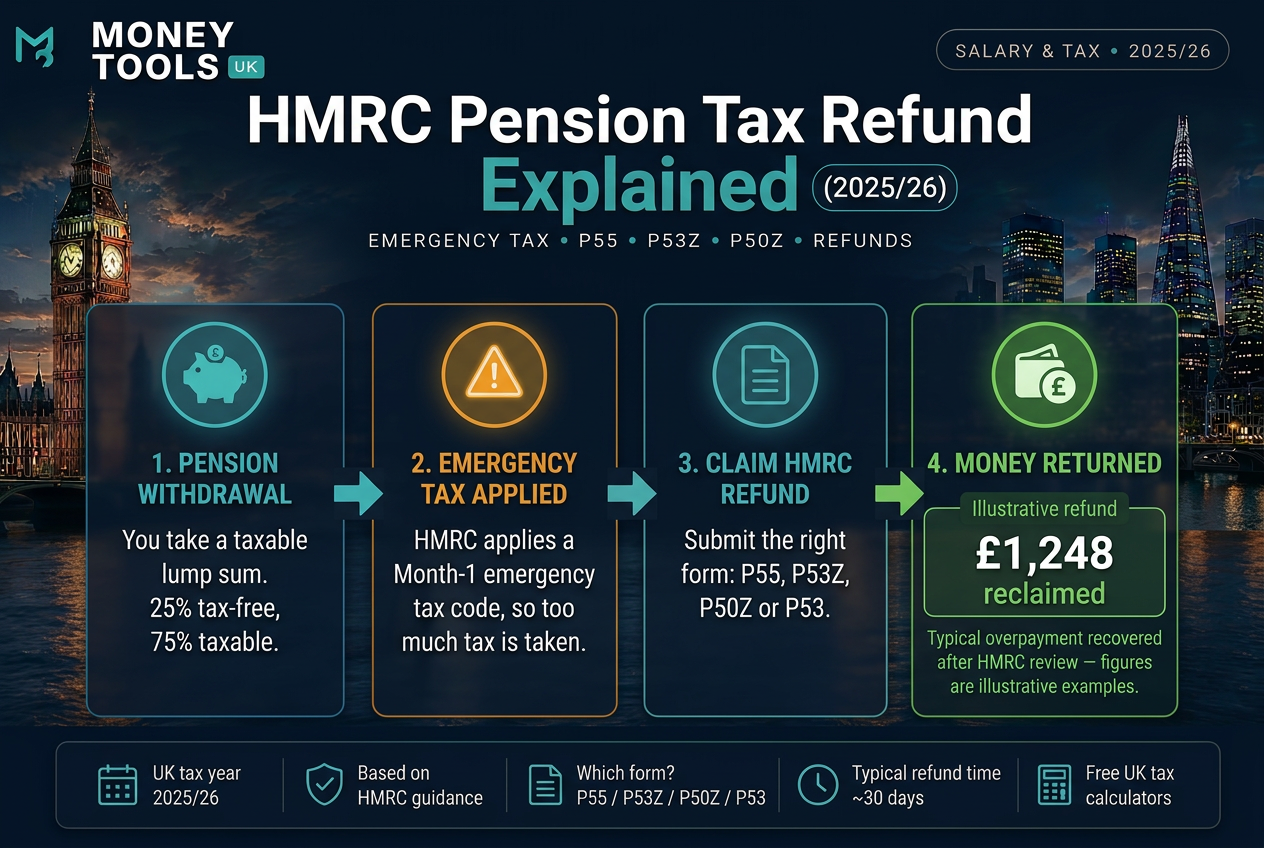
Why HMRC overtaxes pension withdrawals with emergency tax, how pension tax refunds work, and which form to use — P55, P53Z, P50Z or P53 — to reclaim overpaid tax for 2025/26.
Read guide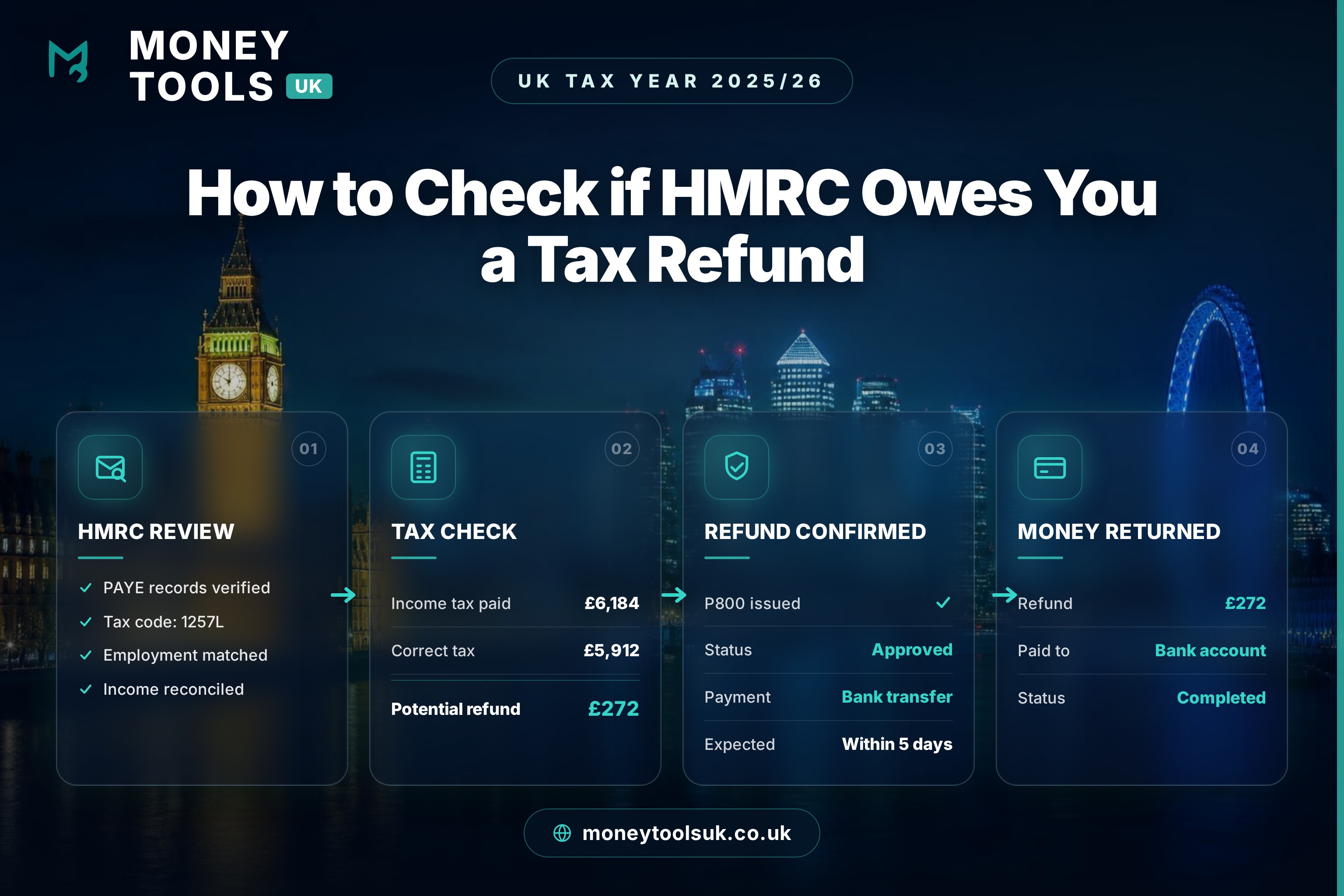
A plain-English UK guide to checking if HMRC owes you a tax refund: why overpayments happen, how to use your Personal Tax Account, P800 and Simple Assessment, when refunds are automatic, how to claim, and how to avoid tax refund scams.
Read guide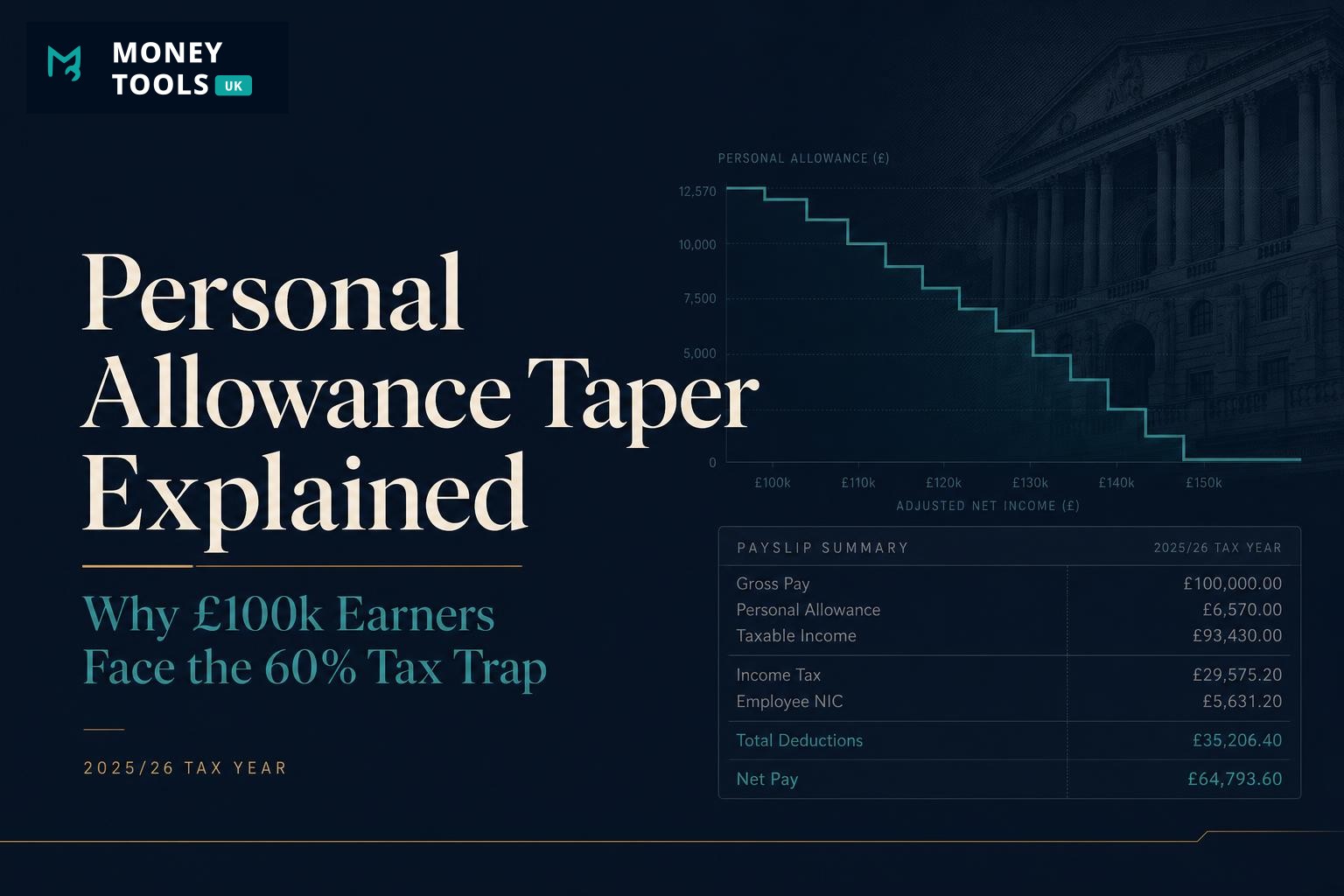
Understand the personal allowance taper for 2025/26. Learn why income between £100,000 and £125,140 is taxed at an effective 60% marginal rate, how adjusted net income works, and how salary sacrifice and pension contributions can restore your lost allowance.
Read guideDisclaimer: This content is for informational purposes only and should not be treated as financial, tax, mortgage, investment or legal advice.