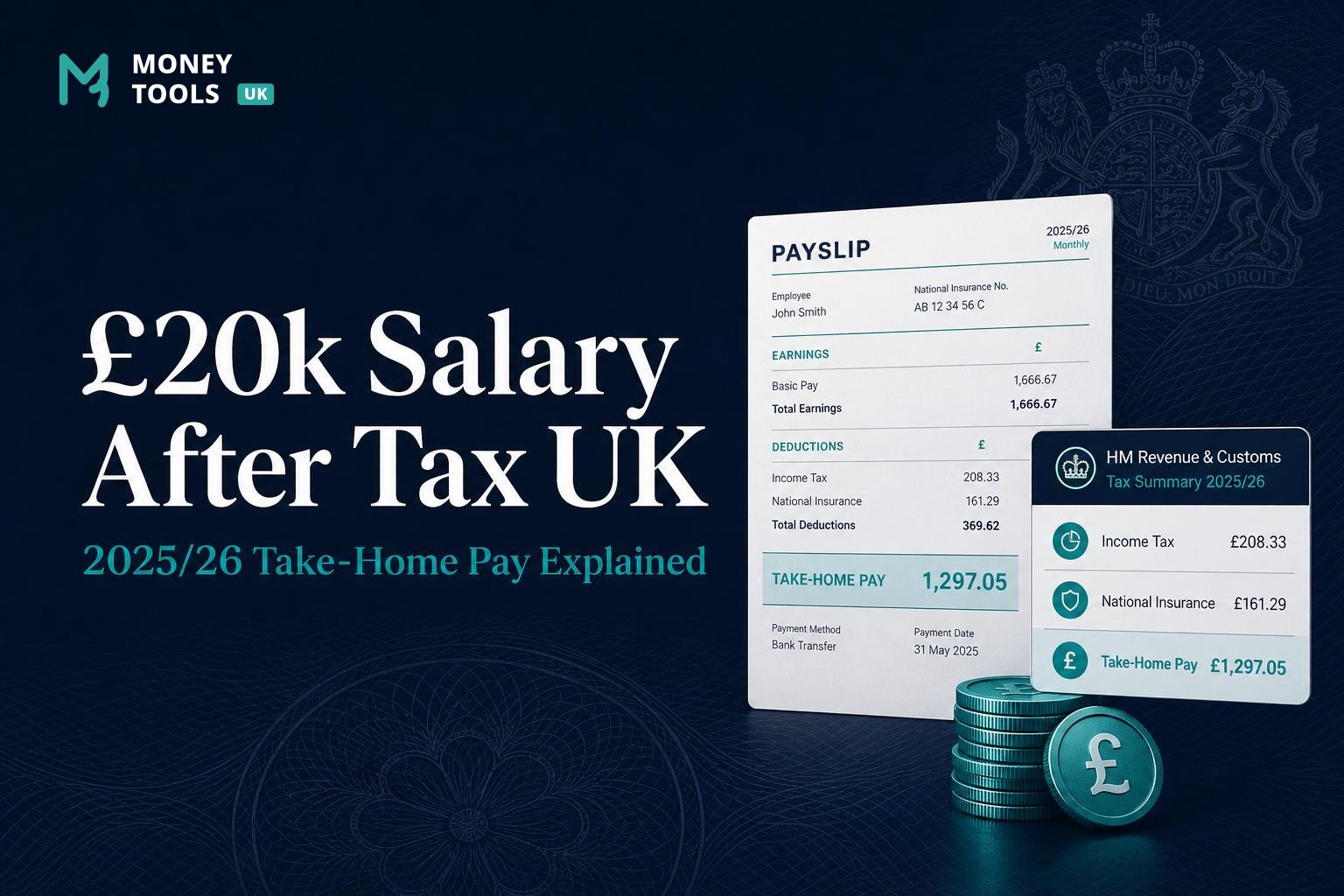
A £20,000 salary sits comfortably within the UK basic-rate tax band and attracts relatively little income tax compared with higher salaries. In this guide we'll break down exactly how much take-home pay you receive in the 2025/26 tax year after income tax, National Insurance, pension contributions and student loan deductions.
One thing catches almost everyone out: your gross salary is not your take-home pay. A £20,000 job offer sounds like £1,667 a month, but Income Tax and National Insurance take a slice before the money lands in your account. The good news is that at £20k those deductions are modest — you keep almost 90p of every pound you earn.
Quick takeaway
Updated for 2025/26
The short answer
The short answer
Annual Take-Home
£17,920
Estimated annual net pay
Monthly Take-Home
£1,493
Approximate monthly pay
Weekly Take-Home
£345
Approximate weekly pay
Effective Tax Rate
10.4%
Effective Income Tax + NI rate
Figures assume standard PAYE employment with no pension or student loan deductions.
How a £20,000 salary is taxed in 2025/26
For 2025/26, the UK income tax thresholds (England, Wales and Northern Ireland) remain frozen. The personal allowance is £12,570 — you pay no income tax on this slice at all. The basic-rate band then runs from £12,570 up to £50,270, taxed at 20%. A £20,000 salary sits well inside the basic-rate band, so every pound of taxable income is charged at just 20% — there's no higher-rate tax to worry about.
Because more than 60% of your salary is either tax-free (the personal allowance) or taxed at the lowest 20% rate, £20k is one of the most lightly taxed full-time salaries in the UK. This is deliberate: the tax system is progressive, so lower earners keep a much larger share of their pay than those in the higher- and additional-rate bands.
Income tax on £20,000
Your taxable income is gross salary minus the personal allowance:
- Taxable income: £20,000 − £12,570 = £7,430
- Basic rate (20%): £7,430 × 20% = £1,486
- Higher rate (40%): £0 — you're £30,270 below the higher-rate threshold
That's £1,486 in income tax for the year, or about £124 a month deducted via PAYE.
National Insurance on £20,000
Employee Class 1 National Insurance for 2025/26 is 8% on earnings between the primary threshold of £12,570 and the upper earnings limit of £50,270. On a £20,000 salary:
- NI'able earnings: £20,000 − £12,570 = £7,430
- NI at 8%: £7,430 × 8% = £594
So you'll pay around £594 in National Insurance across the year — roughly £50 a month.
Putting it together: £20,000 − £1,486 income tax − £594 NI = £17,920 net pay a year, or about £1,493 a month.
Monthly and weekly take-home pay
Here is the full picture for a £20,000 gross salary in 2025/26 with no pension or student loan deductions:
| Gross salary | £20,000 / year |
|---|---|
| Income tax | −£1,486 / year |
| National Insurance | −£594 / year |
| Annual take-home | £17,920 / year |
| Monthly take-home | £1,493 / month |
| Weekly take-home | £345 / week |
Note that monthly and weekly figures are simple averages (annual ÷ 12 and annual ÷ 52). Your actual payslip may vary by a few pounds month to month because PAYE applies your allowances on a cumulative basis, and a non-standard tax code will change the numbers.
See your own number in seconds
Use the Money Tools UK Take-Home Pay Calculator to calculate your exact take-home pay including pension contributions, student loans, bonuses and salary sacrifice arrangements.
£20k take-home with pension contributions
Under auto-enrolment, most employees contribute at least 5% of qualifying earnings while the employer adds at least 3%. How that affects your take-home depends on whether your scheme uses relief at source or salary sacrifice.
Relief at source (the most common setup)
With relief at source, your contribution comes from your net pay and HMRC tops it up by 20%. A 5% contribution on £20k is £1,000/year, reducing your take-home to around £16,920/year (~£1,410/month) — but £1,250 lands in your pension once the basic-rate top-up is added. You're effectively saving for retirement at a 20% discount.
Salary sacrifice
If your employer offers salary sacrifice, you give up £1,000 of gross salary in exchange for a £1,000 pension contribution. Because the sacrifice happens before tax and National Insurance, you also save the 8% NI. Your take-home cash lands at around £17,200/year (~£1,433/month) for the same £1,000 going into your pension — roughly £280/year more in your pocket than relief at source. Read our Salary Sacrifice Explained guide to see how the savings work in detail.
The one drawback to watch
£20k take-home with a student loan
Student loan repayments are 9% (6% for Postgraduate Loans) of income above a plan-specific threshold. At £20,000, your salary is below — or only just above — most repayment thresholds, so deductions are often minimal or zero:
- Plan 1 (threshold £26,065): £20k is below the threshold → £0.
- Plan 2 (threshold £28,470): below threshold → £0.
- Plan 4 (Scotland, threshold £32,745): below threshold → £0.
- Plan 5 (threshold £25,000): below threshold → £0.
- Postgraduate Loan (threshold £21,000, 6%): below threshold → £0.
In other words, on a £20,000 salary you'll typically repay nothing towards your student loan in 2025/26 — every plan's threshold is at or above your earnings. Repayments only begin once your income rises above the relevant threshold, and even then they're calculated only on the amount above it.
Full payslip comparison at £20k
Here's how the most common scenarios compare side by side for a £20,000 gross salary in 2025/26:
| Scenario | Annual take-home | Monthly take-home |
|---|---|---|
| No pension, no student loan | £17,920 | £1,493 |
| 5% pension (relief at source) | £16,920 | £1,410 |
| Plan 2 student loan | £17,920 | £1,493 |
| 5% salary sacrifice pension | £17,200 | £1,433 |
| 5% pension + student loan | £16,920 | £1,410 |
Because no student loan plan deducts anything at £20k, the "student loan" rows match their no-loan equivalents — a useful reminder that repayments are tied to earnings, not to having a loan.
Is £20k enough to live on in the UK?
£1,493 a month after tax has to cover rent, bills, food, transport and any savings. Whether that feels comfortable or tight depends heavily on where you live and whether costs are shared.
Living outside London and shared housing
Outside London and the South East — in much of the North, Midlands, Wales and Scotland — £20k can cover essential living costs for a single person, particularly in shared accommodation. A room in a house share typically costs £400–£600/month in these regions, leaving room for bills and modest spending. In London and other high-cost cities, £20k is genuinely stretched and almost always means flat-sharing.
A typical monthly budget
- Rent (room in a shared house): £450–£650
- Utilities, council tax share, broadband, mobile: £150–£280
- Food and household: £200–£280
- Transport: £60–£150 (a regional bus or rail pass; far more in London)
- Everything else and savings: whatever remains — often £100–£300
Regional differences are stark. The same £20k that feels manageable in Newcastle, Hull or Belfast can feel impossible in inner London once rent and travel are paid. Budgeting carefully, claiming any benefits you're entitled to, and capturing employer pension matching all make a meaningful difference at this income level.
Benefits and support available on a £20k salary
A £20,000 salary does not automatically prevent you from receiving state support. Eligibility depends on your household circumstances, rent, savings and family situation — not on gross pay alone.
Universal Credit
Some workers on £20k still qualify for Universal Credit, particularly renters, parents and single-income households. The taper rate means your award reduces gradually as earnings rise, but a top-up can remain significant once housing costs and children are factored in.
Child Benefit
You can claim Child Benefit at £20,000 without any income-related charge — the High Income Child Benefit Charge only begins above £60,000. For a family with two children this is worth roughly £1,900 a year tax-free.
Council Tax Reduction
Some local authorities offer Council Tax Reduction for lower-income households, even if you are working. Rules and amounts vary by council, so it is worth checking your specific local authority scheme rather than assuming you do not qualify.
Free childcare support
Eligible working parents can receive up to 15 or 30 hours of free childcare per week for qualifying ages, depending on income thresholds and working hours. At £20k you are well inside the qualifying range if you meet the minimum hours requirement.
Help to Save
If you receive Working Tax Credit or Universal Credit, the government’s Help to Save scheme gives you a 50% bonus on savings up to £50 a month over four years — a powerful way to build a safety net on a modest salary.
Workplace pension contributions
Remaining enrolled in your workplace pension is valuable even when take-home pay feels tight. You receive tax relief on your contributions and free employer matching, which is effectively a pay rise you would otherwise forfeit.
Check before you assume
Common mistakes people make at £20k
- Opting out of the workplace pension. Leaving auto-enrolment to boost take-home throws away free employer contributions and 20% tax relief — one of the worst long-term money decisions at any salary.
- Not claiming Marriage Allowance. If you earn under the personal allowance or your partner does, one of you can transfer £1,260 of allowance — worth up to £252/year.
- Missing Universal Credit support. Many people on £20k, especially with children or high rent, are entitled to top-up support but never check.
- Not checking your tax code. An incorrect code is a common cause of overpaying. Compare yours against the standard 1257L and query anything unusual with HMRC.
- Assuming student loans always apply. At £20k you're below every repayment threshold, so nothing should be deducted — if it is, query it.
How to legitimately keep more of your £20k
- Capture every penny of employer pension matching. It's the highest guaranteed return you'll ever get on your money.
- Claim Marriage Allowance where eligible — up to £252/year for couples where one partner earns below the personal allowance.
- Use tax-free savings. An ISA shelters interest and growth from tax, and a Lifetime ISA adds a 25% government bonus if you're saving for a first home.
- Use budgeting tools. Planning around your real monthly net figure — about £1,493 — makes irregular costs and savings far easier to manage.
- Make the most of employer benefits. Cycle-to-work, season-ticket loans, discount schemes and salary sacrifice (where offered) cut costs on things you'd buy anyway.
The single most powerful step is simply knowing your real number. You can calculate your exact take-home pay — including pension contributions, student loans, bonuses and salary sacrifice — in seconds.
Calculate your exact £20k take-home pay
Use the UK Take-Home Pay Calculator to include:
- pension contributions
- student loans (Plan 1, 2, 4, 5 and Postgraduate)
- bonuses
- side hustle income
- salary sacrifice
Related guides
- £30k Salary After Tax UK — the next major milestone, still fully inside the basic-rate band.
- £35k Salary After Tax UK — see how take-home pay changes at £35,000 and compare income tax, National Insurance, pension contributions and monthly net pay.
- £40k Salary After Tax UK — comfortably above the median wage and a common pay packet.
- £50k Salary After Tax UK — understand take-home pay at the higher end of the basic-rate tax band before higher-rate tax begins.
- £60k Salary After Tax UK — explore how take-home pay changes once earnings move above £60,000 and how pension planning becomes increasingly valuable.
- Salary Sacrifice Explained — how to cut tax and NI while boosting your pension.
- Salary to Hourly Calculator — work out what £20k is per hour, day and week.
Sources & references
This guide references current HMRC and GOV.UK guidance for the 2025/26 UK tax year.
- HMRC — Income Tax rates and Personal Allowances
- HMRC — National Insurance: how much you pay
- GOV.UK — Repaying your student loan: what you pay
- HMRC — PAYE rates and thresholds for employers 2025 to 2026
Last updated
This article was last reviewed on 16 June 2026 and reflects the UK tax thresholds, National Insurance rates and student loan plans confirmed for the 2025/26 tax year. We refresh this guide each time HMRC publishes a material change.
Disclaimer
Money Tools UK provides educational content and calculators only. The figures above are estimates based on standard 2025/26 UK tax rules for England, Wales and Northern Ireland (with Scottish rates noted where relevant) and assume a single PAYE employment and a standard 1257L tax code. They do not account for benefits in kind, taxable expenses, pension annual-allowance limits, or personal circumstances that may change your actual liability. For regulated tax or financial advice, please speak to a qualified accountant or independent financial adviser.
Get new UK finance and property guides from Money Tools UK
Plain-English UK finance insights, tax updates and property investing guides.
Related Salary Guides
Explore nearby salary levels to compare take-home pay, Income Tax, National Insurance, student loan deductions and pension contributions.
Related calculators
UK Take-Home Pay Calculator
The exact calculator this article is built around — open it and run your own numbers.
Open calculatorFrequently asked questions
Related guides
More flagship guides and tools from Money Tools UK.
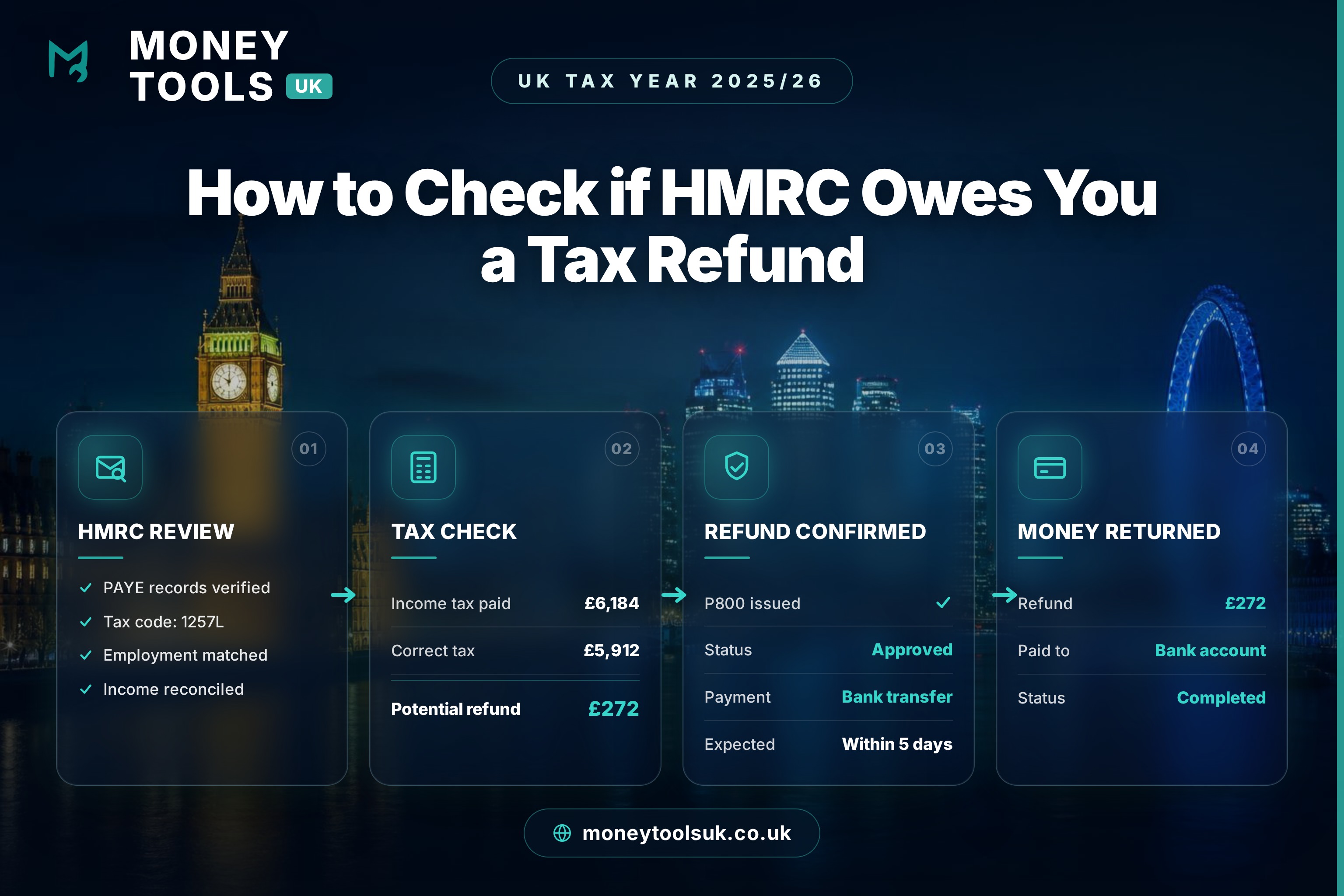
A plain-English UK guide to checking if HMRC owes you a tax refund: why overpayments happen, how to use your Personal Tax Account, P800 and Simple Assessment, when refunds are automatic, how to claim, and how to avoid tax refund scams.
Read guide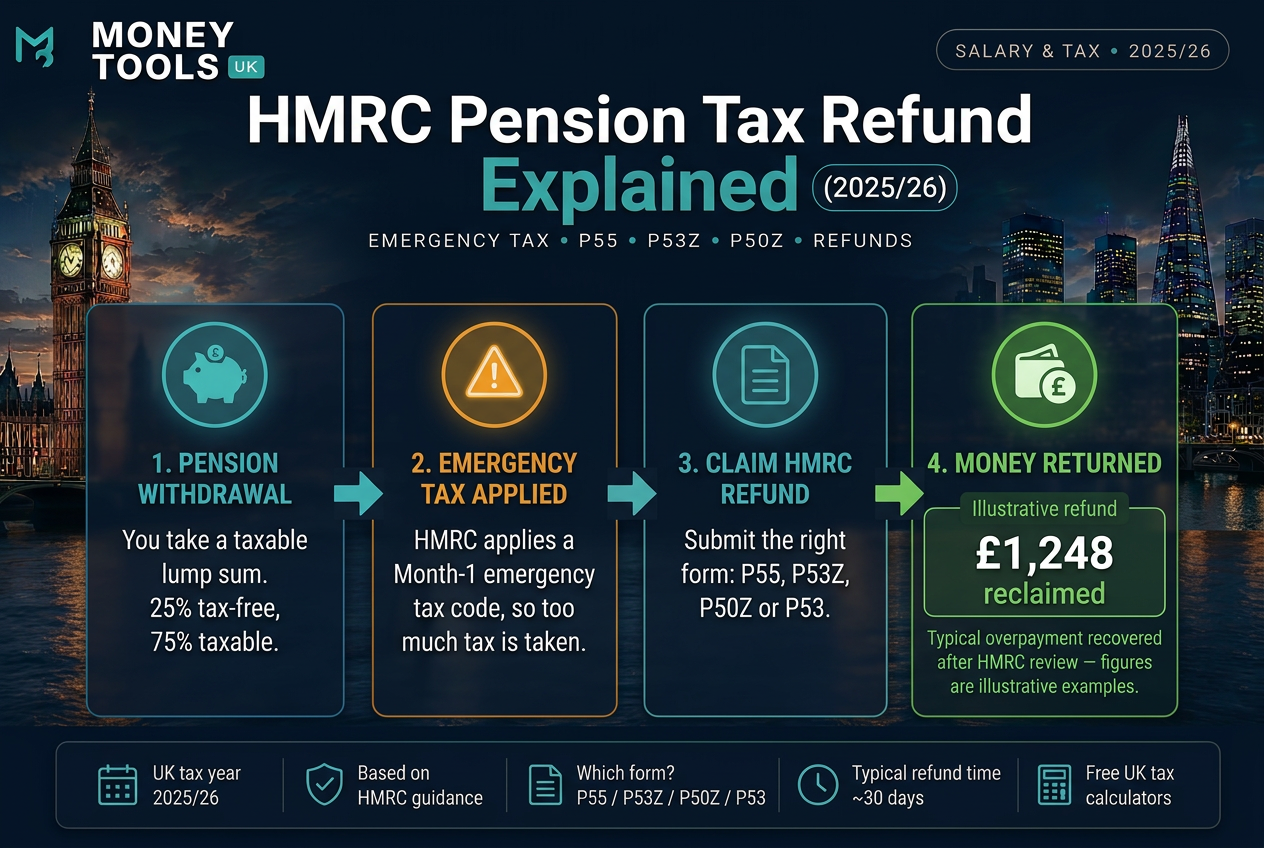
Why HMRC overtaxes pension withdrawals with emergency tax, how pension tax refunds work, and which form to use — P55, P53Z, P50Z or P53 — to reclaim overpaid tax for 2025/26.
Read guide
Learn how UK company car tax works in 2025/26, including Benefit-in-Kind tax, P11D value, CO2 emissions, electric cars, fuel benefit and salary sacrifice examples.
Read guideDisclaimer: This content is for informational purposes only and should not be treated as financial, tax, mortgage, investment or legal advice.