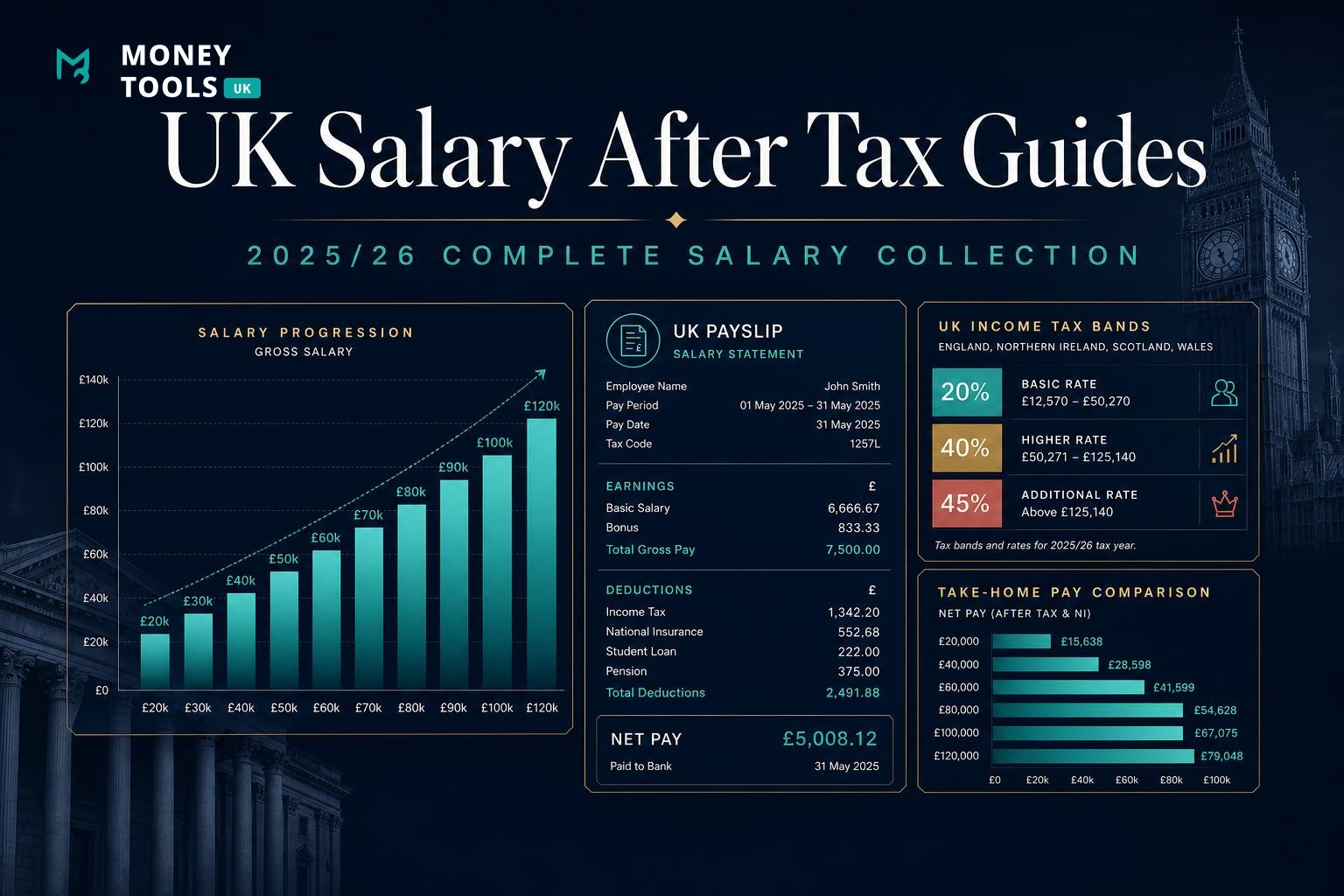
UK Salary After Tax Guides
2025/26 Complete Salary Collection
The central resource centre for every Money Tools UK salary after tax guide — compare take-home pay, Income Tax, National Insurance, student loans and pension contributions across salary levels.
Most popular guides
Start with the guides most commonly used by UK employees and higher earners.
£50k Salary After Tax UK
Understand the higher-rate tax threshold and take-home pay on £50,000.
Read guide£60k Salary After Tax UK
See why Child Benefit and tax planning matter most around £60,000.
Read guideSalary Sacrifice Explained
How sacrificing salary into your pension cuts Income Tax and National Insurance.
Read guideChild Benefit Tax Charge Explained
How the High Income Child Benefit Charge works and how to reduce or avoid it.
Read guideUK salary after tax guides
A complete breakdown of tax, deductions and take-home pay at every salary level for 2025/26.
Not sure where to start?
Most UK employees earn between £30,000 and £40,000 per year. Start with the salary guide closest to your income and then explore related tax-planning articles to discover ways to improve your take-home pay.
Entry-level and lower salaries
£30k Salary After Tax UK
See how Income Tax, National Insurance and student loan deductions affect a £30,000 salary.
Read guide£35k Salary After Tax UK
A detailed breakdown of tax and take-home pay on a £35,000 salary.
Read guideMiddle-income salaries
£50k Salary After Tax UK
Understand the higher-rate tax threshold and take-home pay on £50,000.
Read guide£60k Salary After Tax UK
Learn how Child Benefit and tax planning become increasingly important at £60,000.
Read guideHigher-income salaries
£80k Salary After Tax UK
Understand take-home pay, tax planning and salary sacrifice opportunities at £80,000.
Read guideHigh-earner salaries
£120k Salary After Tax UK
Learn how adjusted net income and pension planning can significantly affect your tax position.
Read guideAbout this collection
Understand exactly what lands in your bank account
Understanding your take-home pay is one of the most important aspects of personal finance. Whether you're considering a pay rise, comparing job offers, planning pension contributions or simply trying to understand your payslip, knowing how much tax and National Insurance you pay can help you make better financial decisions.
This hub brings together all Money Tools UK salary after tax guides for the 2025/26 tax year. Each guide explains Income Tax, National Insurance, student loan deductions, pension contributions, take-home pay, effective tax rates and tax planning opportunities — in plain English.
Looking for another salary level?
Browse all UK Salary After Tax Guides in one place.
Popular tax planning guides
Go deeper on the rules and reliefs that shape your take-home pay at higher incomes.
Related calculators
Run your own numbers with our free, HMRC-aligned 2025/26 calculators.
Take-Home Pay Calculator
Work out net pay after Income Tax, National Insurance, pension and student loan.
Open calculatorSalary to Hourly Calculator
Convert an annual UK salary into an equivalent hourly rate.
Open calculatorHourly to Salary Calculator
Work an hourly rate up into a full-time equivalent salary.
Open calculatorComing soon
- Adjusted Net Income Calculator
- Child Benefit Calculator
- Personal Allowance Taper Calculator
Frequently asked questions
Sources & references
Looking for another salary level?
Browse all UK Salary After Tax Guides in one place.
Last updated: 15 June 2026
Disclaimer: This content is for informational purposes only and should not be treated as financial, tax, mortgage, investment or legal advice. Figures are estimates based on published 2025/26 HMRC thresholds and may vary depending on individual circumstances.