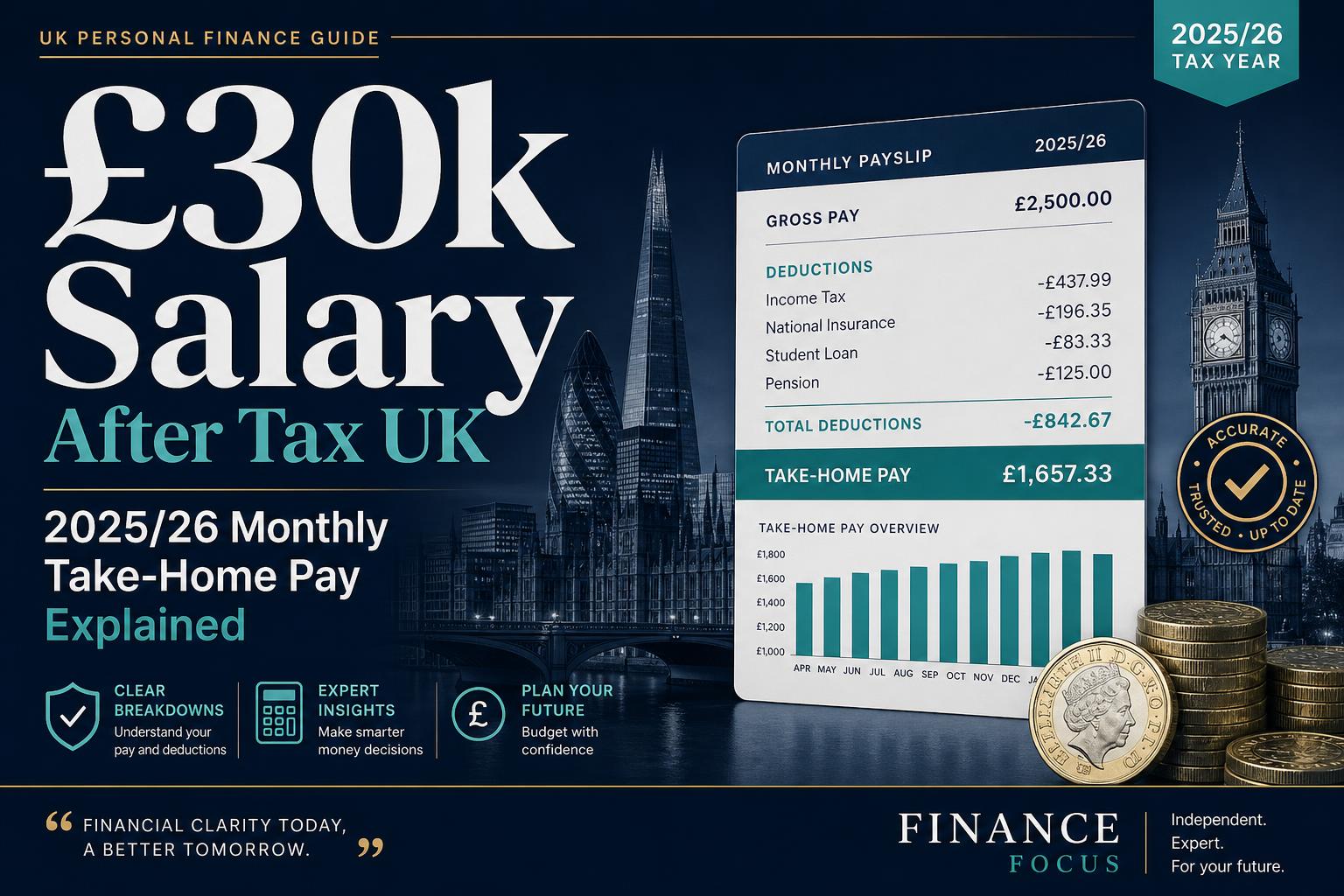
A £30,000 salary is one of the most common pay packets in the UK — close to the typical full-time wage for younger workers and those in the early-to-mid stages of their career. It's firmly inside the basic-rate tax band, and it's the salary level at which most people start thinking seriously about budgeting, building savings and getting onto the property ladder. In this guide we'll show exactly what £30k looks like on your payslip in the 2025/26 tax year, how much actually reaches your bank account each month, and how pensions and student loans reshape that figure.
One thing catches almost everyone out: your gross salary is not your take-home pay. A £30,000 job offer sounds like £2,500 a month, but Income Tax and National Insurance take a meaningful slice before the money ever lands in your account. Knowing the real number is the first step to budgeting with confidence.
Updated for 2025/26
The short answer
The short answer
Annual Take-Home
£25,120
Estimated annual net pay
Monthly Take-Home
£2,093
Approximate monthly pay
Weekly Take-Home
£483
Approximate weekly pay
Effective Tax Rate
16.3%
Effective Income Tax + NI rate
Figures assume standard PAYE employment with no pension or student loan deductions.
How a £30,000 salary is taxed in 2025/26
For 2025/26, the UK income tax thresholds (England, Wales and Northern Ireland) remain frozen. The personal allowance is £12,570 — you pay no income tax on this slice at all. The basic-rate band runs from £12,570 up to £50,270, taxed at 20%. A £30,000 salary sits comfortably inside the basic-rate band, so every pound of taxable income is charged at just 20%.
National Insurance works in a similar way. You pay no NI on the first £12,570, then 8% on earnings between £12,570 and £50,270. At £30,000 you're well below the upper threshold, so all of your NI is at the main 8% rate. Add the two together and the maths is refreshingly simple.
Income tax on £30,000
Your taxable income is gross salary minus the personal allowance: £30,000 − £12,570 = £17,430. All of that sits inside the basic-rate band:
- Basic rate (20%): £17,430 × 20% = £3,486
- Higher rate (40%): £0 — you're £20,270 below the higher-rate threshold
That's £3,486 in income tax for the year, or about £291 a month deducted via PAYE.
National Insurance on £30,000
Employee Class 1 National Insurance for 2025/26 is 8% on earnings between £12,570 and £50,270. On a £30,000 salary:
- NI'able earnings: £30,000 − £12,570 = £17,430
- NI at 8%: £17,430 × 8% = £1,394
So you'll pay around £1,394 in National Insurance across the year — roughly £116 a month.
Putting it together: £30,000 − £3,486 income tax − £1,394 NI = £25,120 net pay a year, or about £2,093 a month.
See your exact £30k take-home in seconds
Run your salary, pension, student loan and bonus through the UK Take-Home Pay Calculator for a full payslip-style breakdown.
Monthly take-home pay examples
Your real monthly figure depends on what comes off your payslip alongside tax and NI. Here's how £30,000 looks under the most common scenarios for 2025/26:
- No pension, no student loan: £25,120/year → £2,093/month
- 5% pension (relief at source): ~£23,620/year → ~£1,968/month
- 5% workplace pension (salary sacrifice): ~£24,040/year → ~£2,003/month
- Plan 2 student loan: ~£24,983/year → ~£2,082/month
- Postgraduate loan: ~£24,580/year → ~£2,048/month
What does £30k look like in real life?
£2,093 a month after tax has to cover rent or mortgage, bills, food, transport and any savings you make outside payroll. Whether that feels comfortable or tight depends almost entirely on where you live and whether you're supporting anyone else.
Renting
The conventional "30% of net pay" guideline suggests a sustainable rent budget of around £625/month on £30k. That comfortably covers a room in a shared house almost anywhere, or a one-bed flat in much of the North, Midlands, Wales and Scotland — but barely a room-share in inner London, where rents routinely exceed £900/month for a single room.
Utility bills and commuting
Energy, water, broadband, mobile and council tax typically swallow £250–£400/month for a single person. Commuting adds more: a regional bus or rail pass might cost £60–£120/month, while a London travelcard can run to £200+/month — close to £2,500 a year of post-tax income.
Childcare costs
Childcare is the single biggest squeeze on a £30k household. Full-time nursery in much of the UK costs £1,000–£1,600/month — often more than the rent. On £30k this is only workable with the funded childcare hours, Tax-Free Childcare top-ups, or a partner contributing.
London versus the rest of the UK
£30k stretches very differently by postcode. In Newcastle, Sheffield, Cardiff or Belfast it supports a comfortable single-person lifestyle with room to save. In London it's closer to break-even after rent and travel — many Londoners on £30k flat-share or commute from cheaper outer zones to make the numbers work. The same salary that feels modest in Zone 2 can feel genuinely flexible in a lower-cost region.
Is £30k enough to live on in the UK?
For a single person outside London, a £30,000 salary is generally enough to cover essential living costs, build an emergency fund and save modestly each month. In many parts of the North, Midlands, Wales and Scotland, £30k provides a comfortable standard of living when combined with sensible budgeting.
In higher-cost areas such as London and parts of the South East, housing costs can consume a much larger share of take-home pay. Rent, commuting and childcare can quickly reduce disposable income, making budgeting and tax-efficient benefits more important.
Whether £30k feels comfortable ultimately depends on your location, housing costs, family circumstances and existing financial commitments. For many workers, it represents the point at which consistent saving and long-term financial planning become achievable.
Can you buy a house on £30k?
Yes — but realistically as part of a couple, with a Help to Buy/Lifetime ISA boost, or in a lower-cost region. UK lenders typically offer mortgages worth 4–4.5× annual salary, so a single £30k earner can usually borrow around £120,000–£135,000.
- Deposit: a 10% deposit on a £150,000 home is £15,000 — a Lifetime ISA adds a 25% government bonus (up to £1,000/year) to help you get there faster.
- Affordability checks: lenders also stress-test your outgoings, so student loan and other debt repayments reduce how much you can borrow.
- Joint application: two £30k incomes can typically support borrowing of around £240,000–£270,000, opening up far more of the market.
For example, a couple each earning £30k with a £20,000 deposit could realistically target a home around £260,000–£290,000 — enough for a starter home in most of the UK outside the South East.
Check your borrowing power
Pension contributions on £30k
Pension contributions are the single most effective long-term lever any £30k earner has — and at this salary, employer matching matters more than ever.
Workplace pensions and employer matching
Under auto-enrolment, you contribute at least 5% and your employer adds at least 3%. Many employers will match higher contributions — for example matching up to 5% or 6%. On £30k, an extra 1% you contribute to unlock a 1% employer match is an instant, guaranteed return: free money you'd otherwise leave on the table.
Tax relief
Most workplace pensions use relief at source: contributions come from your net pay and HMRC tops them up by 20%. A 5% contribution (£1,500/year) reduces your take-home to around £23,620/year (~£1,968/month), but £1,875 lands in your pension once the basic-rate top-up is added. With salary sacrifice, you also save the 8% NI, leaving take-home around £24,040/year (~£2,003/month) for the same contribution — roughly £120/year more in your pocket.
If your employer offers a salary sacrifice pension scheme, you may be able to reduce both Income Tax and National Insurance while increasing the amount paid into your pension. For many employees, salary sacrifice is one of the most tax-efficient workplace benefits available. Read our guide to Salary Sacrifice Explained to see how the savings work in practice.
Over a working life, even modest £30k contributions compound dramatically. £1,500/year invested over 35 years at a 5% real return could grow to well over £140,000 in today's money — before any employer matching.
Student loan impact on £30k
Student loan repayments are deducted via PAYE as a percentage of income above a plan-specific threshold. They don't reduce your tax, but they do shrink your payslip. Here's how a £30,000 salary looks under each plan for 2025/26:
- Plan 1 (started uni before Sept 2012, England/Wales): threshold £26,065, 9%. Annual repayment ≈ £354 (~£29/month) → take-home ~£24,766/year.
- Plan 2 (started 2012–2023, England/Wales): threshold £28,470, 9%. Annual repayment ≈ £137 (~£11/month) → take-home ~£24,983/year.
- Plan 4 (Scotland): threshold £32,745, 9%. At £30k you're below the threshold, so £0 is deducted.
- Plan 5 (started uni from Sept 2023): threshold £25,000, 9%. Annual repayment ≈ £450 (~£37/month) → take-home ~£24,670/year.
- Postgraduate Loan: threshold £21,000, 6%. Annual repayment ≈ £540 (~£45/month) → take-home ~£24,580/year.
If you hold both an undergraduate and a postgraduate loan, both are deducted at the same time — worth budgeting for from day one.
Common mistakes people make on £30k
- Confusing gross pay with net pay. A £30,000 job offer is not £2,500/month in your account — the real figure is closer to £2,093/month, or less with pension and student loan.
- Ignoring pension contributions and employer matching. Opting out of auto-enrolment to "boost" take-home throws away free employer money and 20% tax relief.
- Underestimating student loan deductions. Plan 5 quietly takes ~£37/month and a Postgraduate Loan ~£45/month before you've seen the money.
- Failing to budget for irregular expenses. Car insurance, MOTs, Christmas and annual subscriptions wreck a £30k budget if they aren't spread across the year.
- Not claiming workplace benefits. Cycle-to-work, season-ticket loans, healthcare and discount schemes can be worth hundreds of pounds a year that often go unused.
Full payslip comparison at £30k
Here's how the most common scenarios compare side by side for a £30,000 gross salary in 2025/26:
| Scenario | Annual take-home | Monthly take-home |
|---|---|---|
| No pension, no student loan | £25,120 | £2,093 |
| 5% pension (relief at source) | £23,620 | £1,968 |
| 5% workplace pension (salary sacrifice) | £24,040 | £2,003 |
| Plan 2 student loan | £24,983 | £2,082 |
| Plan 2 student loan + 5% pension | ~£23,483 | ~£1,957 |
How much more do you take home on £40k?
How to keep more of your £30k
- Capture every penny of employer pension matching. It's the highest guaranteed return you'll ever get.
- Use workplace benefits. Cycle-to-work, season-ticket loans and salary-sacrifice schemes (where offered) cut tax and NI on things you'd buy anyway.
- Check your tax code. An incorrect code is one of the most common reasons people overpay. Compare yours against the standard 1257L and query anything unusual with HMRC.
- Open a Lifetime ISA if saving for a first home. The 25% government bonus is effectively free money toward your deposit.
- Budget with the net figure, not the gross. Plan around £2,093/month, ring-fence irregular costs, and automate savings on payday.
Calculate your exact £30k take-home pay
Use the UK Take-Home Pay Calculator to include:
- pension contributions
- student loans (Plan 1, 2, 4, 5 and Postgraduate)
- bonuses
- side hustle income
- salary sacrifice
Related guides
- £40k Salary After Tax UK — the next major milestone, still fully inside the basic-rate band.
- £50k Salary After Tax UK — right on the edge of the higher-rate threshold.
- Mortgage Affordability Calculator — see how much you could borrow on £30k, single or joint.
- Salary to Hourly Calculator — work out what £30k is per hour, day and week.
Sources & references
This guide references current HMRC and GOV.UK guidance for the 2025/26 UK tax year.
- HMRC — Income Tax rates and Personal Allowances
- HMRC — National Insurance: how much you pay
- GOV.UK — Repaying your student loan: what you pay
- GOV.UK — Workplace pensions
- GOV.UK — Lifetime ISA
Last updated
This article was last reviewed on 5 June 2026 and reflects the UK tax thresholds, National Insurance rates and student loan plans confirmed for the 2025/26 tax year. We refresh this guide each time HMRC publishes a material change.
Disclaimer
Money Tools UK provides educational content and calculators only. The figures above are estimates based on standard 2025/26 UK tax rules for England, Wales and Northern Ireland (with Scottish rates noted where relevant) and assume a single PAYE employment and a standard 1257L tax code. They do not account for benefits in kind, taxable expenses, pension annual-allowance limits, or personal circumstances that may change your actual liability. For regulated tax or financial advice, please speak to a qualified accountant or independent financial adviser.
Get new UK finance and property guides from Money Tools UK
Plain-English UK finance insights, tax updates and property investing guides.
Related Salary Guides
Explore nearby salary levels to compare take-home pay, Income Tax, National Insurance, student loan deductions and pension contributions.
Related calculators
UK Take-Home Pay Calculator
The exact calculator this article is built around — open it and run your own numbers.
Open calculatorFrequently asked questions
Related guides
More flagship guides and tools from Money Tools UK.
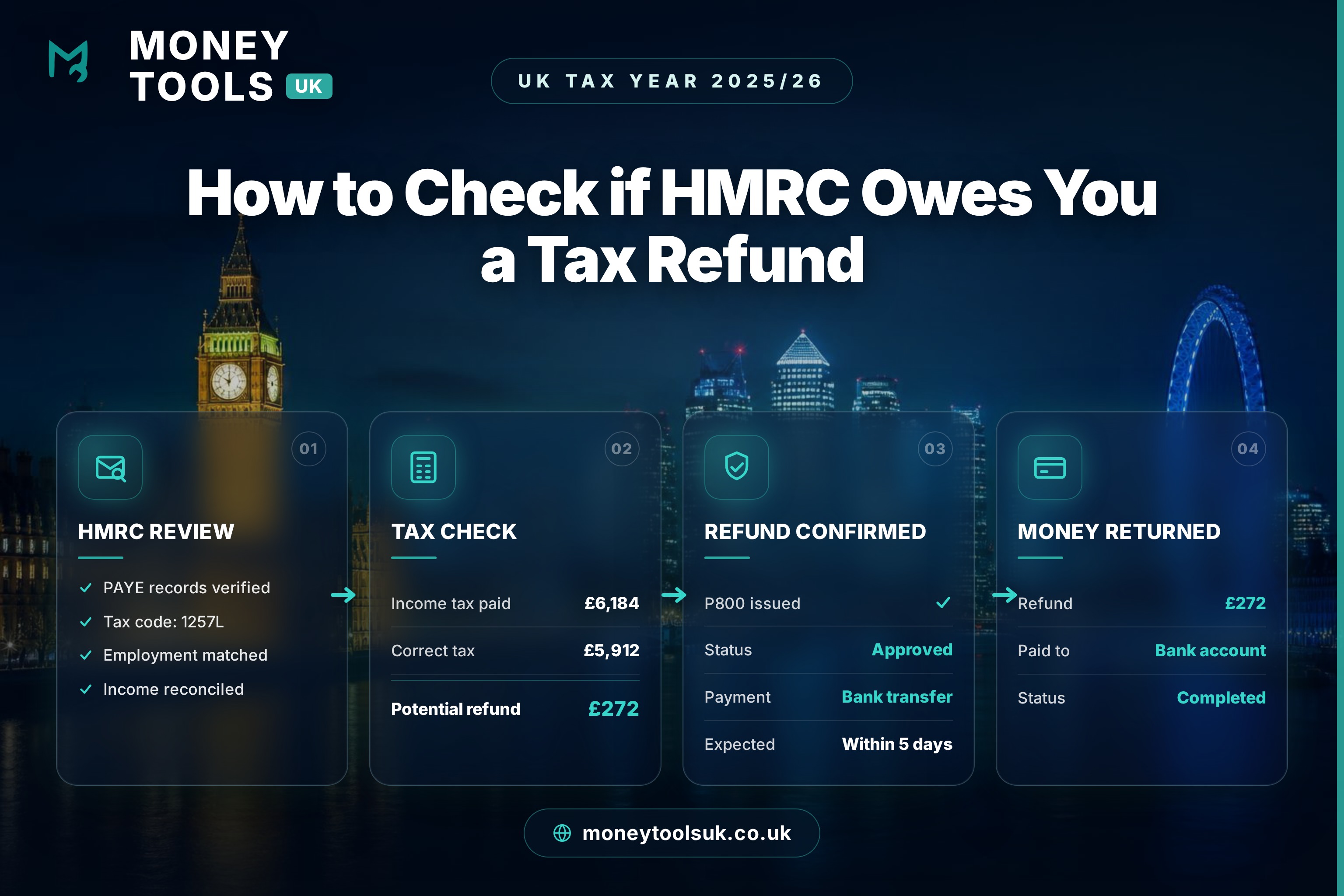
A plain-English UK guide to checking if HMRC owes you a tax refund: why overpayments happen, how to use your Personal Tax Account, P800 and Simple Assessment, when refunds are automatic, how to claim, and how to avoid tax refund scams.
Read guide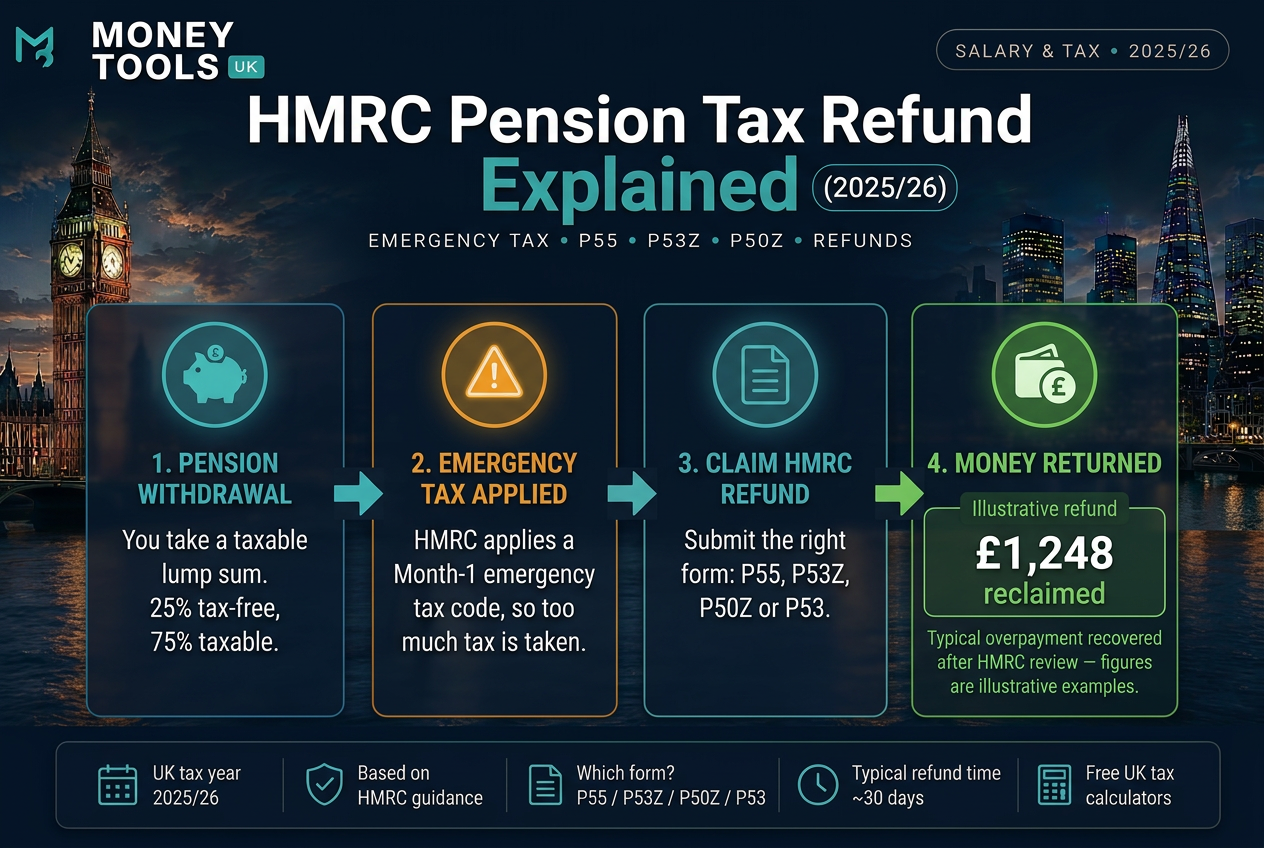
Why HMRC overtaxes pension withdrawals with emergency tax, how pension tax refunds work, and which form to use — P55, P53Z, P50Z or P53 — to reclaim overpaid tax for 2025/26.
Read guide
Learn how UK company car tax works in 2025/26, including Benefit-in-Kind tax, P11D value, CO2 emissions, electric cars, fuel benefit and salary sacrifice examples.
Read guideDisclaimer: This content is for informational purposes only and should not be treated as financial, tax, mortgage, investment or legal advice.