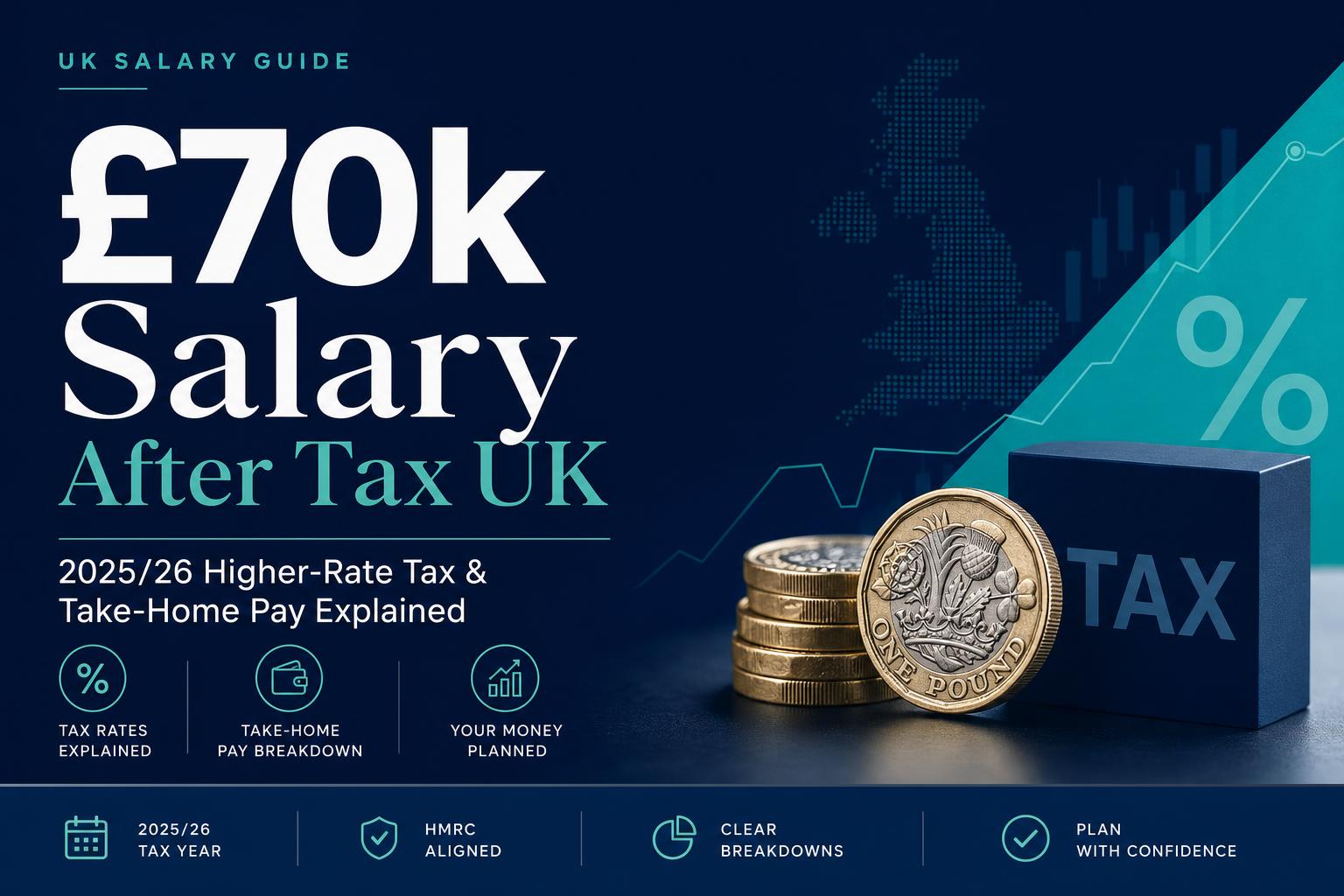
A £70,000 salary is firmly a high-earner wage in the UK. It sits well above the median full-time salary of around £37,000, places you in roughly the top 8–10% of earners, and means a large slice of your pay is taxed at the 40% higher rate. At this level, understanding your deductions matters more than ever: marginal tax, the High Income Child Benefit Charge, salary sacrifice and student loans can all swing your take-home by thousands of pounds a year. This guide shows exactly what £70k looks like on your payslip in the 2025/26 tax year — and how to keep more of it.
A £70,000 salary places you comfortably above the UK median salary and within the country's higher-earning households, giving many workers significantly greater flexibility for saving, investing and pension planning.
Updated for 2025/26
The short answer
Annual Take-Home
£50,557
Estimated annual net pay
Monthly Take-Home
£4,213
Approximate monthly pay
Weekly Take-Home
£972
Approximate weekly pay
Marginal Tax Rate
42%
40% tax + 2% NI above £50,270
Figures assume standard PAYE employment with no pension or student loan deductions.
How a £70,000 salary is taxed in 2025/26
For 2025/26, the UK income tax thresholds (England, Wales and Northern Ireland) remain frozen. The personal allowance is £12,570, the basic-rate band runs up to £50,270, and earnings above that point are charged at 40%. A £70,000 salary therefore spans two bands: the first slice is taxed at 20%, and a much larger slice — from £50,270 up to £70,000 — is taxed at the full 40%.
National Insurance follows a similar split. You pay 8% between £12,570 and £50,270, then 2% on every pound above that. At £70k nearly £20,000 of your salary sits in the 40% / 2% zone, which is why the effective deduction rate climbs steadily as your salary rises through the higher-rate band.
Income tax on £70,000
Your taxable income is gross salary minus the personal allowance: £70,000 − £12,570 = £57,430. That amount is split across two rate bands:
- Basic rate (20%): £37,700 × 20% = £7,540
- Higher rate (40%): £19,730 × 40% = £7,892
- Total income tax: £15,432 a year (~£1,286 a month)
National Insurance on £70,000
- Main rate (8%): £50,270 − £12,570 = £37,700 → ×8% = £3,016
- Upper rate (2%): £70,000 − £50,270 = £19,730 → ×2% = £395
- Total NI: about £3,411 a year (~£284 a month)
What most £70k earners actually take home
With no pension contributions and no student loan, a £70,000 salary in 2025/26 lands in your bank account as follows:
- Gross salary: £70,000
- Income tax: −£15,432
- National Insurance: −£3,411
- Annual take-home: about £50,557
- Monthly take-home: about £4,213
- Weekly take-home: about £972
That's an effective tax-and-NI rate of around 27.8% — higher than the ~24.4% paid on £60k, because the extra £10,000 of gross pay is taxed almost entirely at 40% income tax plus 2% NI.
See your exact £70k take-home in seconds
Run your salary, pension, student loan, bonus and salary sacrifice through the UK Take-Home Pay Calculator for a full payslip-style breakdown.
Monthly take-home pay breakdown
Pension contributions and student loans change the picture considerably at £70k. Here are five worked examples for the 2025/26 tax year:
- No pension, no student loan: ~£50,557/year (~£4,213/month).
- 5% pension (relief at source): £3,500/year out of net pay → take-home ~£46,957/year (~£3,913/month) before claiming higher-rate relief via Self Assessment.
- 5% salary sacrifice pension: £3,500 sacrificed pre-tax and pre-NI → take-home ~£48,114/year (~£4,010/month), with £3,500 going straight into your pension.
- Plan 2 student loan: ~£3,738/year (~£312/month) → take-home ~£46,819/year (~£3,902/month).
- Postgraduate loan: ~£2,940/year (~£245/month) → take-home ~£47,617/year (~£3,968/month).
Higher-rate tax explained
The single most misunderstood number on a UK payslip is the marginal tax rate. Crossing £50,270 does not push all your income into 40% — only the slice above the threshold is taxed at the higher rate. The UK income tax structure at £70k works like a stack of layers:
- Personal allowance (0%): the first £12,570 is tax-free.
- Basic-rate band (20%): the next £37,700 (up to £50,270) is taxed at 20%.
- Higher-rate band (40%): everything from £50,270 to £70,000 — £19,730 — is taxed at 40%.
On £70k, the next £1 you earn is taxed at:
- 40% income tax
- 2% employee National Insurance
- 9% Plan 2 student loan (if applicable)
- = 42% — or 51% with Plan 2 marginal deductions
A common misunderstanding
What if your salary rises?
Estimated take-home
£45,357
Marginal tax rate
42%
Extra tax vs £50k
£4,162
Crossing £50,270 pushes additional earnings into the higher-rate tax band (40% income tax + 2% NI).
Pension optimisation at £70k
Pension contributions are the most powerful tax tool available to anyone earning above £50,270. They convert taxable, NI'd, possibly student-loaned income into a long-term investment — and depending on how your scheme runs, they can save anywhere from 20% to 42% on every pound contributed.
Tax relief and the higher-rate reclaim
Most workplace pensions use relief at source. Contributions come out of net pay; HMRC tops up 20% automatically. Higher-rate taxpayers, however, must claim the additional 20% back via Self Assessment or by writing to HMRC. Many people on £70k never claim this and quietly lose £700+ a year in unrelieved tax.
Salary sacrifice and National Insurance savings
With salary sacrifice, you formally give up part of your gross pay in exchange for an employer pension contribution. The sacrificed amount is invisible to income tax and National Insurance, and many employers also pass on their NI saving. For higher-rate taxpayers it is usually the single best lever on the payslip — it secures the full 40% relief immediately, without waiting for a Self Assessment refund, and saves the 2% NI that relief at source does not.
Sacrificing larger amounts compounds the benefit. Sacrificing the slice above £50,270 reduces your higher-rate tax exposure, can protect Child Benefit, and dramatically boosts long-term retirement savings because the contribution is made from completely untaxed income.
The £70k pension lever
What happens if you increase your pension?
New annual take-home
£49,127
Tax & NI saved
£1,470
Into your pension
£3,500
Assumes relief-at-source contributions on a £70,000 salary, no student loan. Higher-rate relief shown as combined tax & NI saved versus 0% pension.
The High Income Child Benefit Charge at £70k
If you or your partner claim Child Benefit, £70k is squarely inside the High Income Child Benefit Charge (HICBC) zone. For 2024/25 onwards, the charge starts at £60,000 of adjusted net income and is fully clawed back by £80,000. At £70k you sit exactly halfway through the taper.
- You lose 1% of your Child Benefit for every £200 of adjusted net income above £60,000.
- At £70,000, that's £10,000 ÷ £200 = 50% of your Child Benefit clawed back through the tax system.
- Crucially, pension contributions reduce adjusted net income. Sacrificing or contributing £10,000 brings your adjusted net income back to £60,000 — wiping out the charge entirely and keeping 100% of your Child Benefit.
Why £70k earners get caught out
Bonuses and company benefits
At £70k, bonuses and benefits-in-kind sit entirely in the higher-rate band, so they're taxed harder than your base salary feels like it should be.
- Annual bonuses: a £5,000 bonus on £70k is taxed at 40% income tax + 2% NI, landing as about £2,900 net — or as little as ~£2,450 with a Plan 2 student loan. Paying the bonus into pension via salary sacrifice avoids the deductions entirely.
- Company car tax: a petrol or diesel car with high CO₂ emissions can add £6,000+ of "benefit in kind" to your taxable income — taxed at 40%. Electric vehicles are taxed at far lower BIK rates (3% for 2025/26), making them dramatically more tax-efficient.
- Private medical insurance: employer-paid health cover is a taxable benefit. £1,000 of cover adds £1,000 to your taxable income, costing ~£400 in higher-rate tax.
- Other benefits-in-kind: gym memberships, interest-free loans over £10,000 and similar perks are reported on your P11D and taxed at your marginal rate.
The key point: benefits-in-kind are invisible to your bank account but very visible on your tax code, often reducing your personal allowance and increasing PAYE deductions across the year.
Student loan impact at £70k
Student loan repayments are calculated by HMRC as a percentage of income above a plan-specific threshold and deducted via PAYE. They don't reduce your tax, but they do shrink your payslip — and at £70k they're substantial. 2025/26 figures:
- Plan 1: threshold £26,065, 9%. Annual ≈ £3,954 (~£330/month) → take-home ~£46,603/year.
- Plan 2: threshold £28,470, 9%. Annual ≈ £3,738 (~£312/month) → take-home ~£46,819/year.
- Plan 4 (Scotland): threshold £32,745, 9%. Annual ≈ £3,353 (~£279/month) → take-home ~£47,204/year.
- Plan 5 (from Sept 2023): threshold £25,000, 9%. Annual ≈ £4,050 (~£338/month) → take-home ~£46,507/year.
- Postgraduate Loan: threshold £21,000, 6%. Annual ≈ £2,940 (~£245/month) → take-home ~£47,617/year.
If you hold both an undergraduate plan and a postgraduate loan, both are deducted simultaneously. On £70k that easily reaches £550+ a month of combined repayments.
Lifestyle and affordability on £70k
A £70,000 salary supports a comfortable lifestyle across most of the UK, but the gap between London and the regions is stark.
- Mortgage affordability: at 4–4.5× income, a single £70k salary supports roughly £280,000–£315,000 of borrowing — comfortable for most regional markets, tighter in London and the South East.
- Savings potential: with disciplined budgeting, a £70k earner can realistically save 15–25% of net pay while maintaining a good standard of living outside the capital.
- Pension contributions: higher earners benefit most from maximising pension input — both for the 40% relief and to manage adjusted net income for Child Benefit.
- London vs regional UK: rent or mortgage costs in London can consume 40%+ of net pay, whereas the same salary in the North or Midlands leaves far more disposable income.
- Household budgeting: a couple where one partner earns £70k may be better off rebalancing pension and ISA contributions to stay below key thresholds.
You can also use our Mortgage Affordability Calculator to estimate how much you may be able to borrow on a £70,000 salary based on current lending multiples and affordability rules.
Common mistakes people make at £70k
- Misunderstanding higher-rate tax. Believing a £1 pay rise above £50,270 taxes your whole salary at 40%. Only the slice above the threshold is taxed at the higher rate.
- Not using salary sacrifice. Choosing relief at source over sacrifice leaves the 2% NI saving on the table and forces you to chase higher-rate relief via Self Assessment — often worth £700+/year at £70k.
- Ignoring the Child Benefit tax charge. At £70k you lose 50% of your Child Benefit through the HICBC unless you reduce adjusted net income with pension contributions.
- Forgetting student loan deductions. At 9% above the threshold, a Plan 2 loan removes £300+/month — easy to overlook when budgeting a "£70k" salary.
- Overlooking company benefit taxation. A high-CO₂ company car or private medical cover can quietly add thousands of taxable income, all charged at 40%.
Full payslip comparison at £70k
Here's how the most common scenarios compare side by side for a £70,000 gross salary in 2025/26 (illustrative figures):
| Scenario | Annual take-home | Monthly take-home |
|---|---|---|
| No pension, no student loan | £50,557 | £4,213 |
| 5% pension (relief at source) | £46,957 | £3,913 |
| 5% pension (salary sacrifice) | £48,114 | £4,010 |
| Plan 2 student loan | £46,819 | £3,902 |
| Plan 2 + 5% salary sacrifice | ~£44,376 | ~£3,698 |
Compare with £60k
What changes between £60k and £70k?
Calculate your exact £70k take-home pay
Use the UK Take-Home Pay Calculator to include:
- pension contributions
- salary sacrifice
- bonuses
- company car tax (BIK)
- benefits-in-kind
- side hustle income
- student loans (Plan 1, 2, 4, 5 and Postgraduate)
Convert your salary into an hourly rate
See what your £70k salary works out at per hour, per week and per month after factoring in your working hours and weeks.
Earning more? See how £100k is taxed
Sources & references
This guide references current HMRC and GOV.UK guidance for the 2025/26 UK tax year.
- HMRC — Income Tax rates and Personal Allowances
- HMRC — National Insurance: how much you pay
- GOV.UK — Repaying your student loan: what you pay
- HMRC — PAYE rates and thresholds for employers 2025 to 2026
- GOV.UK — High Income Child Benefit Charge
- GOV.UK — Tax on your private pension contributions
- GOV.UK — Tax on company benefits (BIK)
Last updated
This article was last reviewed on 29 May 2026 and reflects the UK tax thresholds, National Insurance rates and student loan plans confirmed for the 2025/26 tax year. We refresh this guide each time HMRC publishes a material change.
Disclaimer
Money Tools UK provides educational content and calculators only. The figures above are estimates based on standard 2025/26 UK tax rules for England, Wales and Northern Ireland (with Scottish rates noted where relevant) and assume a single PAYE employment and a standard 1257L tax code. They do not account for benefits in kind, taxable expenses, pension annual-allowance limits, or personal circumstances that may change your actual liability. For regulated tax or financial advice, please speak to a qualified accountant or independent financial adviser.
Get new UK finance and property guides from Money Tools UK
Plain-English UK finance insights, tax updates and property investing guides.
Related Salary Guides
Explore nearby salary levels to compare take-home pay, Income Tax, National Insurance, student loan deductions and pension contributions.
Related calculators
UK Take-Home Pay Calculator
The exact calculator this article is built around — open it and run your own numbers.
Open calculatorFrequently asked questions
Related guides
More flagship guides and tools from Money Tools UK.
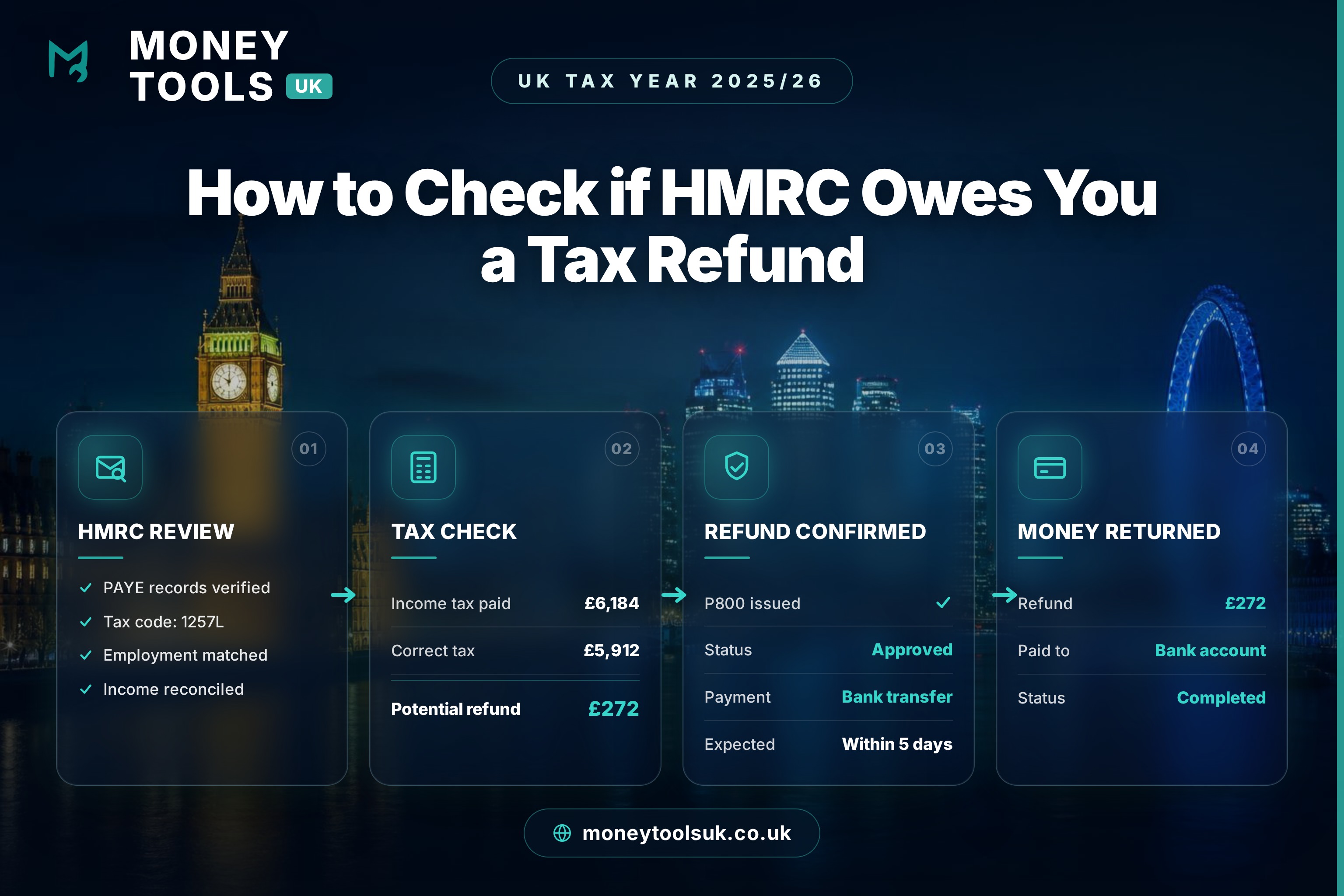
A plain-English UK guide to checking if HMRC owes you a tax refund: why overpayments happen, how to use your Personal Tax Account, P800 and Simple Assessment, when refunds are automatic, how to claim, and how to avoid tax refund scams.
Read guide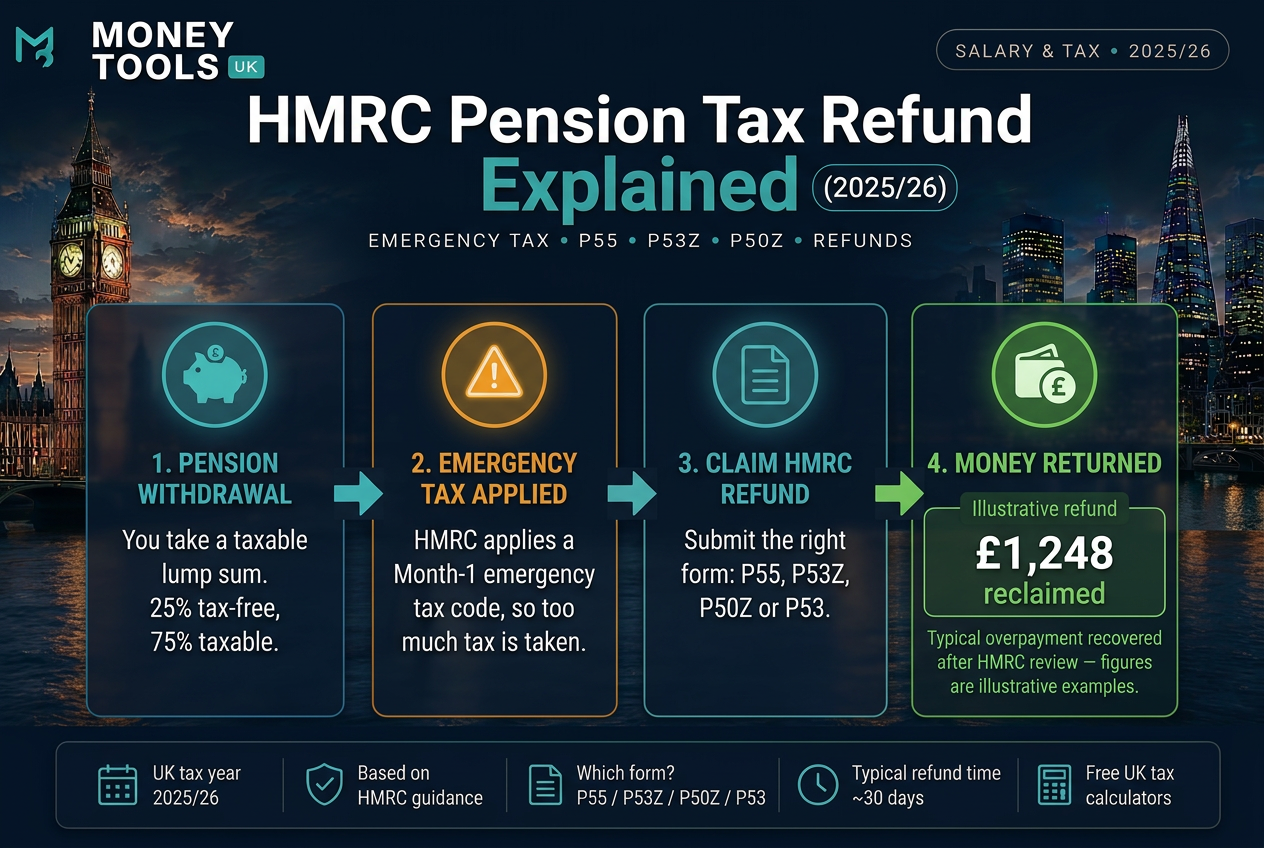
Why HMRC overtaxes pension withdrawals with emergency tax, how pension tax refunds work, and which form to use — P55, P53Z, P50Z or P53 — to reclaim overpaid tax for 2025/26.
Read guide
Learn how UK company car tax works in 2025/26, including Benefit-in-Kind tax, P11D value, CO2 emissions, electric cars, fuel benefit and salary sacrifice examples.
Read guideDisclaimer: This content is for informational purposes only and should not be treated as financial, tax, mortgage, investment or legal advice.