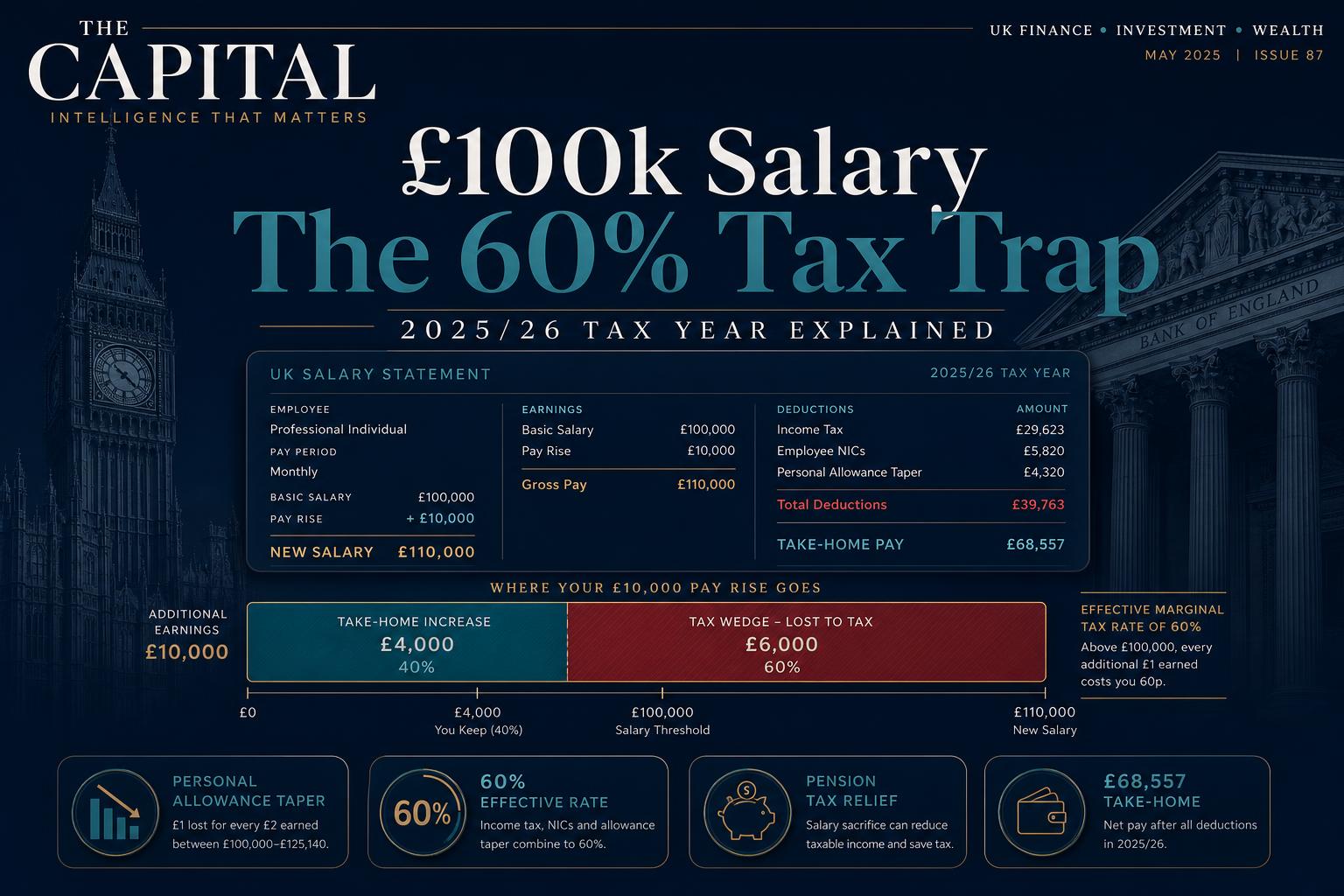
A £100,000 salary puts you well above the UK average income and firmly into higher-rate tax territory. It also places you right next to one of the most important thresholds in the entire UK tax system: the point where your personal allowance starts to disappear. This guide explains exactly how much you'll take home from a £100,000 salary in the 2025/26 tax year, how income tax and National Insurance are calculated, why the famous 60% tax trap exists just above £100k, and why pension contributions are especially powerful at this income level.
Updated for 2025/26
The short answer
Annual Take-Home
£68,557
Estimated annual net pay
Monthly Take-Home
£5,713
Approximate monthly pay
Weekly Take-Home
£1,318
Approximate weekly pay
Marginal Tax Trap
60%
Effective rate above £100,000
Figures assume standard PAYE employment with no pension or student loan deductions.
How a £100,000 salary is taxed in 2025/26
For England, Wales and Northern Ireland, income tax in 2025/26 is charged across three bands:
- Personal Allowance: £12,570 (taxed at 0%)
- Basic rate (20%): £12,571 to £50,270
- Higher rate (40%): £50,271 to £125,140
At exactly £100,000 you retain your full personal allowance, because the taper only begins once income exceeds £100,000. National Insurance follows a separate structure: you pay 8% between £12,570 and £50,270, then just 2% on everything above £50,270. This means a large slice of your income is taxed at the higher 40% rate but attracts only 2% National Insurance.
Income tax on £100,000
Your taxable income is gross salary minus the personal allowance: £100,000 − £12,570 = £87,430. That amount is split across two rate bands:
- Basic rate (20%): £37,700 × 20% = £7,540
- Higher rate (40%): £49,730 × 40% = £19,892
- Total income tax: £27,432 a year (~£2,286 a month)
National Insurance on £100,000
- Main rate (8%): £50,270 − £12,570 = £37,700 → ×8% = £3,016
- Upper rate (2%): £100,000 − £50,270 = £49,730 → ×2% = £995
- Total NI: about £4,011 a year (~£334 a month)
Monthly and weekly take-home pay
With no pension contributions and no student loan, a £100,000 salary in 2025/26 lands in your bank account as follows:
- Gross salary: £100,000
- Income tax: −£27,432
- National Insurance: −£4,011
- Annual take-home: about £68,557
- Monthly take-home: about £5,713
- Weekly take-home: about £1,318
That's an effective tax-and-NI rate of around 31.4%. For many people at this level, pension contributions or salary sacrifice arrangements will reduce tax and increase overall efficiency — especially because of what happens immediately above £100,000.
See your exact £100k take-home in seconds
Run your salary, pension, student loan, bonus and salary sacrifice through the UK Take-Home Pay Calculator for a full payslip-style breakdown.
Why £100k is such an important threshold
£100,000 is one of the most closely watched salary levels in the UK because of what happens immediately above it. Once your income exceeds £100,000:
- Your personal allowance begins to reduce.
- You lose £1 of allowance for every £2 earned above £100,000.
- The personal allowance disappears entirely at £125,140.
This creates the famous "60% tax trap". Many higher earners use pension contributions or salary sacrifice arrangements to keep their adjusted net income below £100,000 and protect their full allowance.
Understanding the 60% tax trap
Between £100,000 and £125,140, the maths gets brutal:
- You pay 40% higher-rate tax on the income itself.
- You effectively lose part of your personal allowance as it tapers away.
- Each £1 of lost allowance causes another 40p of tax.
As a result, the effective marginal tax rate on earnings in this band becomes approximately 60% (more with a student loan on top).
Worked example: £100k → £110k
The £10,000 pay rise shock
If your salary rises from £100,000 to £110,000, you receive £10,000 of additional gross income.
However:
- 40% higher-rate tax applies
- Part of your personal allowance is lost
- Additional income becomes taxable
- National Insurance still applies
As a result, many employees keep only around £4,000–£5,000 of the £10,000 increase.
This is why the £100k–£125,140 range is known as the 60% tax trap and why pension contributions are often the most tax-efficient option.
What if your salary rises?
Estimated take-home
£45,357
Marginal tax rate
42%
Extra tax vs £50k
£4,162
Crossing £50,270 pushes additional earnings into the higher-rate tax band (40% income tax + 2% NI).
Real-world example: Sarah earns £103,000
Sarah earns £103,000 a year.
Because her income exceeds £100,000, she begins losing her personal allowance.
Instead of accepting the additional tax cost, she contributes £3,000 into her pension.
Benefits:
- Reduced adjusted net income
- Lower effective tax burden
- Partial preservation of personal allowance
- Increased retirement savings
Case study takeaway
The result is significantly better overall tax efficiency than simply taking the additional salary as taxable income.
£100k take-home with pension contributions
Pension contributions can dramatically improve tax efficiency at £100k — both because of higher-rate relief and because they reduce your adjusted net income, protecting your personal allowance.
Relief-at-source pension
A 5% contribution (£5,000/year) reduces your net take-home pay, builds retirement savings, and entitles you to additional higher-rate tax relief claimed via Self Assessment. Your approximate annual take-home becomes £64,500–£65,500 depending on how your scheme is structured and once higher-rate relief is reclaimed.
Salary sacrifice pension
Salary sacrifice is often more efficient. If you sacrifice 5% (£5,000), your taxable salary falls to £95,000, your income tax decreases, your National Insurance decreases, and your pension receives the full contribution before tax. Many employers also share part of their own National Insurance saving, boosting the amount that reaches your pension.
The £100k pension lever
What happens if you increase your pension?
New annual take-home
£65,657
Tax & NI saved
£2,100
Into your pension
£5,000
Assumes relief-at-source contributions on a £100,000 salary, no student loan. Higher-rate relief shown as combined tax & NI saved versus 0% pension.
£100k take-home with a student loan
Student loan deductions are calculated separately from tax, as a percentage of income above a plan-specific threshold, and deducted via PAYE. At £100k they're substantial. 2025/26 figures:
- Plan 2: threshold £28,470, 9%. Annual ≈ £6,438 → take-home ~£62,119/year.
- Plan 5 (from Sept 2023): threshold £25,000, 9%. Annual ≈ £6,750 → take-home ~£61,807/year.
- Postgraduate Loan: threshold £21,000, 6%. Annual ≈ £4,740. This deduction applies in addition to any undergraduate student loan.
If you hold both an undergraduate plan and a postgraduate loan, both are deducted simultaneously — easily exceeding £900+ a month of combined repayments at £100k.
Full payslip comparison at £100k
Here's how the most common scenarios compare side by side for a £100,000 gross salary in 2025/26 (illustrative figures):
| Scenario | Annual take-home | Monthly take-home |
|---|---|---|
| No pension, no student loan | £68,557 | £5,713 |
| 5% pension (relief at source) | ~£65,000 | ~£5,417 |
| 5% pension (salary sacrifice) | ~£65,700 | ~£5,475 |
| Plan 2 student loan | ~£62,120 | ~£5,177 |
| Plan 2 + Postgraduate Loan | ~£57,380 | ~£4,782 |
| Plan 2 + 5% salary sacrifice | ~£59,000 | ~£4,917 |
Compare with £70k
Does Scotland change the picture?
Yes. Scotland uses its own income tax bands and rates. A Scottish taxpayer earning £100,000 will generally pay more income tax than someone earning the same amount in England, Wales or Northern Ireland, because of the additional intermediate and advanced Scottish bands. National Insurance and student loan rules, however, remain UK-wide and are unaffected by where you live.
Common mistakes people make at £100k
- Assuming a pay rise always helps proportionally. Between £100,000 and £125,140, much of a raise is lost to the 60% effective rate.
- Ignoring the personal allowance taper. Crossing £100k quietly erodes your tax-free allowance £1 for every £2.
- Forgetting about student loan deductions. At 9% above the threshold, a Plan 2 loan removes £500+/month.
- Not using pension contributions strategically. Pension relief at the 60% marginal rate is the most valuable lever at this salary.
- Missing salary sacrifice opportunities. Sacrifice saves income tax and NI and protects your allowance.
- Calculating adjusted net income incorrectly. Get this wrong and you misjudge both the taper and any Child Benefit charge.
How to legitimately keep more of your £100k
- Pension contributions.
- Salary sacrifice arrangements.
- Cycle-to-work schemes.
- Electric vehicle salary sacrifice.
- Gift Aid donations.
- Marriage Allowance (where applicable).
- Careful bonus planning.
For many people, reducing adjusted net income below £100,000 can produce substantial tax savings by restoring the full personal allowance and escaping the 60% trap entirely.
What if you also have side-hustle income?
Many £100k earners also receive income from:
- Freelancing
- Consulting
- eBay selling
- Vinted sales
- Dividend income
- Rental property income
Additional income is usually taxed at your marginal rate and can accelerate the loss of your personal allowance.
Even relatively small amounts of extra income can push adjusted net income further into the 60% tax trap.
Use the UK Take-Home Pay Calculator to model multiple income streams and understand the true tax impact.
Want your exact take-home pay?
Use the UK Take-Home Pay Calculator to include:
- pension contributions
- salary sacrifice
- student loans
- bonuses
- benefits-in-kind
- company car tax
- multiple income streams
Estimate your student loan repayments
See exactly how Plan 1, 2, 4, 5 and Postgraduate loan deductions stack up on a £100k salary.
Sources & references
This guide references current HMRC and GOV.UK guidance for the 2025/26 UK tax year.
- HMRC — Income Tax rates and Personal Allowances
- HMRC — National Insurance: how much you pay
- GOV.UK — Personal Allowance for income over £100,000
- GOV.UK — Repaying your student loan: what you pay
- GOV.UK — Salary sacrifice guidance
Last updated
This article was last reviewed on 30 May 2026 and reflects current UK income tax thresholds, National Insurance rates, personal allowance taper rules and student loan repayment thresholds for the 2025/26 tax year. We review and update this guide whenever HMRC or GOV.UK publishes a material change affecting salary calculations.
Disclaimer
Money Tools UK provides educational content and calculators only. The figures above are estimates based on standard 2025/26 UK tax rules for England, Wales and Northern Ireland (with Scottish rates noted where relevant) and assume a single PAYE employment with a standard tax code. Individual circumstances may vary. For regulated tax or financial advice, please speak to a qualified accountant or independent financial adviser.
Compare other salary levels
Understanding how tax changes at different salary levels helps put £100k earnings into context.
Get new UK finance and property guides from Money Tools UK
Plain-English UK finance insights, tax updates and property investing guides.
Related Salary Guides
Explore nearby salary levels to compare take-home pay, Income Tax, National Insurance, student loan deductions and pension contributions.
Related calculators
UK Take-Home Pay Calculator
The exact calculator this article is built around — open it and run your own numbers.
Open calculatorFrequently asked questions
Related guides
More flagship guides and tools from Money Tools UK.
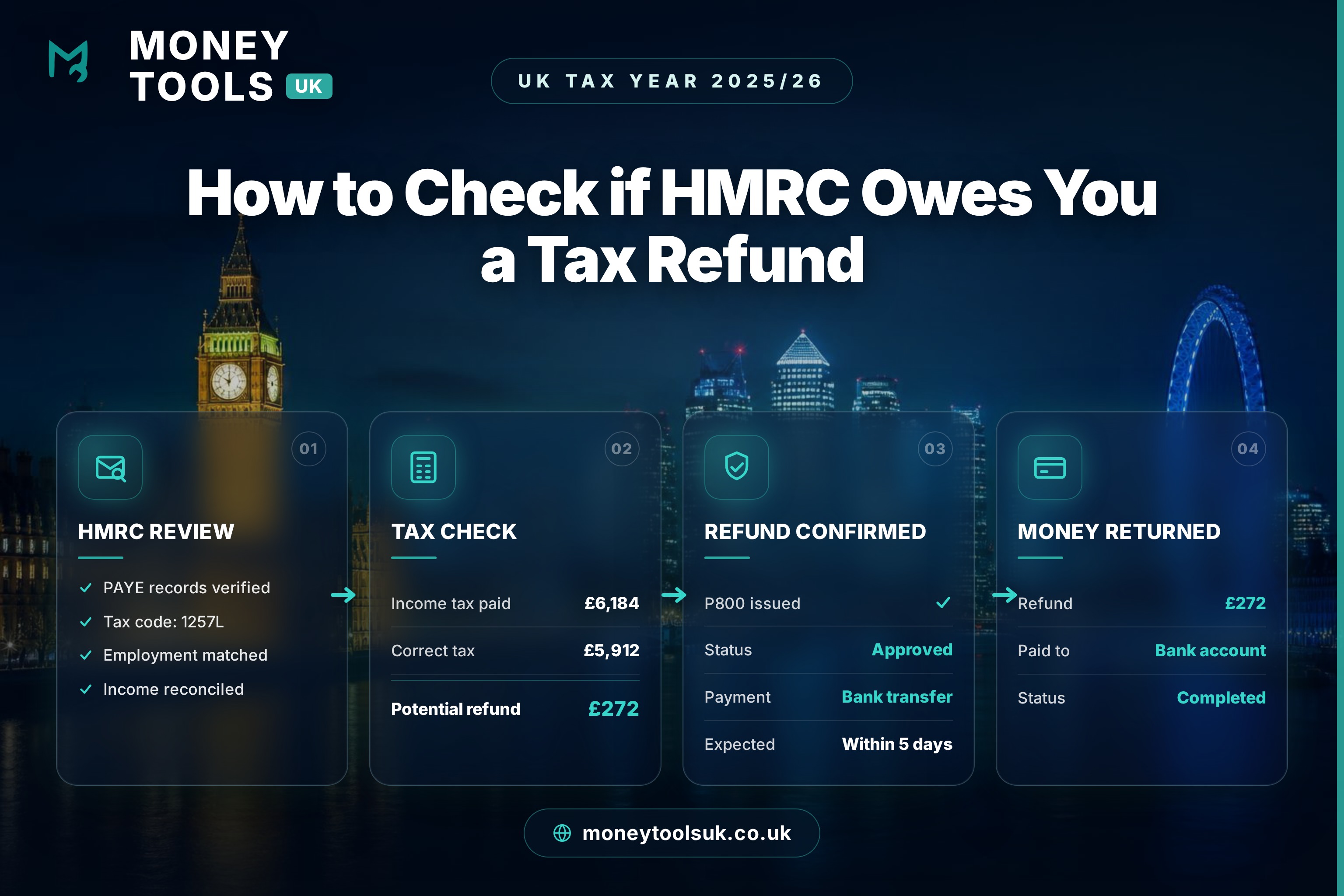
A plain-English UK guide to checking if HMRC owes you a tax refund: why overpayments happen, how to use your Personal Tax Account, P800 and Simple Assessment, when refunds are automatic, how to claim, and how to avoid tax refund scams.
Read guide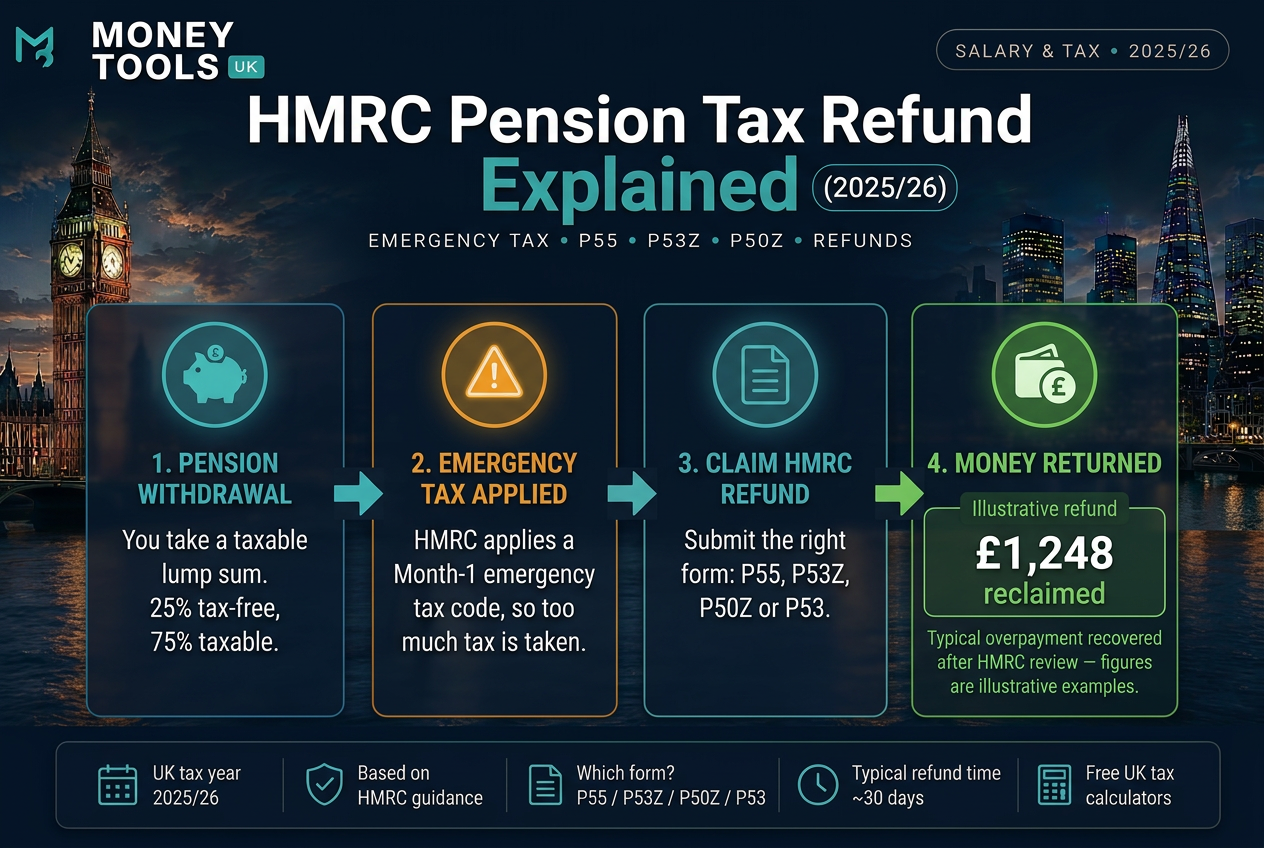
Why HMRC overtaxes pension withdrawals with emergency tax, how pension tax refunds work, and which form to use — P55, P53Z, P50Z or P53 — to reclaim overpaid tax for 2025/26.
Read guide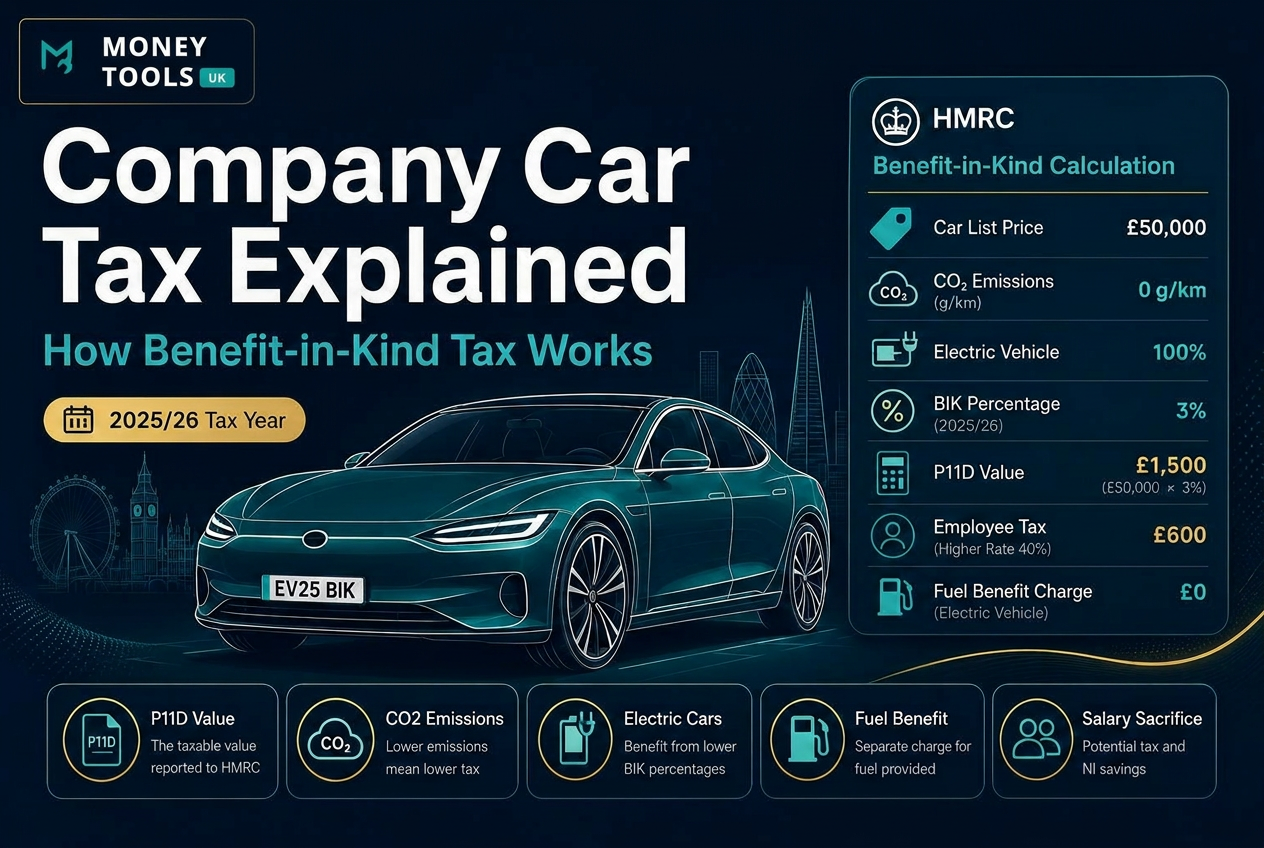
Learn how UK company car tax works in 2025/26, including Benefit-in-Kind tax, P11D value, CO2 emissions, electric cars, fuel benefit and salary sacrifice examples.
Read guideDisclaimer: This content is for informational purposes only and should not be treated as financial, tax, mortgage, investment or legal advice.