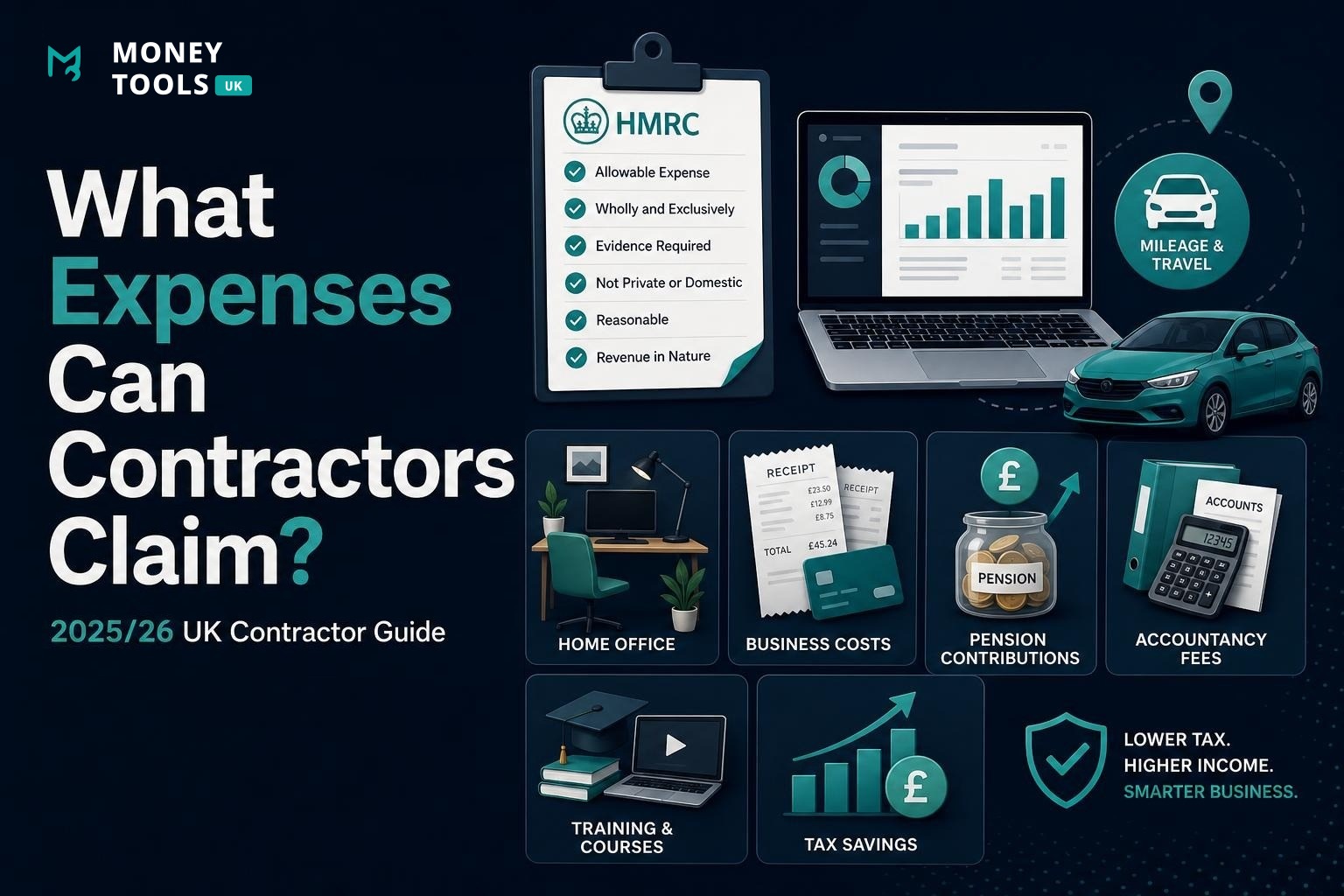
The test
Wholly & exclusively
Most flexibility
Outside IR35 Ltd
Always need
Records & receipts
Expenses reduce tax — they are not free money. Claiming a legitimate business cost lowers your taxable profit, but you still spend the money. The skill is knowing which costs HMRC genuinely allows.
One of the biggest advantages of running through a limited company is the ability to claim legitimate business expenses. However, many contractors are unsure what HMRC actually allows. Can you claim mileage? Can you claim a laptop? Can you claim broadband? Can you claim training courses?
For limited company contractors the answer almost always comes back to one principle: the expense must be wholly and exclusively for business purposes. Where you are claiming employee-style expenses, or working inside IR35, additional rules may apply and some costs that would otherwise be allowable can be restricted. This guide explains the most common contractor expenses, the difference between working inside and outside IR35, what HMRC allows, what it does not allow and how expenses affect your tax bill.
Typical contractor tax savings
Many limited company contractors claim several thousand pounds of legitimate business expenses each year. While expenses are not free money, reducing taxable profits can often save hundreds or even thousands of pounds in Corporation Tax depending on income levels and business costs.
The short answer
Most UK contractors operating through a limited company can claim legitimate business expenses that are incurred wholly and exclusively for business purposes.
Claiming allowable expenses can:
- reduce Corporation Tax
- reduce taxable profits
- improve overall tax efficiency
- lower the real cost of running your business
However, not every expense is allowable, and different rules may apply depending on whether you are working inside or outside IR35.
Most common contractor expenses at a glance
Before getting into the detail, here is a quick reference to the expenses contractors ask about most often, and how HMRC generally treats them.
| Expense category | Usually claimable? | Notes |
|---|---|---|
| Mileage | ✅ Yes | Business journeys only |
| Laptop & equipment | ✅ Yes | Business use proportion |
| Software subscriptions | ✅ Yes | Business-related software |
| Home office costs | ✅ Yes | Flat-rate or apportioned |
| Accountancy fees | ✅ Yes | Company-related fees |
| Professional memberships | ✅ Yes | Relevant professional bodies |
| Pension contributions | ✅ Yes | Often highly tax efficient |
| Broadband | ⚠️ Sometimes | Depends on circumstances |
| Meals | ⚠️ Sometimes | Usually business travel only |
| Everyday clothing | ❌ No | Normally not allowable |
| Commuting to regular workplace | ❌ No | Usually disallowed |
| Family holidays | ❌ No | Personal expense |
Most contractor expense questions can be answered by applying HMRC's core test: was the expense incurred wholly and exclusively for business purposes? If the answer is yes, there is a good chance it may be allowable.
HMRC's golden rule
Wholly and exclusively for business
Usually allowable
- a laptop used for work
- accountancy fees
- business insurance
Not usually allowable
- a family holiday
- everyday personal clothing
- a private gym membership
A useful test: if a cost has a clear personal benefit (a "duality of purpose"), HMRC may disallow it entirely unless the business element can be cleanly separated and measured.
How contractor expenses reduce tax
The core mechanism is simple:
How expenses lower your tax
Worked example
| Contract income | £120,000 |
|---|---|
| Allowable expenses | − £10,000 |
| Taxable profit | £110,000 |
Expenses are not free money
What could this save a typical contractor?
Example contractor
| Expense | Annual cost |
|---|---|
| Mileage | £2,250 |
| Home office | £312 |
| Software | £600 |
| Accountancy fees | £1,200 |
| Professional insurance | £500 |
| Total allowable expenses | £4,862 |
If a contractor claims £4,862 of legitimate business expenses, those costs reduce taxable profit before Corporation Tax is calculated. At a 19% Corporation Tax rate, this could reduce the company's tax bill by approximately £924.
Expenses are not free money, but claiming legitimate business costs can significantly improve overall tax efficiency.
Travel expenses
Contractors operating outside IR35 may often claim genuine business travel that is not ordinary commuting, including:
- business travel between sites or to client meetings
- train tickets and rail fares
- taxis for business journeys
- parking (but not fines)
- hotels and overnight accommodation for business trips
- business mileage in your own vehicle
Ordinary commuting is not allowable
Mileage claims
If you use your own personal vehicle for business journeys, you can usually claim tax-free mileage using HMRC's approved mileage allowance payment (AMAP) rates rather than claiming actual running costs.
| Vehicle | First 10,000 miles | Over 10,000 miles |
|---|---|---|
| Cars and vans | 45p per mile | 25p per mile |
| Motorcycles | 24p per mile | 24p per mile |
| Bicycles | 20p per mile | 20p per mile |
Worked example — 5,000 business miles
A contractor drives 5,000 business miles in their own car during the year. All miles fall within the first 10,000, so the rate is 45p:
- 5,000 miles × 45p = £2,250
- The company pays this £2,250 to the director tax-free.
- It is also an allowable business cost that reduces taxable profit.
These rates are intended to cover fuel, insurance, servicing and wear and tear, so you cannot also claim those running costs separately for the same vehicle. Keep a mileage log showing the date, journey, reason and miles.
Home office expenses
Many contractors work from home for at least part of the week. There are two broad ways a limited company director can claim home working costs:
- HMRC flat rate: a simple fixed amount of £6 per week (£26 per month) with no need to keep detailed bills — the easiest and lowest-risk method for most directors.
- Apportioned actual costs: a reasonable proportion of household running costs (heat, light, broadband, etc.) based on the number of rooms used for work and the time they are used for business.
Apportionment example
Mobile phone and broadband
- Mobile phone: if the contract is in the company's name, the full cost can usually be claimed even if there is some incidental private use. A personal contract you partly use for business is far harder to claim.
- Broadband: if you already pay for home broadband personally, HMRC usually sees no additional cost from business use, so it is often not claimable. A dedicated business line in the company name is more clearly allowable.
- Mixed use: where a cost is genuinely shared, only the identifiable business proportion is allowable.
Computers and equipment
Equipment bought by the company for business use is generally allowable, including:
- laptops and desktop computers
- monitors
- printers
- office furniture (desk, chair)
- webcams and headsets
- business phones
Larger items of equipment are usually treated as capital expenditure. In practice most contractors can claim the full cost in the year of purchase via the Annual Investment Allowance (AIA), which gives 100% tax relief on qualifying plant and machinery up to a generous annual limit. Where there is some private use, the claim is restricted to the business proportion.
Software subscriptions
Software and online tools used to run the business are normally allowable, for example:
- Microsoft 365
- Google Workspace
- Adobe Creative Cloud (where used for work)
- accounting software (e.g. for bookkeeping and VAT)
- cloud storage and backups
- project management and collaboration tools
Training and professional development
Training that maintains or updates existing skills relevant to your current trade is generally allowable. The position is more difficult where training provides an entirely new skill or qualification — HMRC may treat that as capital or personal in nature rather than an allowable revenue cost.
Rule of thumb
Professional memberships
Fees and subscriptions to professional bodies and industry organisations can be allowable where the membership is relevant to your work and, in many cases, where the body appears on HMRC's approved list (List 3). Examples include:
- professional institutes and chartered bodies
- industry membership organisations
- relevant trade or technical journals and subscriptions
Accountancy fees
The cost of running the company's finances is a clear business expense, including:
- accountancy and bookkeeping fees
- payroll software and processing
- business tax advice
- company secretarial services and confirmation statement filing
Note that fees relating purely to your personal tax affairs may not always be allowable to the company, so a good accountant will split company and personal work appropriately.
Pension contributions
Employer pension contributions made by the limited company directly into a director's pension are one of the most tax-efficient ways to extract value from a contractor company. When made wholly and exclusively for the business, employer contributions are normally an allowable expense that reduces Corporation Tax, and they are not subject to Income Tax or National Insurance at the point of contribution.
The Best Salary and Dividend Split for UK Contractors in 2025/26
Optimising expenses is only one part of contractor tax planning. Many contractors combine allowable expenses with a tax-efficient salary and dividend strategy to reduce their overall tax bill.
Contributions count towards your annual allowance, so larger payments need planning. Pensions sit naturally alongside your salary and dividend strategy — model the impact in the Contractor Tax Calculator before deciding.
Insurance costs
Business insurance taken out for the company is generally allowable, such as:
- professional indemnity insurance
- public liability insurance
- cyber insurance
- other business insurance relevant to your work
Some agencies and clients require professional indemnity cover as a condition of contracting, making it both a practical necessity and an allowable cost.
Expenses inside IR35 vs outside IR35
IR35 status has a big impact on what you can realistically claim. Outside IR35 contractors operate as a genuine business with broad expense flexibility; inside IR35 engagements are treated much more like employment, so most expenses give no extra tax relief.
| Expense category | Outside IR35 | Inside IR35 |
|---|---|---|
| Travel to client site | Often claimable (non-commuting) | Generally not claimable |
| Accommodation | Claimable for business trips | Generally not claimable |
| Business mileage | Claimable at AMAP rates | Generally not claimable |
| Home office | Flat rate or apportioned | Very limited |
| Equipment | Claimable (AIA) | Limited relief |
| Software subscriptions | Claimable | Limited relief |
| Pension contributions | Employer contributions efficient | Still possible via salary sacrifice |
Key takeaway
What contractors cannot usually claim
Commonly disallowed costs
- ordinary commuting to a regular workplace
- everyday clothing (even if worn for work)
- private meals and routine subsistence near home
- personal holidays
- family and household expenses
- fines and penalties (e.g. parking and speeding fines)
Record keeping requirements
Every claim should be backed by evidence. Good records protect you if HMRC ever asks questions:
- keep receipts and VAT invoices for purchases
- retain sales invoices and bank statements
- use bookkeeping or accounting software to record transactions
- keep a mileage log for vehicle claims
Limited companies must generally keep their accounting records for at least six years from the end of the relevant accounting period (longer in some circumstances). Digital records are fine and are increasingly expected.
What if you have lost a receipt?
While HMRC recommends keeping receipts and invoices wherever possible, a missing receipt does not automatically mean an expense cannot be claimed. Business bank statements, credit card statements, supplier invoices and accounting records may help demonstrate that a genuine business expense was incurred. However, keeping the original receipt or invoice remains the strongest form of evidence and makes it much easier to support a claim if HMRC ever asks questions.
Common HMRC red flags
Issues that often trigger enquiries
- claiming ordinary commuting as business travel
- claiming everyday clothing as a business expense
- claiming personal broadband entirely as business use
- missing receipts or insufficient records
- claiming personal meals as business expenses
- mixing personal and company spending
- over-claiming expenses while working inside IR35
When in doubt, keep evidence and seek professional advice before making a claim.
Common mistakes
- claiming personal costs as business expenses
- missing or lost receipts
- poor or out-of-date bookkeeping
- mixing personal and business spending in one account
- misunderstanding IR35 rules and over-claiming inside IR35
Contractor expenses checklist
Allowable expenses to review (outside IR35)
- ✓Travel
- ✓Mileage
- ✓Home office
- ✓Equipment
- ✓Software
- ✓Training
- ✓Accountancy
- ✓Insurance
- ✓Pension contributions
Estimate your contractor take-home pay
Use the Money Tools UK Contractor Tax Calculator to see how allowable expenses, salary and dividends may affect your overall tax position.
Sources & references
This guide reflects official UK government and HMRC guidance on allowable business expenses for the 2025/26 tax year.
- GOV.UK — Expenses if you're self-employed and limited company expenses
- GOV.UK — Claim tax relief for your job expenses
- GOV.UK — Travel and subsistence (expenses and benefits)
- GOV.UK — Business mileage and approved mileage rates
- GOV.UK — Capital allowances and Annual Investment Allowance
- GOV.UK — Understanding off-payroll working (IR35)
- GOV.UK — Running a limited company
- HMRC — Employment Income Manual (EIM)
- HMRC — Business Income Manual (BIM)
- MoneyHelper — Pensions and tax
Last updated
This article was last reviewed on 22 June 2026 and reflects UK contractor expense, IR35 and Corporation Tax rules for the 2025/26 tax year. We refresh this guide each time HMRC publishes a material change.
Reviewed by Money Tools UK Editorial Team
This guide was reviewed for accuracy against HMRC and GOV.UK guidance for the 2025/26 tax year. We regularly update our contractor and tax content when thresholds, rates or eligibility rules change.
Last reviewed: 22 June 2026
Disclaimer
Money Tools UK provides educational information only. Tax treatment depends on individual circumstances, company structure and HMRC rules. Always seek professional advice before making tax decisions.
Get new UK finance and property guides from Money Tools UK
Plain-English UK finance insights, tax updates and property investing guides.
Related calculators
Contractor Tax Calculator
The exact calculator this article is built around — open it and run your own numbers.
Open calculatorFrequently asked questions
Related guides
More flagship guides and tools from Money Tools UK.
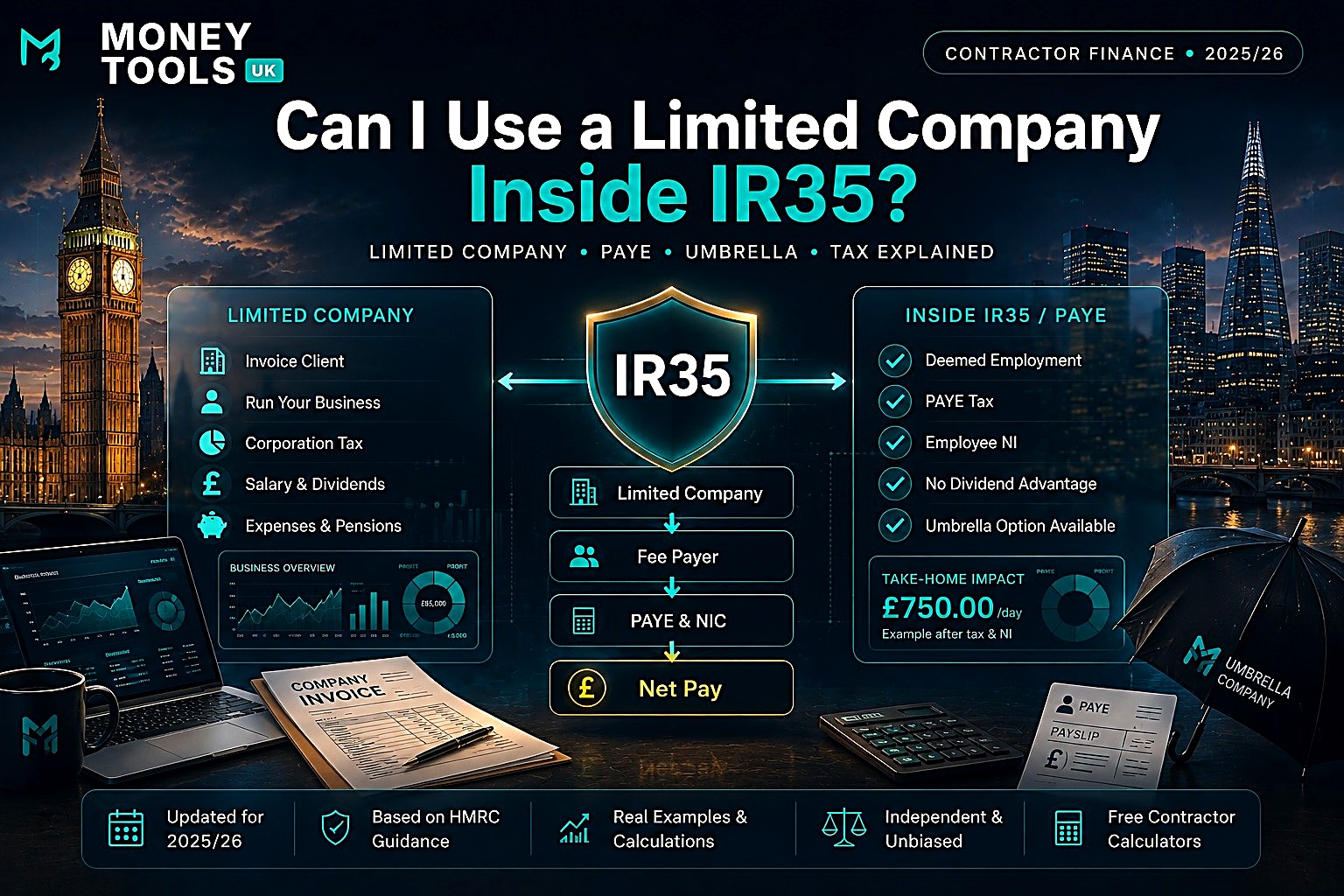
Can you still use a limited company inside IR35? Learn what happens to PAYE, dividends, Corporation Tax, expenses, umbrella companies and mixed inside/outside IR35 contracts.
Read guide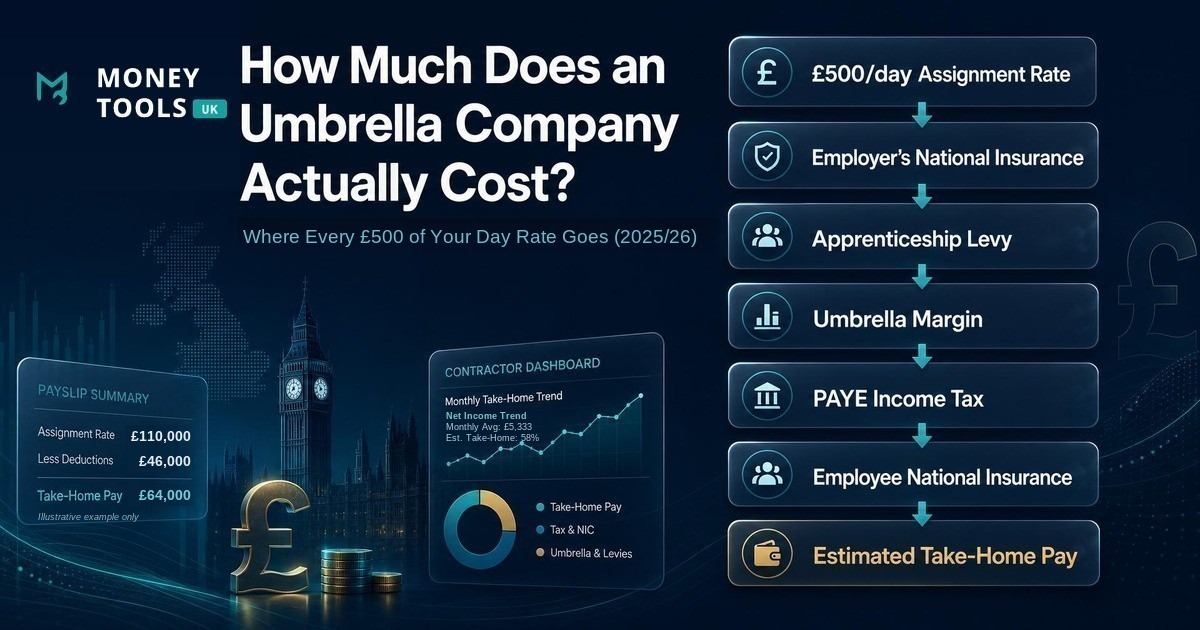
See how much an umbrella company really costs in 2025/26, including umbrella margin, Employer's NI, Apprenticeship Levy, holiday pay, pension deductions and contractor take-home pay.
Read guide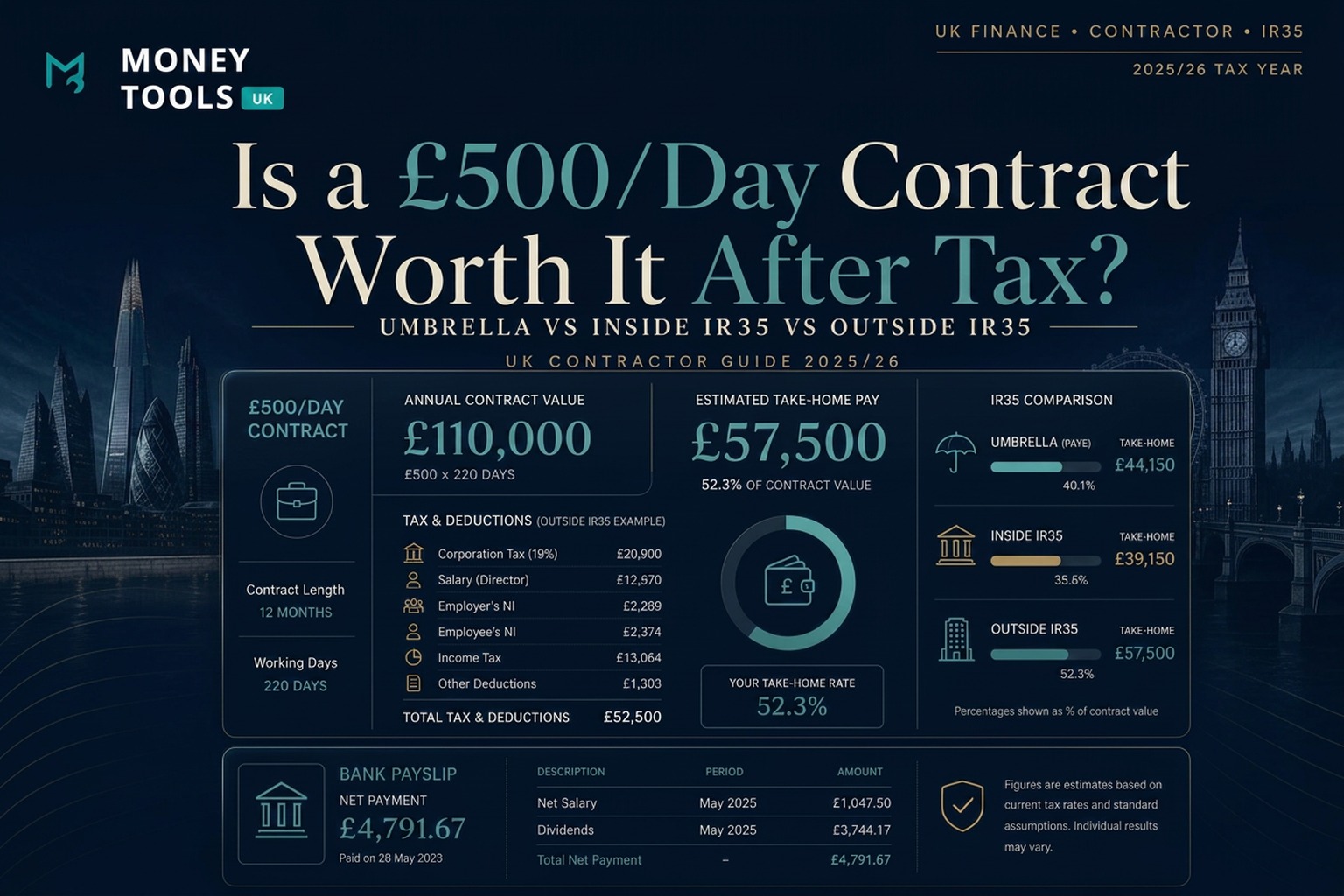
See how much a £500/day contract could be worth after tax in 2025/26. Compare umbrella company, inside IR35, outside IR35 and limited company take-home pay.
Read guideDisclaimer: This content is for informational purposes only and should not be treated as financial, tax, mortgage, investment or legal advice.