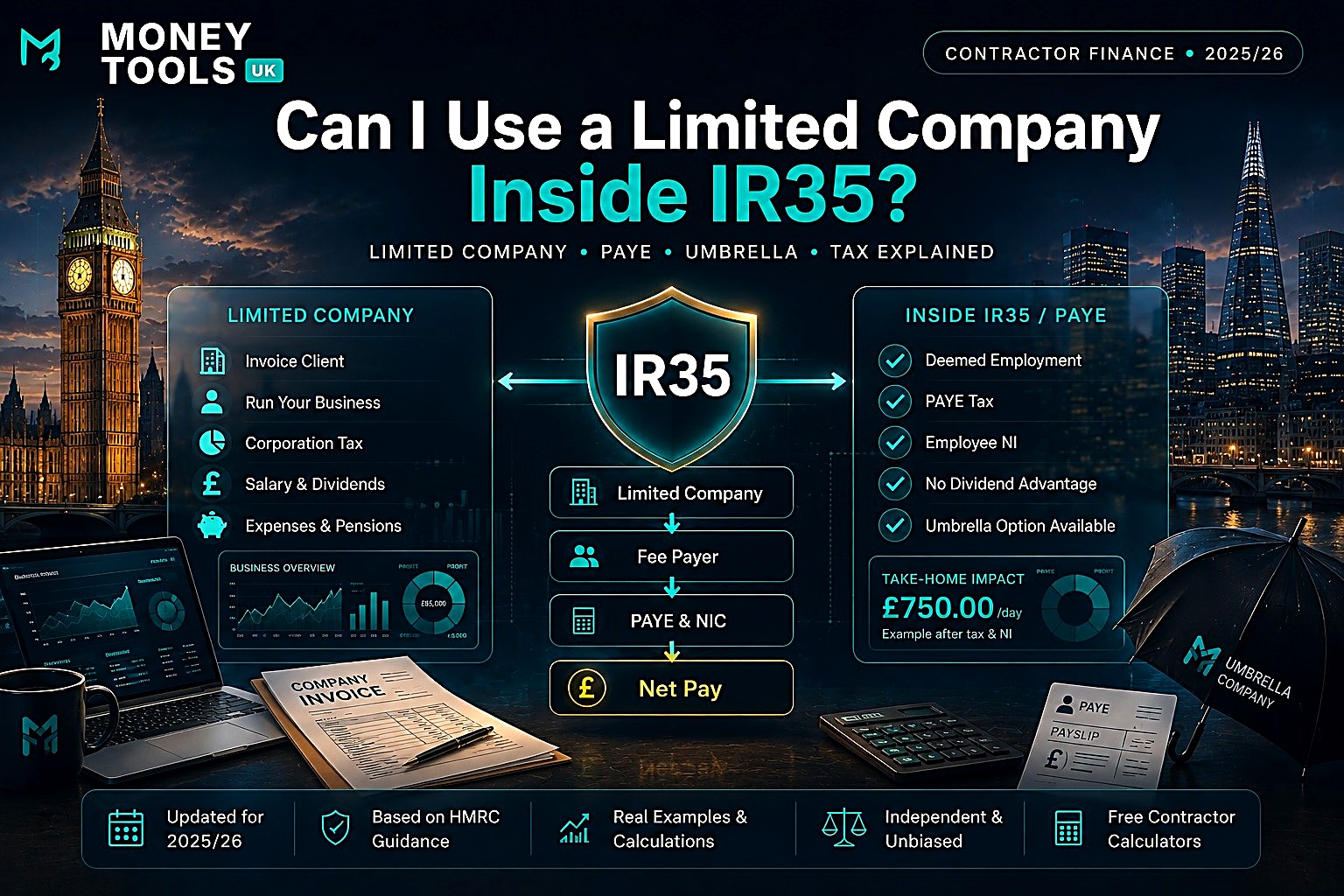
Can you keep the company?
Usually yes
How is it taxed?
Like employment
Often simpler
Umbrella
Inside IR35 does not automatically close your company. It changes how that contract's income is taxed — and usually removes most of the limited company tax advantages for that engagement.
Many contractors assume that being Inside IR35 automatically means they cannot use their limited company. The truth is more nuanced. A contractor may still be able to keep and use a limited company, but the tax treatment of an Inside IR35 contract usually removes many of the benefits that make limited company contracting attractive.
The short version: yes, you can usually keep a limited company if a contract is Inside IR35, but the income from that specific contract is normally taxed broadly like employment income. In many cases an umbrella company may be simpler, but keeping the company may still make sense if you also have Outside IR35 work, plan to take future Outside IR35 contracts, or want to maintain the business.
This guide explains what really changes when a contract falls Inside IR35 in the 2025/26 tax year, what happens to salary, dividends, Corporation Tax, expenses and pensions, and how to decide between keeping your company and switching to an umbrella.
The quick answer
You can usually keep your limited company if one contract is Inside IR35. However, the income from that contract will normally be treated as a deemed employment payment for tax purposes. That means PAYE Income Tax and National Insurance are applied before the money reaches the company or the contractor.
Key point
Inside IR35 does not automatically close your company. It changes how that contract income is taxed — and usually removes the salary, dividend and expense flexibility that makes a limited company attractive.
What does Inside IR35 mean?
Inside IR35 means the working relationship looks more like employment than genuine independent business-to-business contracting for tax purposes. In other words, if you stripped away the limited company or agency, you would look and behave like an employee of the end client.
Status is judged on the real working arrangement, not just the words in the contract. The main factors are:
- Control — how much the client dictates what you do, how, when and where.
- Substitution — whether you can genuinely send a qualified substitute in your place.
- Mutuality of obligation — whether the client must offer work and you must accept it.
- Working practices — whether you operate like an in-house employee (fixed hours, line management, company equipment).
- Client responsibility — for many engagements the end client (or fee-payer) is responsible for deciding your IR35 status.
For a full comparison of the two positions, read Inside IR35 vs Outside IR35.
Can you legally use a limited company inside IR35?
Yes — but the tax advantage is usually reduced or removed for that contract. There is no rule that forces you to close your limited company just because an engagement is Inside IR35.
The limited company may still exist, invoice and receive funds in some circumstances, but the fee-payer (usually the agency or client) may deduct PAYE Income Tax and National Insurance before the money reaches your company, depending on the arrangement. Once tax has already been applied to that deemed employment payment, there is little scope to take the same income again as dividends or to shelter it through normal company planning.
What GOV.UK says
What actually changes when a contract is Inside IR35?
The mechanics of how money flows change significantly. Outside IR35, your company controls the income. Inside IR35, tax is applied at source before you have the same planning options.
Outside IR35 (limited company)
Inside IR35 (deemed employment)
Why the tax benefits are reduced
The main benefit of a limited company is flexibility. Outside IR35, a genuine contractor business can usually blend several levers to manage tax efficiently:
- Salary
- Dividends
- Company expenses
- Pension contributions
- Retained profits
Inside IR35 restricts this because the relevant contract income is treated as employment-like income. Once PAYE has been applied at source, the money is no longer ordinary company profit that you can freely plan around — which is why an Inside IR35 limited company often produces a take-home figure close to an umbrella.
Key takeaway
What happens to salary and dividends?
Outside IR35, contractors often take a low salary plus dividends to reduce National Insurance and use lower dividend tax rates. See Best Salary and Dividend Split for UK Contractors for how this works in practice.
Inside IR35, the relevant contract income is not normally treated the same way. The income is taxed through PAYE as a deemed employment payment, so you cannot simply take that Inside IR35 income out as dividends to avoid PAYE.
Do not take Inside IR35 income as dividends
What happens to Corporation Tax?
If PAYE has already been applied to the deemed employment payment, the Corporation Tax treatment of that income may differ from normal Outside IR35 company income. The point of the rules is to avoid the same income being taxed twice, so amounts already taxed under PAYE are generally not taxed again as company profit.
However, the detail depends on how the payment is routed, whether the fee-payer or your company operates PAYE, and how the funds are recorded in the company accounts.
Get this checked
What happens to expenses?
Inside IR35 usually restricts the usefulness of many company expense claims for that contract. The broad expense flexibility that makes an Outside IR35 limited company attractive is largely lost.
Outside IR35
A wider range of genuine business expenses may be relevant and can reduce taxable profit.
Inside IR35
Many expenses may not reduce your take-home in the same way, and ordinary commuting is generally not claimable.
For a full breakdown of what is and is not allowable, read What Expenses Can Contractors Claim?
What happens to pensions?
Pensions may still be useful Inside IR35, especially employer pension contributions or salary sacrifice, depending on the payment route. Pension contributions can reduce taxable income and remain one of the few efficient planning tools that often survives an Inside IR35 arrangement.
To understand how pension sacrifice cuts Income Tax and National Insurance, and how it affects thresholds, read Salary Sacrifice Explained and Adjusted Net Income Explained.
Umbrella company vs limited company inside IR35
When a contract is Inside IR35, the practical difference between running it through your limited company and using an umbrella company is often small on take-home — but very different on admin and simplicity.
| Feature | Limited Company Inside IR35 | Umbrella Company | Recommendation |
|---|---|---|---|
| Admin | Higher — accounts, filings, payroll | Low — handled for you | 🟠Umbrella simpler |
| Tax flexibility | Very limited for the Inside IR35 contract | None — pure PAYE | 🟠Little difference |
| PAYE deductions | Applied to the deemed employment payment | Applied to the assignment rate | 🟠Broadly similar |
| Expenses | Mostly restricted for that contract | Very limited | 🟠Both restricted |
| Accountancy costs | Ongoing fees still apply | Usually none | 🟠Umbrella cheaper |
| Best for mixed contracts | Yes — keeps the company available | No — one engagement at a time | 🟢Keep the company |
| Best for a simple Inside IR35 role | Rarely worth it | Usually simplest | 🟠Use umbrella |
| Take-home clarity | Can be complex to reconcile | Clear PAYE payslip | 🟠Umbrella clearer |
🟢 Better choice🟠 Depends / little difference🔴 Usually not recommended
For the full structure comparison, see Umbrella Company vs Limited Company and How Much Does an Umbrella Company Actually Cost?
Compare umbrella vs limited company take-home
Run your day rate through the Contractor Tax Calculator to see the real take-home difference between an umbrella company and a limited company inside IR35.
When keeping your limited company may still make sense
Keeping your company running may still be worthwhile if:
- You have Outside IR35 contracts too
- You expect future Outside IR35 work
- You have retained profits in the company
- You have ongoing business expenses
- You want to keep the company active and trading
- You have multiple clients
- You want pension planning flexibility
When an umbrella company may be simpler
An umbrella company may be the simpler option if:
- All your current contracts are Inside IR35
- No Outside IR35 work is expected
- You want minimal admin
- The agency or client prefers umbrella payroll
- Accountancy costs outweigh the company's benefits
- You want straightforward PAYE payslips
To understand every deduction on an umbrella payslip, read How Umbrella Company Take-Home Pay Really Works.
Why do agencies often encourage contractors to use umbrella companies?
When a contract is Inside IR35, many recruitment agencies actively steer contractors towards an umbrella company rather than paying a personal service company. This is usually about reducing their own risk and admin rather than maximising your take-home pay. The main reasons are:
- Payroll simplicity — the umbrella runs PAYE, so the agency pays a single compliant supplier instead of operating deemed-payment payroll itself.
- Compliance — using an established umbrella keeps the agency comfortable that Income Tax and NI are deducted correctly at source.
- Reduced administration — timesheets, payslips, holiday pay and statutory payments are all handled by the umbrella.
- Reduced IR35 risk — with PAYE applied to the assignment rate, there is little residual off-payroll exposure for the agency or client.
- Quicker onboarding — umbrella payroll can usually be set up in a day or two, so you can start faster.
Agency preference is not tax advice
Who is the fee-payer?
The fee-payer is the organisation responsible for deducting Income Tax and National Insurance before paying an Inside IR35 contractor. In plain English, it is whoever sits directly above you in the contractual chain and pays your limited company (or umbrella).
Under the off-payroll rules, the end client decides your IR35 status, but the fee-payer is the party that actually operates PAYE on the deemed employment payment. This is usually the recruitment agency, or the end client if there is no agency in the chain.
Practical example — who deducts the tax?
You work through Your Ltd for a bank, placed by a recruitment agency. The bank (end client) assesses the role as Inside IR35. The agency pays your company, so the agency is the fee-payer. Before the money reaches Your Ltd, the agency deducts Income Tax and Employee NI and pays those to HMRC. Your company receives the net amount as a deemed employment payment.
If there were no agency and the bank paid you directly, the bank would be the fee-payer instead.
Mixed contracts: Inside IR35 and Outside IR35
This is important: a contractor can have one contract Inside IR35 and another Outside IR35 at the same time. IR35 status is assessed per engagement, not permanently attached to the contractor.
Quick example — Contractor A
- Contract 1: Inside IR35, paid via an umbrella company on PAYE.
- Contract 2: Outside IR35, invoiced through the limited company with salary, dividends and expenses.
Here the limited company is still genuinely useful — it handles the Outside IR35 work efficiently, while the Inside IR35 engagement runs cleanly through the umbrella. Closing the company would remove a working structure that is still earning.
Example: Inside IR35 through a limited company
These figures are illustrative only.
- Day rate: £500/day
- Billed days: ~220
- Contract value: ~£110,000
Because the contract is Inside IR35, PAYE treatment may apply to the deemed employment payment before funds are available for normal salary or dividend planning. In practice the take-home lands close to an equivalent umbrella outcome, but you still carry company admin, filings and accountancy costs. For many contractors, that extra effort is not rewarded unless the company is also used for Outside IR35 work.
Example: Inside IR35 through an umbrella company
Using the same £500/day example, the umbrella route runs like this:
Umbrella Route (Inside IR35)
For a deeper breakdown of these numbers, see How Much Does an Umbrella Company Actually Cost? and Is a £500/Day Contract Worth It After Tax?
Put your own numbers in
These worked examples are illustrative. Enter your day rate to see your personal Inside IR35 and umbrella take-home pay side by side.
Decision guide
You may keep your limited company if:
- You have Outside IR35 work
- You expect future Outside IR35 work
- The company has retained funds
- Your accountant confirms it still makes sense
Umbrella may be simpler if:
- All your work is Inside IR35
- You want PAYE simplicity
- Company admin is no longer worthwhile
Red flags and common mistakes
- Assuming Inside IR35 means the company must close
- Taking Inside IR35 income as dividends without advice
- Ignoring ongoing accountancy costs
- Not comparing umbrella take-home pay
- Not checking the Key Information Document
- Treating all contracts as having the same IR35 status
- Closing the company too quickly
- Ignoring retained profits and future plans
What should I do next?
If a contract has been assessed as Inside IR35, work through this short checklist before deciding whether to keep your limited company or move to an umbrella.
Your next-steps checklist
- ✓Check your IR35 status for each current and upcoming contract
- ✓Compare umbrella vs limited company take-home for the same rate
- ✓Review your ongoing accountancy and company running costs
- ✓Consider your future contracts and likely IR35 status
- ✓Decide whether to keep, pause or close your limited company
- ✓Speak to a qualified accountant if you are unsure
Work out your contractor take-home pay
Use the Money Tools UK Contractor Tax Calculator to compare limited company, umbrella and Inside IR35 outcomes before deciding what structure makes sense.
Related guides
These guides explain how IR35 status, umbrella companies and limited company tax planning fit together.
- Umbrella Company vs Limited Company — which structure pays more and when.
- How Much Does an Umbrella Company Actually Cost? — every umbrella deduction explained.
- Is a £500/Day Contract Worth It After Tax? — day-rate take-home compared.
- How Umbrella Company Take-Home Pay Really Works — reading an umbrella payslip.
- Inside IR35 vs Outside IR35 — the status rules that decide your structure.
- Why Is Inside IR35 Take-Home Pay So Low? — where Inside IR35 income goes.
- What Expenses Can Contractors Claim? — allowable business expenses.
- Best Salary and Dividend Split for UK Contractors — limited company tax efficiency.
- Umbrella vs PAYE — how umbrella and agency PAYE deductions compare.
Related calculators
- Contractor Tax Calculator — compare limited company, umbrella and IR35 outcomes.
- Umbrella Company Calculator — estimate umbrella take-home pay.
- IR35 Calculator — compare inside and outside IR35 side by side.
- Inside IR35 Calculator — model Inside IR35 take-home pay.
- Take-Home Pay Calculator — check PAYE take-home for any salary.
Sources & references
This guide reflects official UK government and HMRC guidance on off-payroll working (IR35), employment status, umbrella companies, Corporation Tax, PAYE and National Insurance for the 2025/26 tax year.
- GOV.UK — Understanding off-payroll working (IR35)
- GOV.UK — Check employment status for tax (CEST)
- GOV.UK — IR35: off-payroll working rules for clients
- GOV.UK — Corporation Tax rates
- GOV.UK — PAYE and payroll for employers
- GOV.UK — National Insurance rates and categories
- GOV.UK — Working through an umbrella company
- HMRC — Employment Status Manual
Last updated
This article was last reviewed on 5 July 2026 and reflects UK contractor tax, off-payroll working (IR35), umbrella company, Corporation Tax and PAYE rules for the 2025/26 tax year. We refresh this guide each time HMRC publishes a material change.
Reviewed by Money Tools UK Editorial Team
This guide was reviewed for accuracy against HMRC and GOV.UK off-payroll working guidance for the 2025/26 tax year. We regularly update our contractor and tax content when thresholds, rates or status rules change.
Last reviewed: 5 July 2026
Disclaimer
Money Tools UK provides educational information and calculators only. This article is not tax, accounting, legal, employment or financial advice. Contractor tax treatment depends on contract terms, working practices, fee-payer responsibilities, company structure, expenses, pension arrangements and personal circumstances. Speak to a qualified accountant or tax adviser before making decisions.
Get new UK finance and property guides from Money Tools UK
Plain-English UK finance insights, tax updates and property investing guides.
Related calculators
Contractor Tax Calculator
The exact calculator this article is built around — open it and run your own numbers.
Open calculatorFrequently asked questions
Related guides
More flagship guides and tools from Money Tools UK.
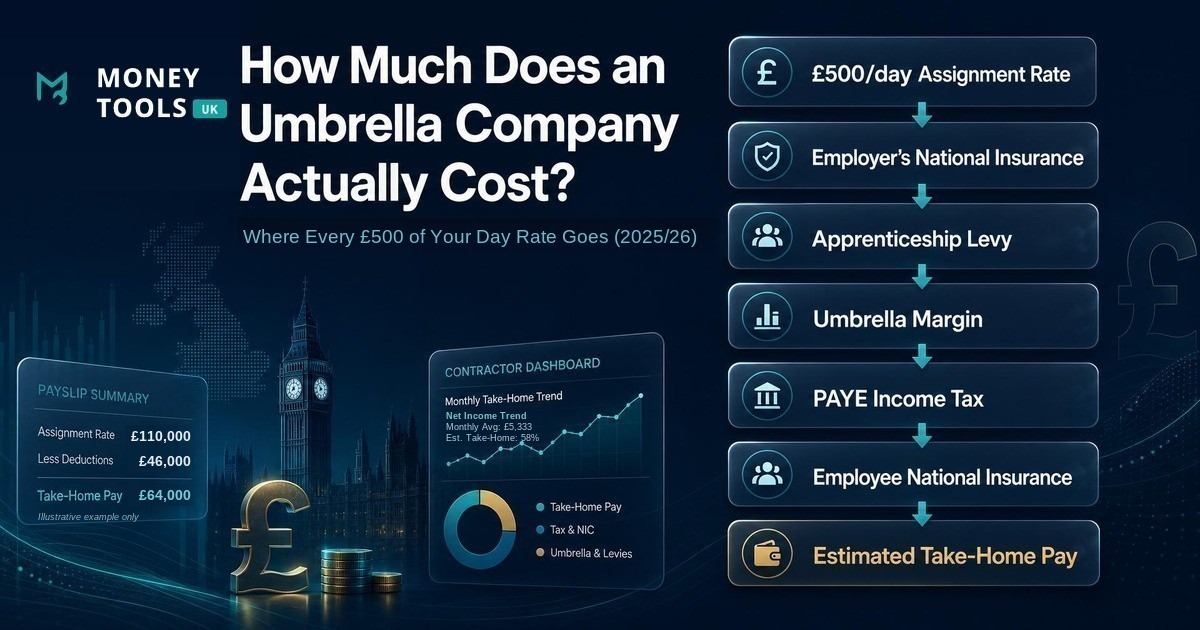
See how much an umbrella company really costs in 2025/26, including umbrella margin, Employer's NI, Apprenticeship Levy, holiday pay, pension deductions and contractor take-home pay.
Read guide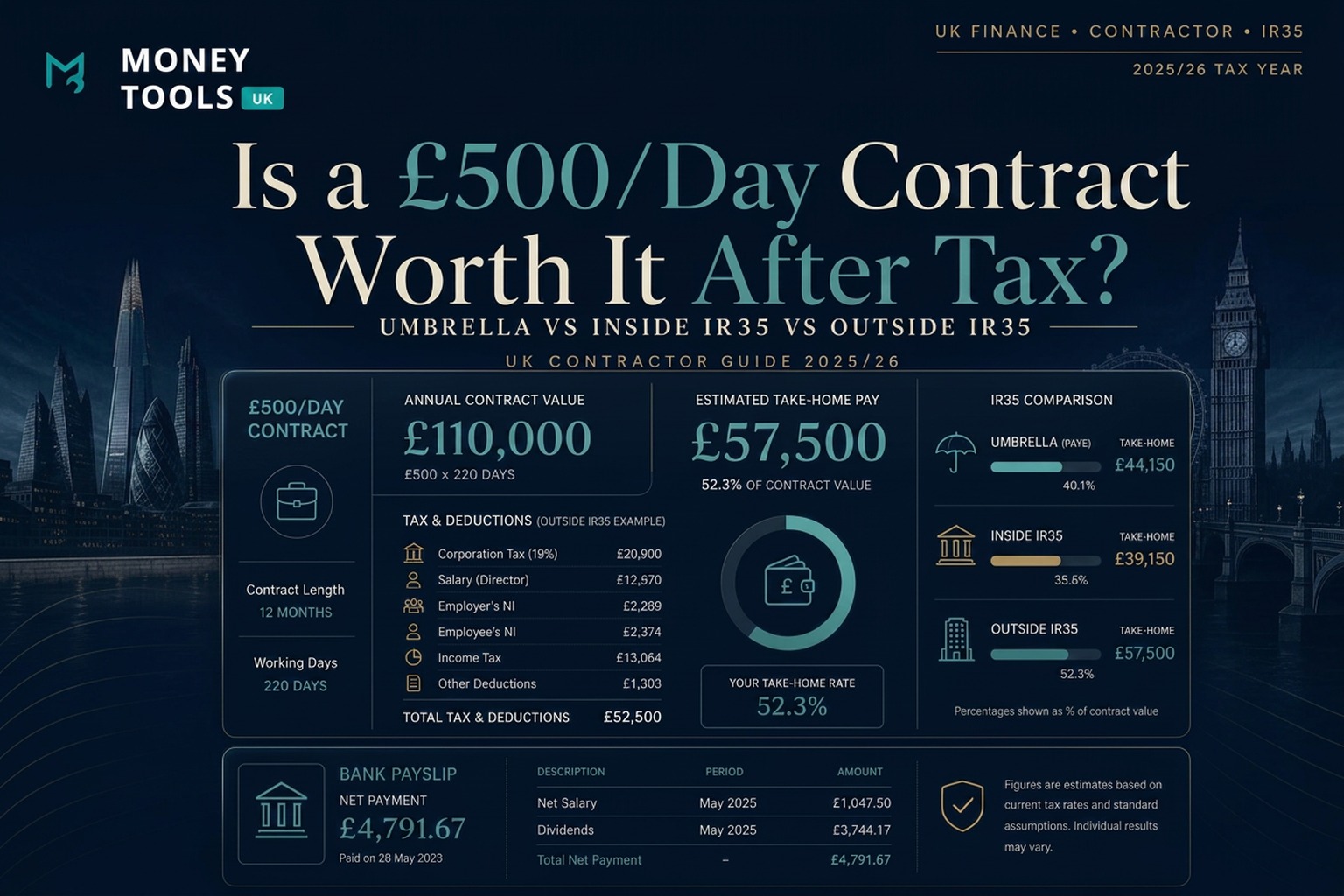
See how much a £500/day contract could be worth after tax in 2025/26. Compare umbrella company, inside IR35, outside IR35 and limited company take-home pay.
Read guide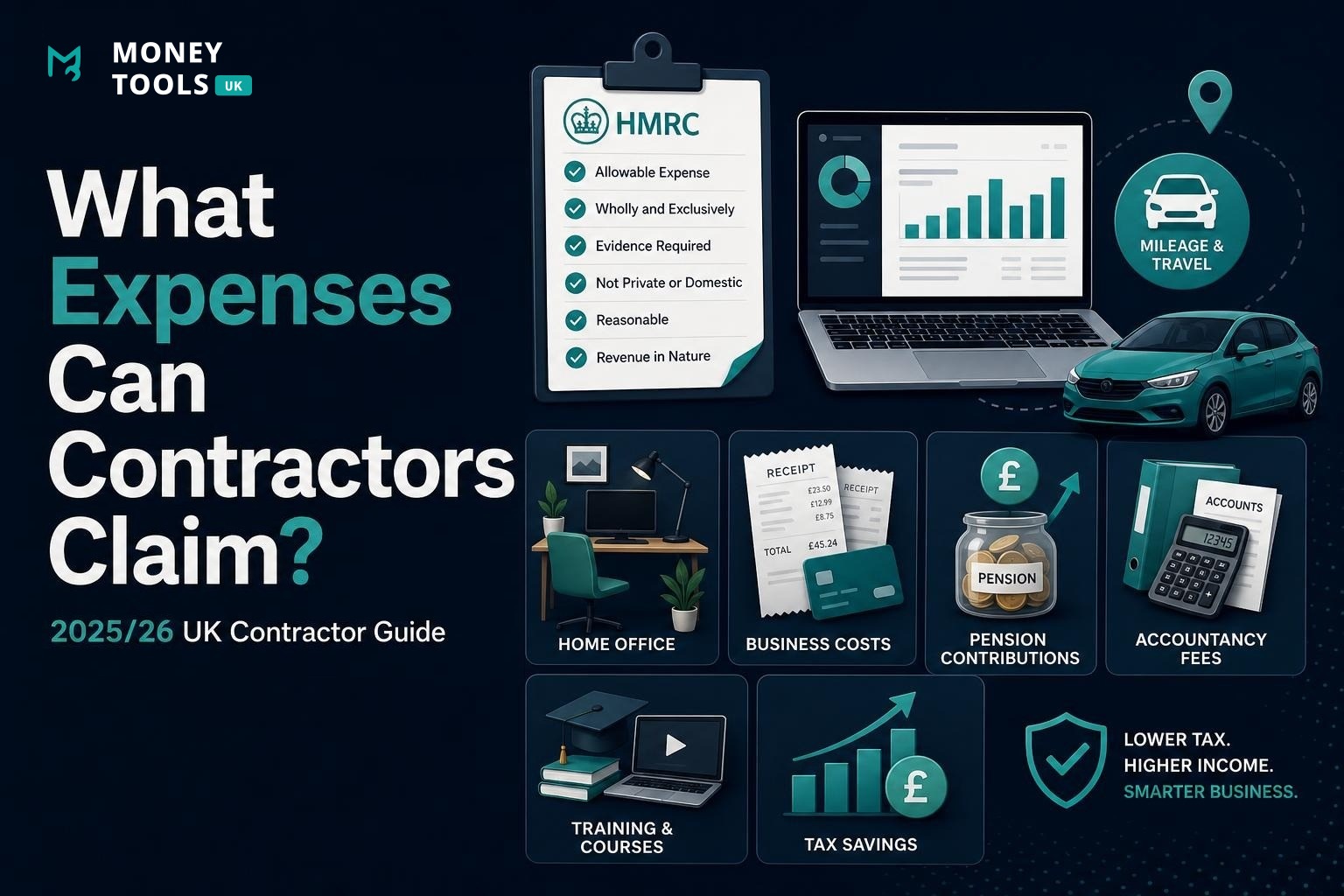
Learn which business expenses UK contractors can claim in 2025/26, including travel, home office, equipment, subscriptions, accountancy fees, training, pensions and more.
Read guideDisclaimer: This content is for informational purposes only and should not be treated as financial, tax, mortgage, investment or legal advice.