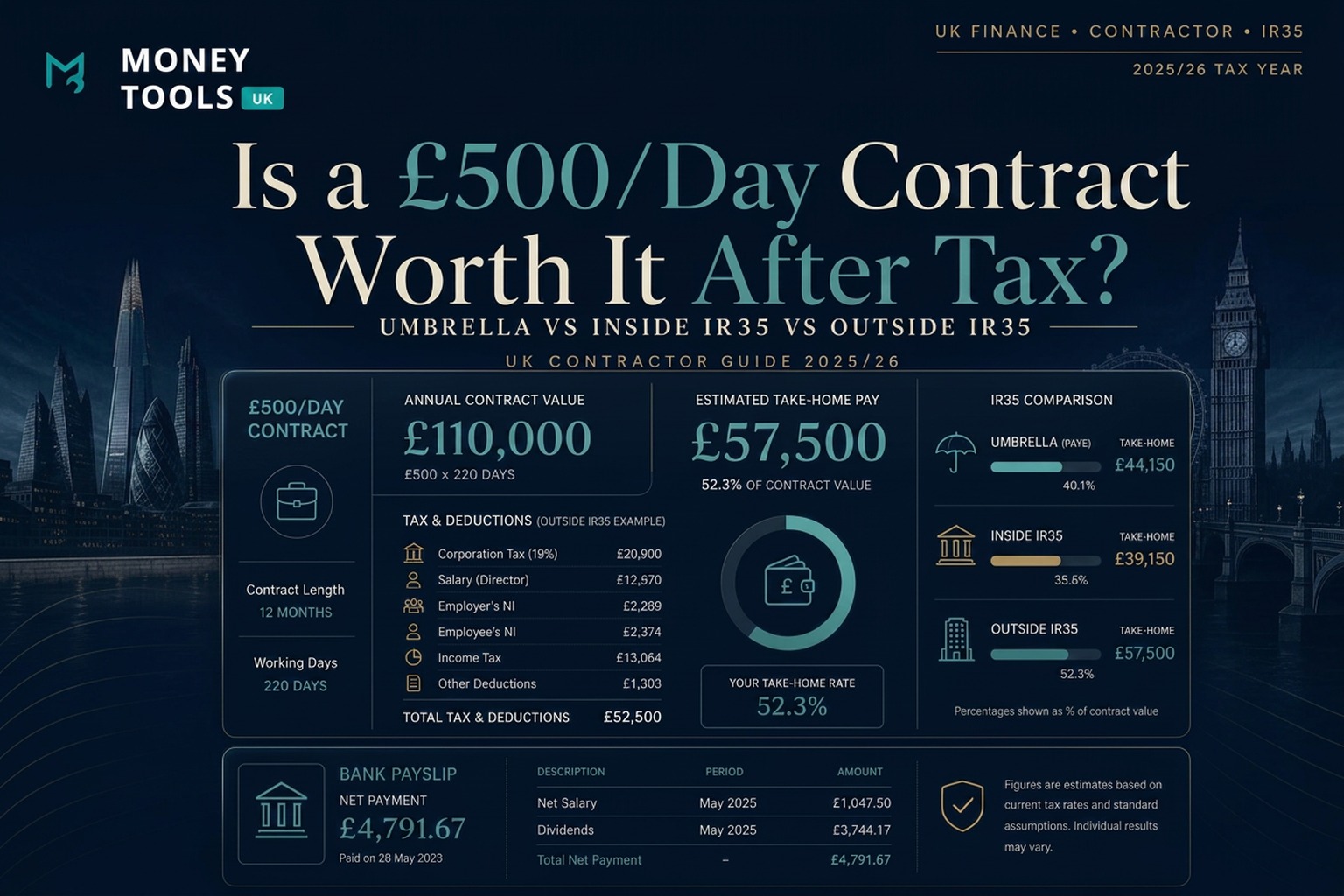
Contract value
~£110k–£130k
What you keep
Depends on structure
Biggest factor
IR35 status
The day rate is not your salary. Two contractors on the same £500/day can keep tens of thousands of pounds more or less depending on how they work and how they plan.
A £500/day contract sounds attractive. At five days per week it may appear to generate well over £100,000 a year. But contractors quickly discover that the amount billed to a client is not the same as the amount that reaches their bank account.
Umbrella companies, PAYE deductions, Employer's National Insurance, IR35 rules, Corporation Tax and dividend strategies can all have a significant impact on take-home pay. This guide shows what a £500/day contract may look like under different working arrangements and helps explain whether a £500/day contract is genuinely worth it in the 2025/26 tax year.
The short answer
A £500/day contract can generate roughly £110,000–£130,000 of annual contract income depending on how many days you actually bill. However, actual take-home pay varies significantly depending on how you work.
Your real take-home depends on:
- whether you use an umbrella company
- whether the contract is inside IR35
- whether the contract is outside IR35
- whether you use a limited company structure
- your pension contributions
- allowable expenses
- your salary and dividend strategy
A contractor on £500/day may keep tens of thousands of pounds less under one structure than another. The single biggest factor is usually your IR35 status.
What does £500/day actually mean?
A day rate looks simple, but it hides a lot of detail. To turn £500/day into an annual figure, contractors typically make a few assumptions:
- £500 per day
- 5 days per week
- around 46 working weeks per year
Quick example
£500 × 5 days × 46 weeks ≈ £115,000 annual contract value. Bill closer to 48 weeks and it approaches £120,000; allow more gaps and it can drop towards £100,000.
The catch is that contractors rarely bill every working day of the year. Real-world income is reduced by:
- holidays (contractors are not paid for time off)
- gaps between contracts
- sickness
- training days
- bench time waiting for the next assignment
This is why a £500/day rate is best thought of as a contract value rather than a salary. Before any tax, the amount you actually invoice is already lower than the headline annual figure suggests.
Annual income from a £500/day contract
The table below shows how the number of billed days changes your annual contract value before any tax or deductions. Use it as a reality check against the optimistic "£500 × 5 × 52" maths.
| Billed days per year | Working pattern | Annual contract value |
|---|---|---|
| 200 days | Frequent gaps / bench time | £100,000 |
| 220 days | Realistic full-time contractor | £110,000 |
| 230 days | Few gaps, limited time off | £115,000 |
| 240 days | Almost continuous billing | £120,000 |
| 260 days | Every weekday (unrealistic) | £130,000 |
Most genuine full-time contractors land somewhere around 220 billed days, giving roughly £110,000 of contract value. That is the figure used in the worked examples below.
What permanent salary is £500/day equivalent to?
Contractors naturally compare day rates to permanent salaries, but the comparison is rarely like-for-like. As a contractor you fund things a permanent employee gets for free — paid holidays, employer pension contributions, sick pay, training, and the periods between contracts when you are not billing at all. You also carry your own business costs.
Taking those factors into account, a £500/day contract is often broadly comparable to a permanent salary somewhere in the region of £80,000–£95,000, depending on the benefits package, pension contributions, how many gaps you have between contracts, and your working arrangements. It is a useful sense-check rather than an exact equivalence — the right figure for you depends on how much of that day rate you actually keep and what you have to cover yourself.
£500/day under an umbrella company
Many contractors — particularly those inside IR35 — are paid through an umbrella company. The umbrella becomes your employer and runs everything through PAYE. Crucially, the assignment rate the agency quotes is not your gross salary: it has to fund employment costs first.
Typical deductions from an umbrella assignment rate include:
- the umbrella's margin (its fee)
- Employer's National Insurance
- the Apprenticeship Levy
- PAYE Income Tax
- Employee's National Insurance
Where a £500/day umbrella rate goes
Example: Where £110,000 of Umbrella Income Goes
Annual assignment value: £110,000
Typical deductions may include:
- Employer’s National Insurance and Apprenticeship Levy: approximately £14,000–£16,000
- Umbrella company margin: approximately £500–£1,500
- Gross taxable pay after employer costs: approximately £93,000–£95,000
- PAYE Income Tax and Employee National Insurance: approximately £28,000–£33,000
Estimated take-home pay:
£62,000–£68,000
Figures are illustrative only and vary depending on tax code, pension contributions, umbrella fees and personal circumstances.
As a rough worked example, on around £110,000 of annual assignment value an umbrella contractor might typically keep in the region of £62,000–£68,000 after all deductions, depending on margin, pension contributions and tax code. That is comfortably less than the headline rate implies.
Why does my assignment rate feel lower than expected?
£500/day inside IR35
When a contract is inside IR35, HMRC treats the engagement as deemed employment for tax purposes. Even if you have a limited company, the income is taxed broadly like a normal salary through PAYE.
Inside IR35 means:
- deemed employment for tax purposes
- PAYE treatment on the contract income
- reduced flexibility over how you take money out
- limited tax planning compared with outside IR35
In practice, the inside IR35 take-home for a £500/day contract is very close to the umbrella result — because most inside IR35 contractors are paid via an umbrella anyway. The tax-efficient salary/dividend split that makes contracting attractive simply is not available. Expect take-home in a similar £60,000–£66,000 region, with little room to improve it beyond pension contributions. Our guide on why inside IR35 take-home pay is so low explains the mechanics in detail.
£500/day outside IR35
Outside IR35 contractors operating genuinely as a business have far more flexibility — and this is where a £500/day contract can become meaningfully more rewarding. Instead of everything running through PAYE, profits can be extracted in a planned way.
Outside IR35 through a limited company typically allows you to use:
- a tax-efficient salary
- dividends taxed at lower rates than salary
- employer pension contributions
- allowable business expenses
Combining a modest director's salary with dividends, claiming legitimate costs and paying into a pension can lift take-home well above the umbrella and inside IR35 outcomes for the same £500/day. To go deeper, see the best salary and dividend split for UK contractors and what expenses contractors can claim.
Limited company example
Here is an illustrative outside IR35 limited company example for a £500/day contract billing around 220 days (~£110,000 of contract income). Figures are rounded and for illustration only.
| Item | Illustrative amount |
|---|---|
| Annual contract income | £110,000 |
| Director's salary | £12,570 |
| Allowable business expenses | £3,000–£6,000 |
| Employer pension contribution | £10,000 (optional) |
| Corporation Tax (19%–25%) | on remaining profit |
| Dividends extracted | from post-tax profit |
| Estimated take-home range | ~£72,000–£80,000 |
The exact result depends on how much you leave in the company, your pension strategy and your expenses. A contractor who maximises pension contributions will show a lower cash take-home but a much higher total financial benefit. Run your own numbers in the Contractor Tax Calculator.
Take-home pay comparison table
The table below brings the three main routes together for a £500/day contract. These figures are illustrative only and will vary with pension contributions, expenses, umbrella margin and personal circumstances.
| Working arrangement | Approx contract value | Typical deductions | Approx take-home | Flexibility |
|---|---|---|---|---|
| Umbrella company | ~£110,000 | Margin, Employer NI, Levy, PAYE, Employee NI | ~£62,000–£68,000 | Low |
| Inside IR35 | ~£110,000 | PAYE Income Tax, Employee NI, employer costs | ~£60,000–£66,000 | Low |
| Outside IR35 limited company | ~£110,000 | Corporation Tax, dividend tax, salary tax/NI | ~£72,000–£80,000 | High |
Assumptions used
These illustrative examples assume:
- approximately 220 billed days per year
- a £500/day contract rate
- standard 2025/26 UK tax rates and thresholds
- no unusual tax circumstances
- typical contractor working patterns
Actual results will vary depending on expenses, pension contributions, tax code, IR35 determination and individual circumstances.
Figures are illustrative only
Why contractors are often surprised
Many first-time contractors expect £500/day to translate into a six-figure salary in their pocket. The gap usually comes down to a handful of costs and assumptions that are easy to overlook:
- Employer's National Insurance funded from the assignment rate
- the Apprenticeship Levy
- umbrella company margins and admin costs
- misunderstanding how day rates convert to gross pay
- forgetting that holidays are unpaid
- forgetting gaps between contracts and bench time
Tax planning opportunities
If your contract is genuinely outside IR35, sensible tax planning can make a £500/day contract considerably more rewarding. The main levers are:
- pension contributions (often the single biggest opportunity)
- claiming legitimate business expenses
- an efficient dividend strategy
- optimising your director's salary
Each of these has its own detailed guide: what expenses contractors can claim, the best salary and dividend split and adjusted net income explained (important once contract income pushes you towards £100,000).
Pension contributions
For outside IR35 contractors, employer pension contributions are one of the most effective tools available. Contributions made by the company are usually an allowable business expense, reduce Corporation Tax, and avoid Income Tax and National Insurance at the point of contribution — subject to the annual allowance.
On a £500/day contract, diverting some profit into a pension can both lower your current tax bill and build long-term wealth. It also helps keep your adjusted net income below key thresholds. Even inside IR35, pension contributions through an umbrella can still improve overall tax efficiency, making them worth considering whatever your structure.
Common mistakes
- assuming £500/day is the same as a £130k salary
- ignoring IR35 status before accepting a contract
- misunderstanding umbrella deductions and the two-rate system
- poor or non-existent tax planning
- failing to budget for gaps between contracts
- no pension planning
- no emergency fund to cover bench time
Is £500/day a good contract rate?
For many contractors, £500/day is a strong professional contract rate — comfortably above the UK average and capable of producing a healthy income, especially outside IR35. But whether it is "good" for you depends on context.
- Sector matters — £500/day is excellent in some fields and mid-range in others such as senior tech, change or finance.
- Experience matters — a junior contractor on £500/day is doing very well; a niche specialist may command far more.
- IR35 status matters — the same rate outside IR35 is worth materially more than inside.
- Location matters — London and remote rates can differ significantly.
- Take-home pay matters — always judge a rate by what you keep, not the headline number.
Realistically, a £500/day outside IR35 contract that bills consistently can leave you better off than a six-figure permanent salary once pension and expenses are factored in — but only with planning. Inside IR35 or via an umbrella, the advantage narrows considerably.
Bottom line
A £500/day contract can be an excellent rate, but the headline figure is only part of the story. The amount you keep depends largely on your IR35 status, contract structure and tax planning. Two contractors earning the same day rate can finish the year with dramatically different take-home pay. Always evaluate a contract based on net income rather than the advertised day rate.
Estimate your contractor take-home pay
Use the Money Tools UK Contractor Tax Calculator to compare umbrella company, inside IR35 and limited company scenarios for a £500/day contract.
Related guides
- What Expenses Can Contractors Claim? — cut your tax bill with allowable costs.
- Umbrella Company vs Limited Company — which structure pays more.
- How Umbrella Company Take-Home Pay Really Works.
- Umbrella vs PAYE — two PAYE routes compared.
- Inside IR35 vs Outside IR35.
- Why Is Inside IR35 Take-Home Pay So Low?
- Best Salary and Dividend Split for UK Contractors.
- How Much Tax Do UK Contractors Actually Pay?
Useful calculators: Contractor Tax Calculator, IR35 Calculator, Umbrella Calculator and the Day Rate Calculator.
Sources & references
This guide reflects official UK government and HMRC guidance on IR35, umbrella companies, National Insurance, Corporation Tax and pensions for the 2025/26 tax year.
- GOV.UK — Understanding off-payroll working (IR35)
- GOV.UK — Working through an umbrella company
- GOV.UK — National Insurance: introduction
- GOV.UK — Corporation Tax
- GOV.UK — Tax on your private pension contributions
- GOV.UK — Check employment status for tax (CEST)
Last updated
This article was last reviewed on 24 June 2026 and reflects UK contractor tax, IR35, PAYE, umbrella company and limited company rules for the 2025/26 tax year. We refresh this guide each time HMRC publishes a material change.
Reviewed by Money Tools UK Editorial Team
This guide was reviewed for accuracy against HMRC and GOV.UK guidance for the 2025/26 tax year. We regularly update our contractor content when thresholds, rates or eligibility rules change.
Last reviewed: 24 June 2026
Disclaimer
Money Tools UK provides educational information and calculators only. This article is not tax, accounting, legal or financial advice. Individual tax outcomes vary depending on IR35 status, contract structure, expenses, pension contributions and personal circumstances.
Get new UK finance and property guides from Money Tools UK
Plain-English UK finance insights, tax updates and property investing guides.
Related calculators
Contractor Tax Calculator
The exact calculator this article is built around — open it and run your own numbers.
Open calculatorFrequently asked questions
Related guides
More flagship guides and tools from Money Tools UK.
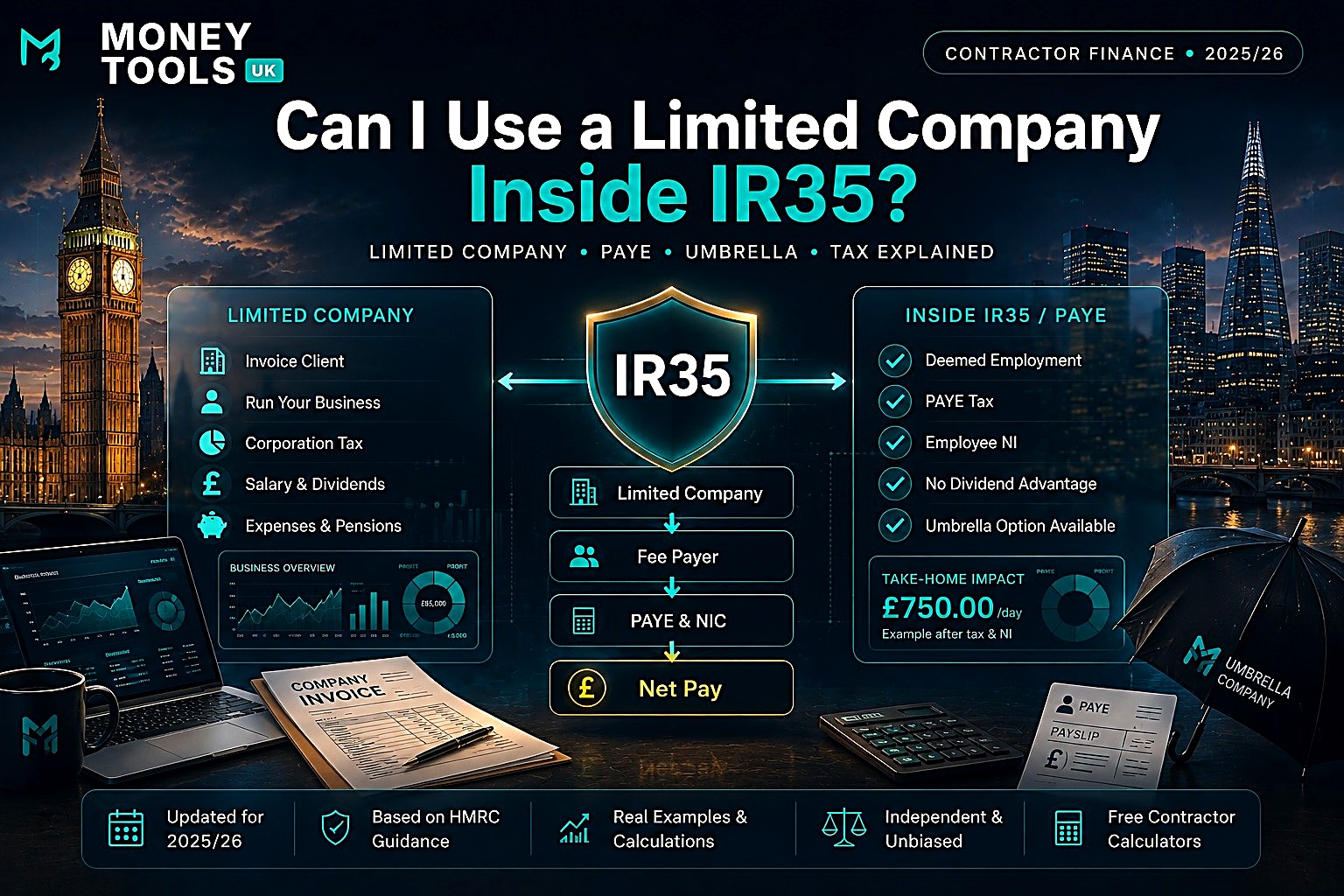
Can you still use a limited company inside IR35? Learn what happens to PAYE, dividends, Corporation Tax, expenses, umbrella companies and mixed inside/outside IR35 contracts.
Read guide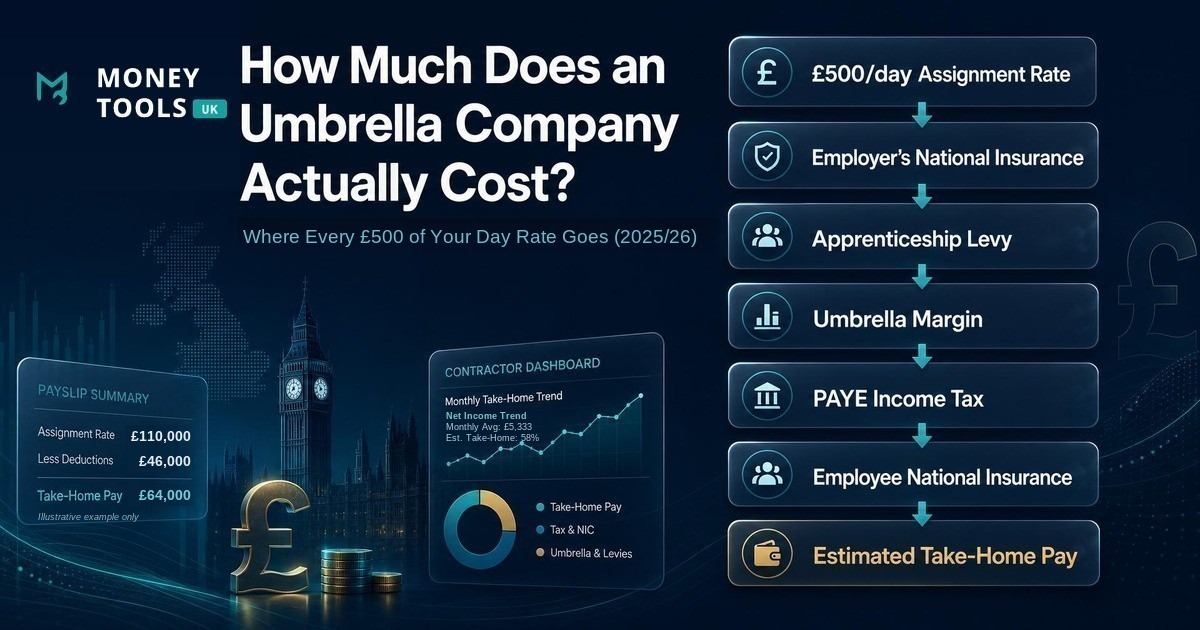
See how much an umbrella company really costs in 2025/26, including umbrella margin, Employer's NI, Apprenticeship Levy, holiday pay, pension deductions and contractor take-home pay.
Read guide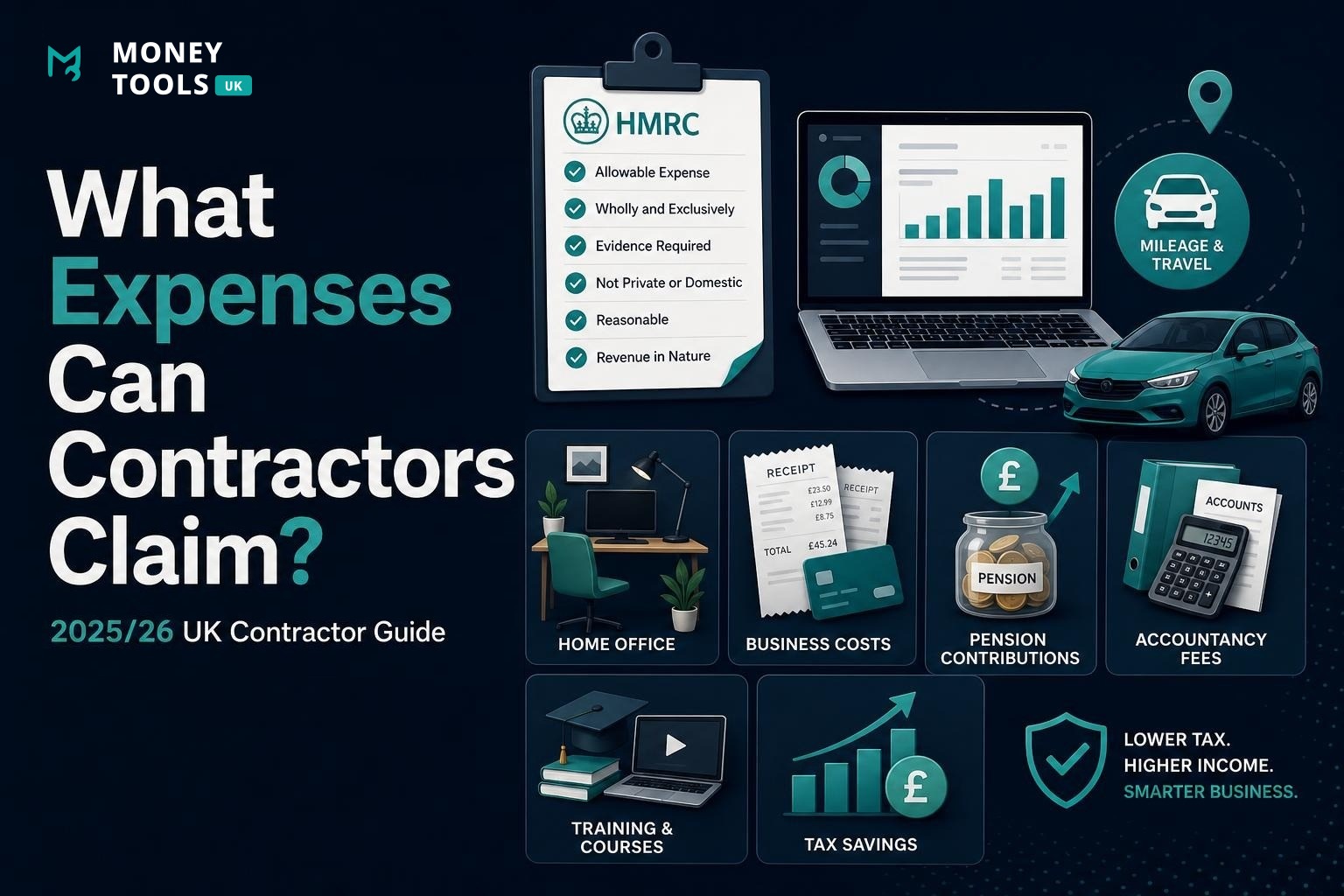
Learn which business expenses UK contractors can claim in 2025/26, including travel, home office, equipment, subscriptions, accountancy fees, training, pensions and more.
Read guideDisclaimer: This content is for informational purposes only and should not be treated as financial, tax, mortgage, investment or legal advice.