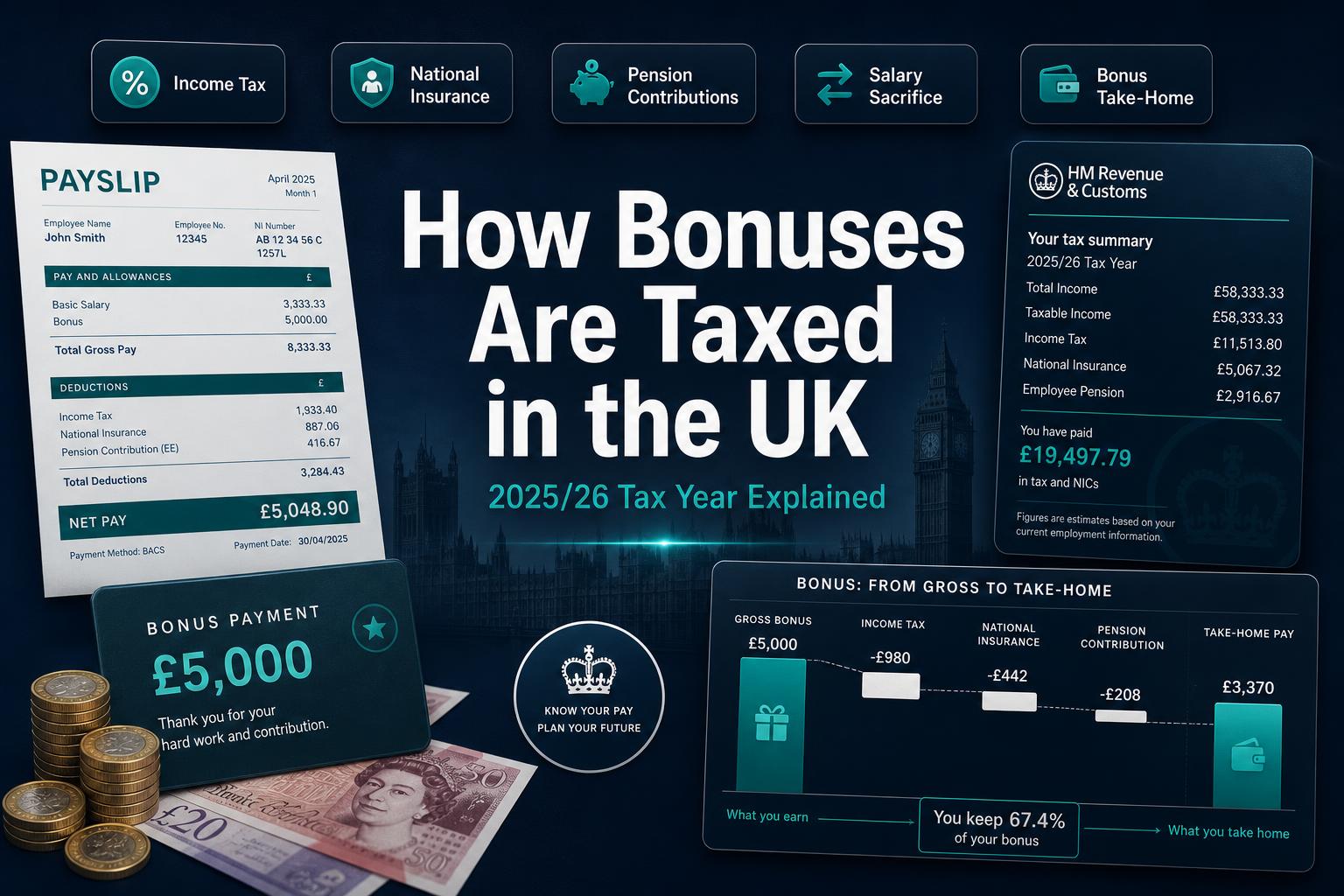
Most UK employees are delighted to receive a bonus — until they see how much actually arrives in their bank account. A bonus is taxed differently from regular salary in one important respect: it often pushes part of your earnings into higher tax bands. As a result, many people believe their employer has "taxed the whole bonus at 40%" or "taken half of it away."
In reality, bonuses are taxed through PAYE using the same Income Tax and National Insurance rules as ordinary earnings. This guide explains exactly how bonus taxation works in the 2025/26 tax year, including worked examples at £30,000, £50,000, £80,000 and £100,000 salaries.
Updated for 2025/26
The short answer
The short answer
How bonus taxation actually works
There is no separate "bonus tax" in the UK. A bonus is simply added to your pay in the month it is paid and run through PAYE alongside your salary. HMRC works on an annual earnings basis: your tax for the year is calculated on your total taxable income, and the normal tax bands still apply in exactly the same order.
- PAYE treatment. Your employer adds the bonus to that month's gross pay and deducts Income Tax, National Insurance and any student loan or pension before paying you.
- Bonus added to salary. The bonus sits on top of your salary, so it is taxed at your marginal rate — the rate that applies to your highest slice of income.
- Annual earnings basis. Over the tax year the system settles to the correct amount, so a bonus is never taxed at a mysterious extra rate.
- Tax bands still apply normally. The personal allowance (£12,570), 20% basic rate to £50,270, 40% higher rate to £125,140 and 45% additional rate above all work as usual.
Bonuses often appear heavily taxed because a single large payment can sit almost entirely in your highest band, while your monthly payroll software may briefly over-deduct. The reality is more reassuring — and the rest of this guide shows exactly why.
Why people think bonuses are taxed more heavily
Several quirks of PAYE make a bonus feel as though it has been taxed at a punitive rate:
- Emergency tax misunderstandings. If a bonus is paid on a non-cumulative or emergency tax code, too much tax can be taken in the short term — though it is refunded automatically later.
- Monthly payroll calculations. PAYE annualises a single month's pay. A big bonus month can make the software assume you'll earn at that rate all year, temporarily over-taxing you.
- Tax code effects. An out-of-date or incorrect tax code changes how much of your allowance is applied that month.
- Higher-rate thresholds. A bonus can push part of your income above £50,270, so that slice is taxed at 40% rather than 20%.
- Marginal tax rates. Because the bonus stacks on top of salary, it is the top slice of your income — and the top slice is always taxed at the highest rate you reach.
Worked example: only the top slice is higher-rate
Bonus taxation example: £30,000 salary + £5,000 bonus
With a £30,000 salary plus a £5,000 bonus, your gross earnings for the year are £35,000. You remain comfortably inside the basic-rate band, so the entire bonus is taxed at 20% Income Tax and 8% National Insurance.
| Gross earnings (salary + bonus) | £35,000 |
|---|---|
| Income Tax on the £5,000 bonus (20%) | −£1,000 |
| National Insurance on the bonus (8%) | −£400 |
| Bonus take-home | £3,600 |
You keep £3,600 of the £5,000 — about 72p in the pound. At basic-rate level, a bonus is one of the most lightly taxed you'll ever receive.
Bonus taxation example: £50,000 salary + £10,000 bonus
This example shows what happens when a bonus crosses into higher-rate tax. Salary £50,000 plus a £10,000 bonus gives total earnings of £60,000. Only the slice above £50,270 is taxed at 40%.
- £270 of the bonus (up to £50,270) is taxed at 20% = £54.
- £9,730 of the bonus (above £50,270) is taxed at 40% = £3,892.
- National Insurance: the first £270 at 8% (£21.60) and the £9,730 above the upper earnings limit at 2% (£194.60) ≈ £216.
Total deductions on the bonus are roughly £4,162, leaving a bonus take-home of about £5,838 — around 58p in the pound. The marginal rate effect is what people feel here: the bulk of the bonus is taxed at 40% plus 2% NI.
Bonus taxation example: £80,000 salary + £10,000 bonus
At £80,000 you are already a higher-rate taxpayer, so the entire £10,000 bonus falls in the 40% band, with National Insurance at the reduced 2% rate (you're above the £50,270 upper earnings limit).
| Income Tax on the bonus (40%) | −£4,000 |
|---|---|
| National Insurance on the bonus (2%) | −£200 |
| Bonus take-home | £5,800 |
Your effective bonus retention is 58% — you keep £5,800 of every £10,000. This is exactly the income level where pension planning becomes valuable: routing some or all of the bonus into a pension can recover the 40% tax (see the pension section below).
Bonus taxation example: £100,000 salary + £10,000 bonus
This is the key example. Once your income climbs above £100,000, your tax-free personal allowance is tapered away at a rate of £1 for every £2 earned. A £10,000 bonus taking you from £100,000 to £110,000 therefore triggers three things at once:
- 40% Income Tax on the £10,000 bonus = £4,000.
- 2% National Insurance on the bonus = £200.
- Personal allowance withdrawal of £5,000 (half the bonus), which becomes newly taxable at 40% = a further £2,000 of tax.
That's around £6,200 of deductions on a £10,000 bonus — an effective marginal rate close to 62%. This is the 60% tax trap: between £100,000 and £125,140, every extra pound is effectively taxed at about 60% once the lost allowance is taken into account. For a full explanation of why this happens, read our £100k Salary After Tax UK guide.
Why the 60% rate matters for bonuses
What happens if your bonus pushes you into a higher tax band?
Only the part of the bonus that lands in the higher band is taxed at the higher rate — never the whole bonus. There are three thresholds to watch:
- Basic rate to higher rate (£50,270). The slice above £50,270 jumps from 20% to 40% Income Tax, and NI on that slice drops from 8% to 2%.
- Higher rate to additional rate (£125,140). Income above £125,140 is taxed at 45%. A large bonus near this level has its top slice taxed at the additional rate.
- Personal allowance taper (£100,000–£125,140). In this band the effective rate spikes to about 60% because the allowance is withdrawn as income rises.
The takeaway: a bonus is taxed in slices, exactly like salary. Knowing which slice your bonus falls into tells you precisely what you'll keep.
How pension contributions can reduce bonus tax
Pensions are the single most effective legal way to reduce the tax on a bonus. Two routes exist:
- Salary sacrifice. You agree to give up the bonus (or part of it) before it is paid, and your employer pays it straight into your pension. Because the sacrifice happens before tax and National Insurance, you avoid Income Tax and the 2%/8% NI.
- Personal pension contributions. If you receive the bonus and then contribute from net pay, basic-rate relief is added automatically and higher- or additional-rate relief is claimed through your tax return.
- Adjusted net income. Pension contributions reduce your adjusted net income, which is the figure used for the personal allowance taper and the High Income Child Benefit Charge.
- Higher-rate relief. A higher-rate taxpayer gets 40% relief, so a £10,000 pension contribution effectively costs around £6,000 — or far less inside the 60% trap.
On the £80,000 + £10,000 example above, sacrificing the entire bonus into a pension means the full £10,000 lands in your pension instead of £5,800 in your bank account — a 40% Income Tax and 2% NI saving on every pound. On the £100,000 + £10,000 example, the saving is even greater because the personal allowance is restored. See our Salary Sacrifice Explained guide for full worked examples of these salary sacrifice arrangements.
See your bonus take-home in seconds
Use the Money Tools UK Take-Home Pay Calculator to add a bonus and instantly see the effect of Income Tax, National Insurance, pension contributions, salary sacrifice and student loans.
Can you avoid paying tax on a bonus?
No — you cannot make a bonus tax-free, and any scheme promising to do so should be treated with extreme caution. However, there are entirely legal ways to reduce the tax you pay:
- Salary sacrifice the bonus into your pension before it is paid.
- Pension contributions from net pay, reclaiming higher-rate relief.
- Charitable giving through Gift Aid, which extends your basic-rate band and can reduce adjusted net income.
- Timing of bonus payments — where your employer allows it, deferring a bonus into a tax year when your income is lower can keep more of it out of higher-rate or taper territory.
Bonus taxation with student loans
If you're repaying a student loan, a bonus increases your repayment for that period because repayments are a percentage of income above the plan threshold:
- Plan 1 — 9% above £26,065.
- Plan 2 — 9% above £28,470.
- Plan 4 (Scotland) — 9% above £32,745.
- Plan 5 — 9% above £25,000.
- Postgraduate Loan — 6% above £21,000.
For example, a Plan 2 borrower receiving a £5,000 bonus on top of a salary already above the threshold pays an extra 9% of the bonus — £450 — towards their loan that period. This is a deduction, not extra tax, and reduces your outstanding balance faster.
Bonus taxation and company directors
Company directors have an extra decision to make: take profit as a PAYE bonus or as dividends.
- PAYE bonuses are taxed as employment income — Income Tax plus employee and employer National Insurance, which makes them comparatively expensive for the company.
- Dividends are paid from post-corporation-tax profit and taxed at lower dividend rates (8.75% basic, 33.75% higher, 39.35% additional) with no National Insurance.
- Why dividends are treated differently — they are a return on shareholding rather than wages, so they sit outside the NI system but after corporation tax has been paid.
The most tax-efficient mix depends on profit levels, corporation tax and your personal income. Our Best Salary and Dividend Split for UK Contractors 2025/26 guide works through the numbers in detail.
Common mistakes people make with bonuses
- Thinking the whole bonus is taxed at 40%. Only the slice above £50,270 reaches the higher rate; the rest is taxed at 20%.
- Misunderstanding marginal rates. The bonus is your top slice of income, which is why it feels heavily taxed.
- Forgetting student loans. A bonus increases your repayment for that period — budget for it.
- Ignoring pension opportunities. Sacrificing a bonus into a pension can save 40%+ in tax and NI.
- Assuming payroll errors. Over-deductions on a bonus month are usually PAYE annualising your pay and will correct themselves automatically.
How to legally keep more of your bonus
- Salary sacrifice the bonus into your pension before payment to avoid Income Tax and National Insurance.
- Pension contributions from net pay, reclaiming higher-rate or additional-rate relief.
- Adjusted net income planning to stay below the £100,000 taper or the £60,000 Child Benefit charge thresholds.
- Timing strategies — defer a bonus into a lower-income tax year where your employer permits.
- Gift Aid donations, which extend your basic-rate band and reduce adjusted net income.
Calculate your exact bonus take-home pay
Use the Money Tools UK Take-Home Pay Calculator to estimate the real value of bonuses, salary sacrifice contributions, student loans and pension deductions.
Related guides
- £100k Salary After Tax UK — understand the 60% tax trap a large bonus can trigger.
- Salary Sacrifice Explained — the most effective way to cut tax on a bonus.
- Personal Allowance Taper Explained — why income between £100k and £125,140 is so heavily taxed.
- Best Salary and Dividend Split for UK Contractors — for directors weighing a bonus against dividends.
- UK Take-Home Pay Calculator — add a bonus and see your exact take-home in seconds.
Sources & references
This guide references current HMRC and GOV.UK guidance for the 2025/26 UK tax year.
- HMRC — Income Tax rates and Personal Allowances
- HMRC — PAYE and payroll for employers
- HMRC — National Insurance: how much you pay
- GOV.UK — Repaying your student loan: what you pay
Last updated
This article was last reviewed on 11 June 2026 and reflects the UK tax thresholds, National Insurance rates and student loan plans confirmed for the 2025/26 tax year. We refresh this guide each time HMRC publishes a material change.
Disclaimer
Money Tools UK provides educational content and calculators only. The figures above are estimates based on standard 2025/26 UK tax rules for England, Wales and Northern Ireland (with Scottish rates noted where relevant) and assume a single PAYE employment and a standard 1257L tax code. They do not account for benefits in kind, taxable expenses, pension annual-allowance limits, or personal circumstances that may change your actual liability. For regulated tax or financial advice, please speak to a qualified accountant or independent financial adviser.
Get new UK finance and property guides from Money Tools UK
Plain-English UK finance insights, tax updates and property investing guides.
Related calculators
UK Take-Home Pay Calculator
The exact calculator this article is built around — open it and run your own numbers.
Open calculatorFrequently asked questions
Related guides
More flagship guides and tools from Money Tools UK.
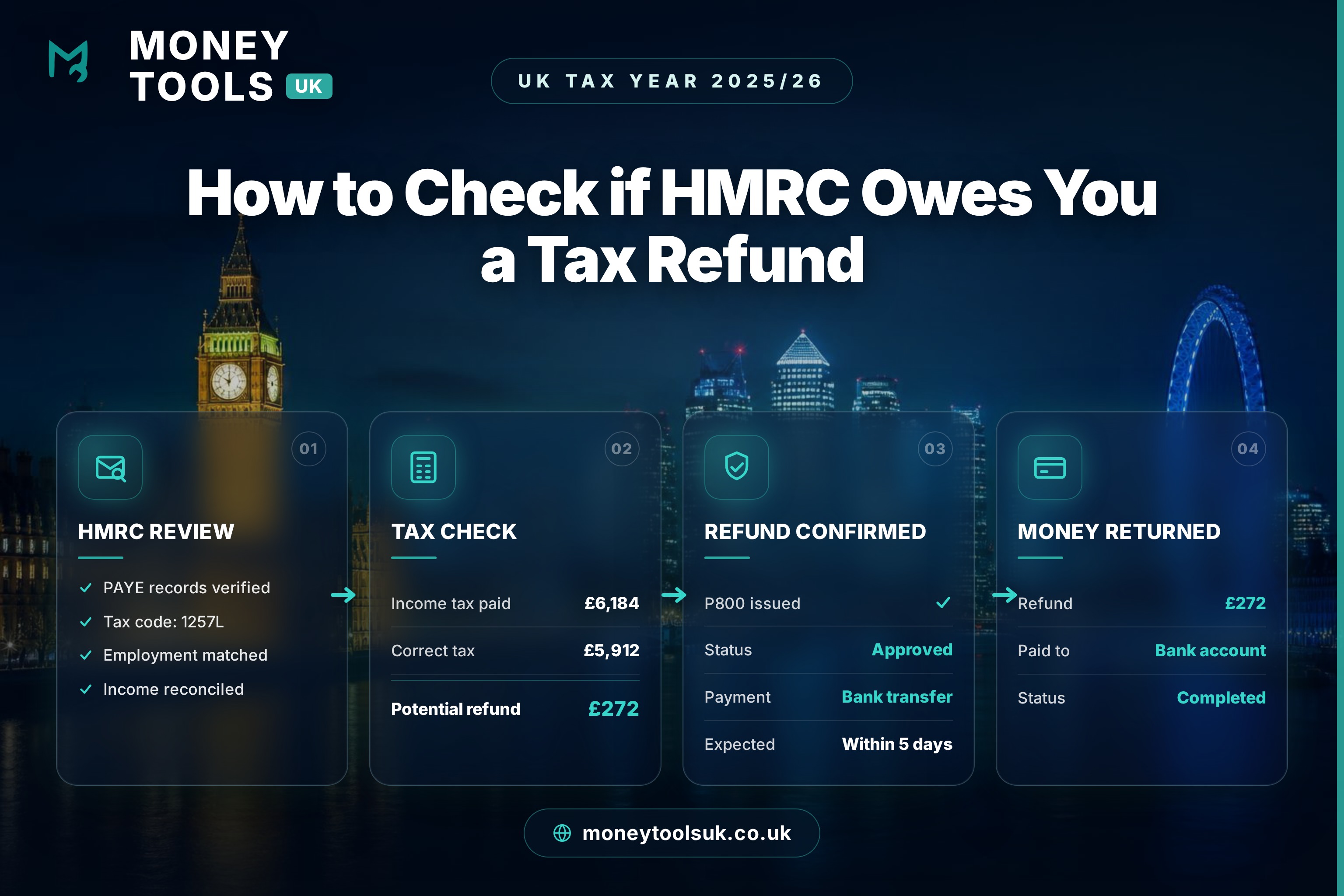
A plain-English UK guide to checking if HMRC owes you a tax refund: why overpayments happen, how to use your Personal Tax Account, P800 and Simple Assessment, when refunds are automatic, how to claim, and how to avoid tax refund scams.
Read guide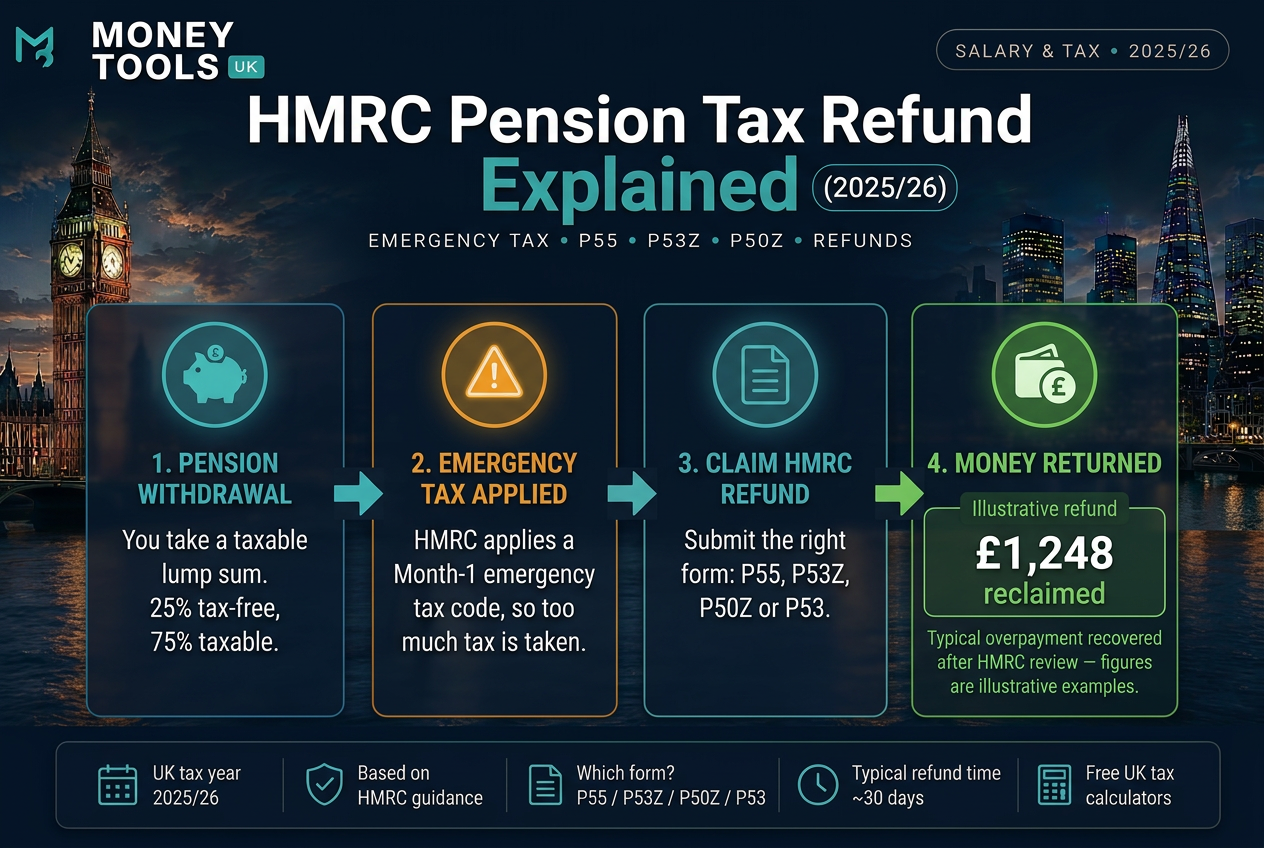
Why HMRC overtaxes pension withdrawals with emergency tax, how pension tax refunds work, and which form to use — P55, P53Z, P50Z or P53 — to reclaim overpaid tax for 2025/26.
Read guide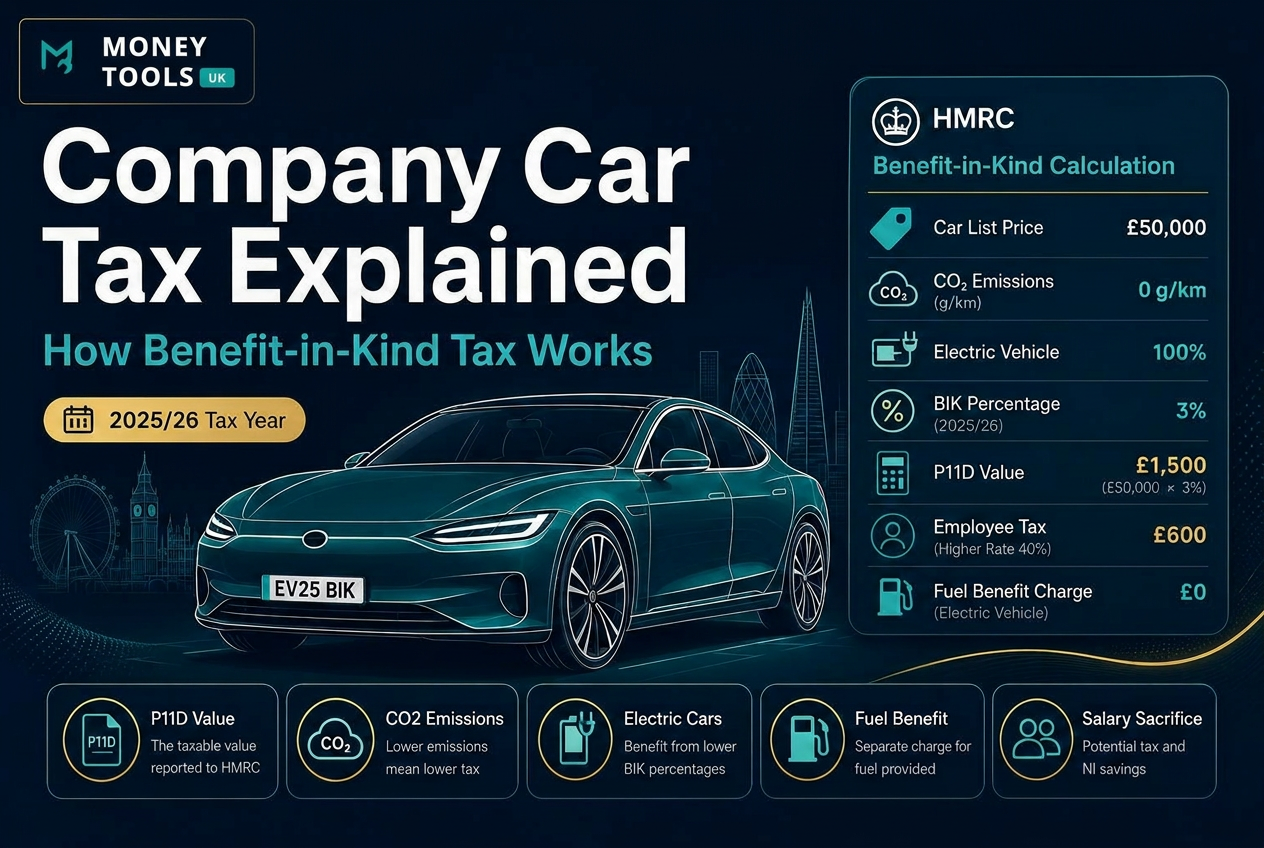
Learn how UK company car tax works in 2025/26, including Benefit-in-Kind tax, P11D value, CO2 emissions, electric cars, fuel benefit and salary sacrifice examples.
Read guideDisclaimer: This content is for informational purposes only and should not be treated as financial, tax, mortgage, investment or legal advice.